



AI Governance in Financial Services: How to Manage Risk
Implement AI governance in financial services with a staged framework covering risk, controls, evaluation, and scaling across regulated workflows.
If you’re a mid-to-large insurance company searching for the best AI, it’s likely that:
The best AI for insurance companies can address these challenges and support complex insurance workflows end to end. But choosing the right fit is hard when the market is crowded with options, from chatbots and copilots to agentic AI systems. To help you understand your options, we cover the top AI solutions for insurers in 2026 and what to consider before making a decision.
In this article:
Want to move beyond pilots and apply AI across your insurance workflows with clear business impact? Neurons Lab can help. Get in touch with us today.
| Main focus | Key AI offerings | Best for | |
|---|---|---|---|
| Neurons Lab | Governed agentic AI across the full insurance lifecycle |
|
Mid-market insurers that want to move AI beyond pilots and deploy governed, custom AI systems across core workflows, with clear business impact and regulatory controls. |
| Gradient AI | AI risk prediction for underwriting and claims1 |
|
Mid-market and large insurers that want to use AI to assess risk more accurately, improve speed, and increase profitability.2 |
| Sprout.ai | Claims automation3 |
|
Insurance companies with high-volume claims processing needs that want to improve quality, customer experience, and operational performance. |
| Shift Technology | AI decisioning and fraud detection5 |
|
Insurers that want to improve fraud detection across claims and underwriting while reducing losses and maintaining operational control. |
| Earnix | AI pricing, rating, and policy personalization7 |
|
Global insurers, brokers, MGAs, banks, and lenders that need real-time decisioning across pricing, underwriting, rating, and personalization at scale. |

Neurons Lab is a UK and Singapore-based Agentic AI consultancy serving financial institutions across North America, Europe, and Asia. As an AI enablement partner, we design, build, and implement agentic AI solutions tailored for mid-market BFSIs operating in highly regulated environments, including banks, insurers, and wealth management firms.
Trusted by 100+ clients, such as HSBC, Visa, and AXA, we co-create agentic systems that run in production and scale across your organization.
This means, rather than a tool or standalone solution targeting a single area like underwriting or fraud detection, you can access expert guidance across multiple AI services to cover your entire insurance lifecycle. These services include:
By working with us, you can develop artificial intelligence customized for your unique processes and business strategy. Here is how:
When you want AI to improve key business metrics, you need to know where it will create the most value and how you will govern, evaluate, and audit it once it is working inside regulated insurance workflows. Neurons Lab helps you with all three.
Through executive-level training, your leaders identify where AI can create the strongest return on investment across the insurance lifecycle. That could mean clearing underwriting backlogs faster, or making decisions more consistent across teams.
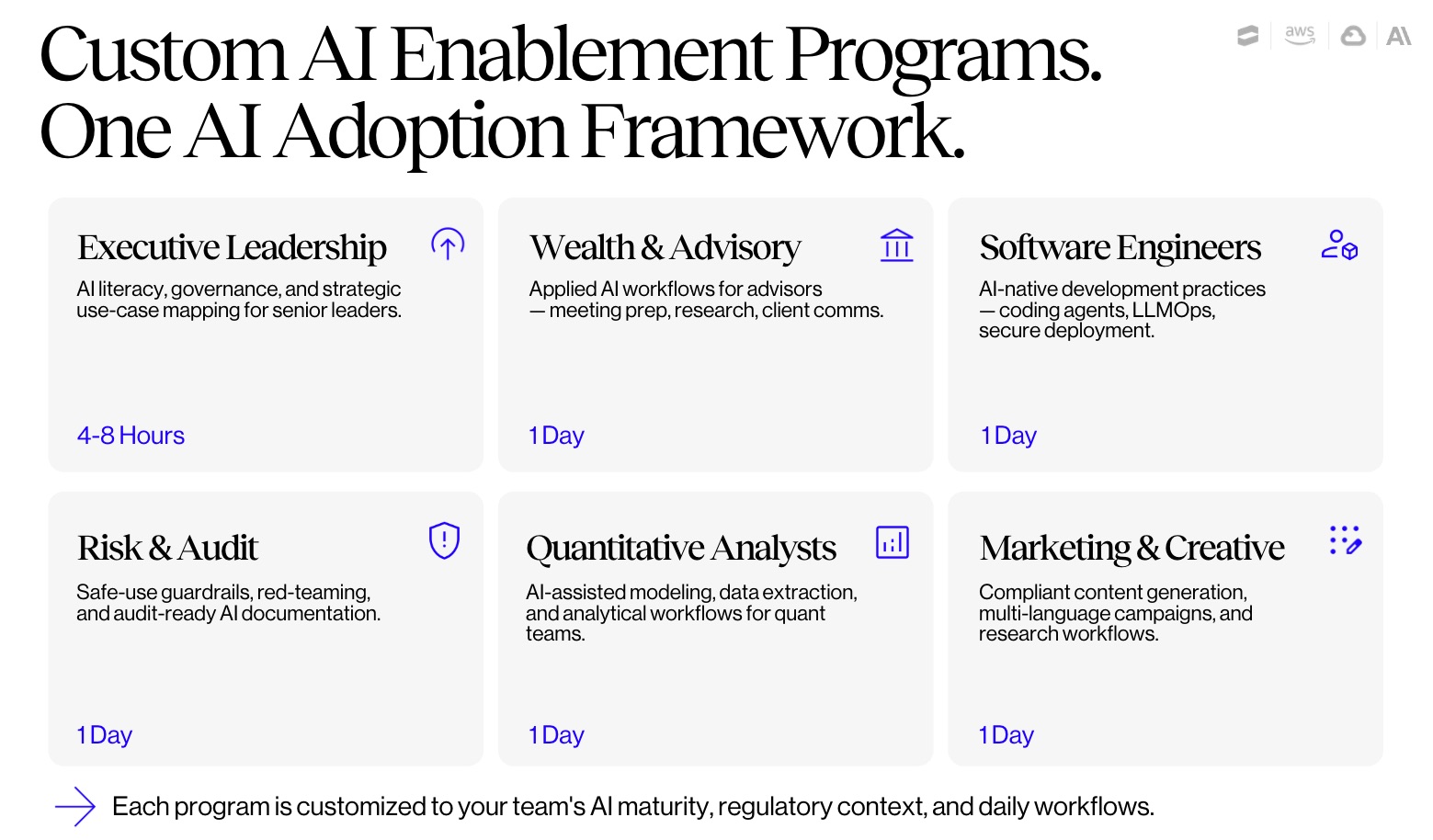
Meanwhile, team-level training ensures your teams across underwriting, claims, operations, and engineering build the skills they need to develop, adopt, and manage AI systems safely.
We then set up a data and governance foundation to support regulated insurance workflows end to end. This includes unifying and cleaning data such as policy records, claims history, customer data, underwriting rules, and broker submissions. That way, your AI systems access reliable information and apply it consistently. With the governance controls we put in place, you stay compliant with regulations such as the Insurance Distribution Directive (IDD), EU AI Act, NAIC guidance for AI governance in insurance, and the Singapore Veritas Initiative.
You’ll also have help setting up AI evaluations, which are structured tests that check for accuracy, hallucinations, bias, and workflow failures. For example, evaluations can test whether the AI misreads policy wording or mishandles claims evidence.
Ongoing monitoring then catches issues like inconsistent fraud flags, drift in underwriting recommendations, or gaps between AI outputs and internal policy rules, so your AI keeps performing consistently and improves over time.
Traceability is built in from the start, so you’ll have every AI-supported decision logged and reviewed. This includes the data used, the rules applied, the checks completed, and the final output. That way, your teams have a clear audit trail to validate outputs and explain AI decisions when regulators ask.
Many insurance agencies struggle to turn pilots into systems their teams use every day. The problem is that pilots often sit outside core workflows like claims, underwriting, and policy servicing. They’re also not connected to existing systems, and ownership is often unclear once the pilot ends. This means AI never reaches workflows like claims handling and fraud detection, where it can affect P&L.
Neurons Lab gives you insurance-specific guidance from strategy to production deployment. You’ll have an expert team handle the technical work required to move AI into your core workflows. This includes data access, system integration, and custom agent design aligned to your needs.
Our co-creation approach means your teams build alongside ours, enabling knowledge transfer and faster adoption.
Your technical teams learn how the system works, maintain it, and manage governance after launch. We can also embed our engineers with a forward deployed expert (FDE) approach, depending on your preference.
Your insurance agents and operational teams across claims management, customer support, and risk help define good outputs, review edge cases, approve escalation logic, and validate whether the AI is producing reliable results. This creates clear ownership once the system is live, with each team responsible for the areas they understand best.
As a result, AI is not left as a disconnected pilot. It becomes a production system that supports real insurance decisions, such as how claims are processed.
For example, one of the world’s largest insurance companies relied on a manual claims review process, leaving it exposed to fraud risk and inconsistent decision-making.
With Neurons Lab, it built an AI claims analysis system on Amazon Bedrock. This system combines Claude 3 with a clinical knowledge graph to check treatments against guidelines and patient data, with medical officers validating outputs through a human-in-the-Loop layer.
In turn, the insurance company has achieved stronger fraud detection and cost control, faster claims processing, more consistent decisions, deeper clinical insight, and continuous improvement of its systems.
Senior underwriters, claims specialists, compliance leads, and service managers often know how to interpret policy wording, assess risk, handle exceptions, spot red flags, and apply internal rules in difficult cases.
When your experts leave or retire, their knowledge leaves with them. Newer, inexperienced teams may apply rules differently, escalate cases inconsistently, or make decisions that increase claims leakage, operating costs, and compliance risk.
Neurons Lab helps you preserve expert judgment before it is lost and turn it into a system you control and can use across your core workflows.
Our Forward Deployed Engineers work alongside your experts to break down insurance processes, define expected outputs, capture edge cases, and translate decision logic into agent workflows.
Together, they preserve how your best performers interpret policy wording, assess risk, review claims evidence, apply underwriting rules, flag fraud indicators, handle exceptions, and escalate complex cases.
That expertise is then built into the AI’s operating logic so it follows your approved ways of working rather than behaving like a generic tool.
With our engineers’ help, you can then turn that knowledge into reusable workflow logic for your AI systems. This gives your teams a more consistent way to apply underwriting rules, review claims evidence, interpret policy wording, handle exceptions, and escalate high-risk cases across departments.
As an insurer, AI only creates measurable value when it improves the workflows that affect your combined ratio, such as reducing claims leakage, increasing underwriting throughput, and lowering service costs. But building AI from scratch for every insurance process can be costly, slow, and difficult to govern.
Neurons Lab helps you build once and reuse AI across the full policy lifecycle, including:
You do this through our expert teams, which help create a customizable framework built for financial services.
You’ll have a library of reusable skills, integrations, data connectors, workflow logic, governance controls, and prebuilt accelerators. These accelerators, like chat-based agents, document-based agents, and voice based agents, help you move faster without starting from scratch for every claim, underwriting, servicing, or compliance use case.
By reusing these components, you can build bespoke agents for specific workflows, then adapt them across other departments. Decision quality and governance controls stay consistent across every process, while development costs stay lower as you scale.
Neurons Lab is best for mid-market insurance companies that want to enable adoption across the entire organization and deploy compliant custom AI solutions tied to significant business impact.
Unlike solutions built for one or two narrow workflows, Neurons Lab supports AI across the full insurance lifecycle. We also work across different insurance lines, including life, health, auto, home, disability, and commercial insurance.
With hands-on support and a proven delivery model, we help you move AI from isolated pilots into claims, underwriting, servicing, and compliance workflows. This way, you can improve key insurance metrics like combined ratio while staying ahead of rising regulatory pressure around AI governance, explainability, and oversight.
We understand that this approach might not be the right fit for every insurance company, so we cover four other AI insurance solutions:
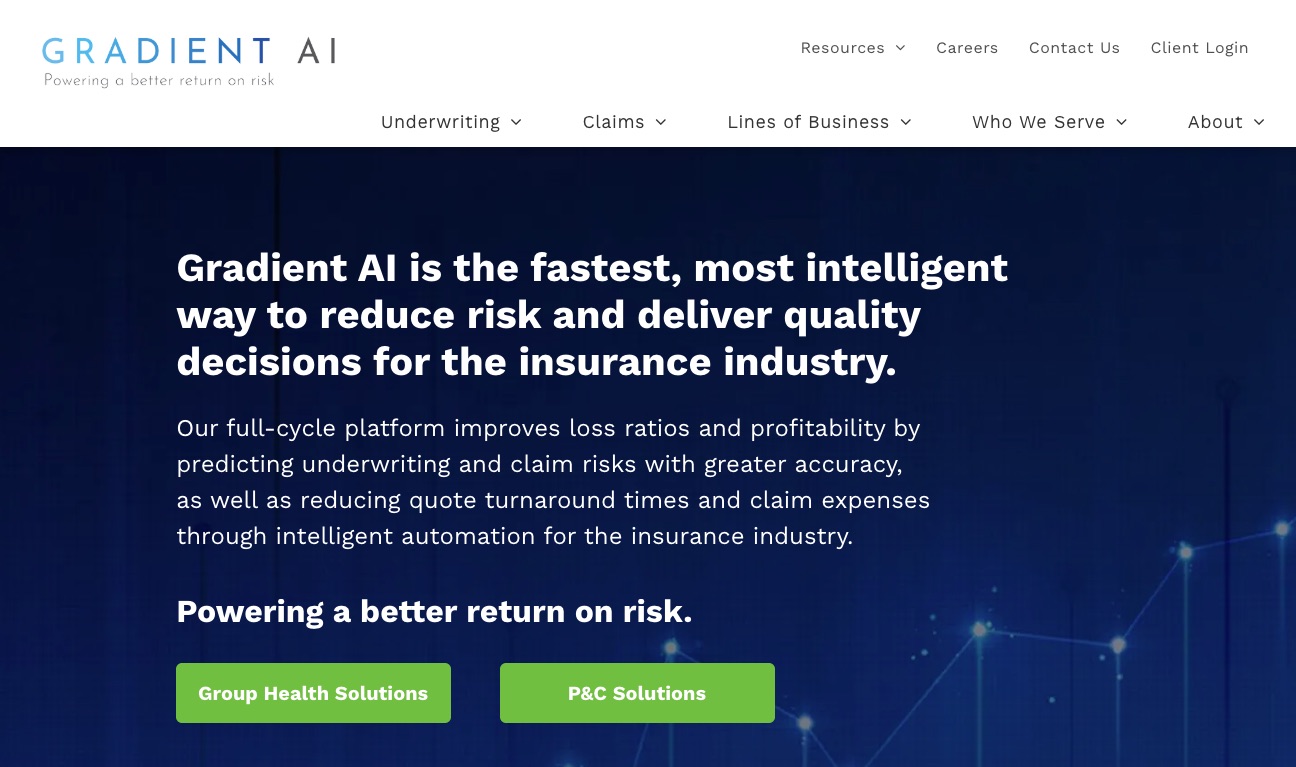
Gradient AI is a provider of AI solutions for the insurance industry. Its solutions help insurers improve loss ratios and profitability by predicting underwriting and claim risks more accurately. Gradient AI also reduces quote turnaround times and claims expenses through intelligent automation. Its AI offerings span:
Best for: Mid-market and large insurers looking to take advantage of the speed, accuracy, and scalability that AI can offer to better assess risk..
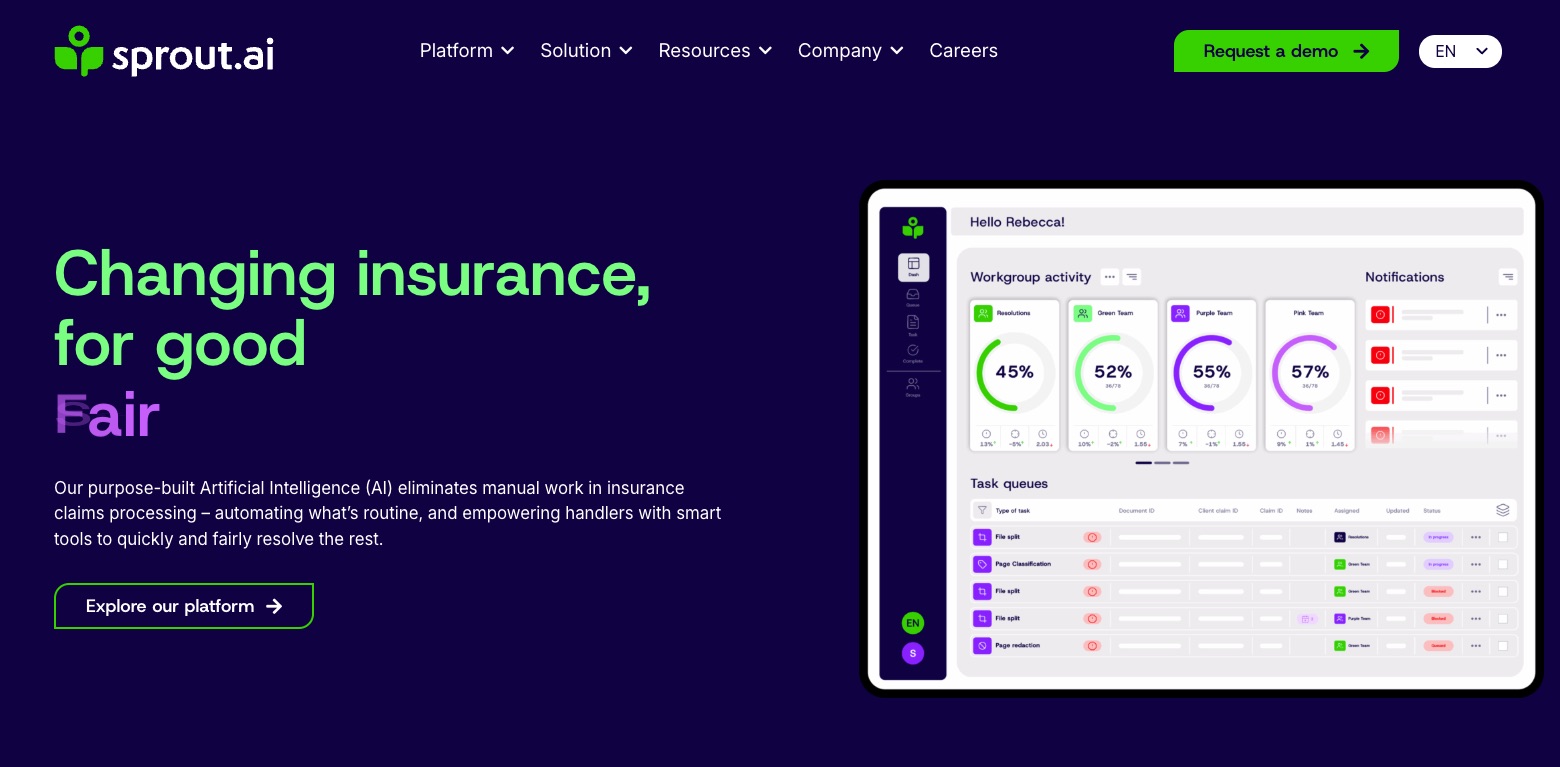
Sprout is an AI-driven claims automation platform that automates manual work from insurance claims processing and fraud detection. It cuts turnaround times, reduces errors, and supports fair, explainable decisions end to end.
Key AI offerings include:
Best for: Insurance companies with high-volume claims processing needs, who want to increase quality, customer satisfaction, and operational performance.
Shift Technology delivers AI agents designed for key insurance workflows. Its AI-powered decisioning and fraud-detection tools help insurers reduce fraud and risk across the policy lifecycle, process claims faster, cut manual work, and improve customer experience.
Key AI offerings cover:
Best for: Insurers looking to streamline fraud detection across claims and underwriting while reducing losses and maintaining operational control.
Earnix is an AI decisioning platform for pricing, underwriting, rating, and product personalization. It enables insurance carriers to price, rate, and underwrite more accurately, ensuring better and more profitable business outcomes. Its key AI offerings include:
Best for: Global insurers, brokers, MGAs, banks, and lenders that need real-time decisioning across pricing, underwriting, rating, and personalization at scale.
When evaluating the best AI for insurance companies, here’s what to consider:
To improve metrics like claims leakage, underwriting turnaround time, service costs, and combined ratio, you need AI to support core insurance workflows end to end. This means designing agentic AI systems that account for your legacy systems, regulatory requirements, and the complexity of real insurance operations.
The right solution doesn’t lock you into narrow use cases or tools that only work in one part of your operations. Instead, it gives you a structured way to build custom AI systems once and reuse them across teams and workflows, while maintaining governance, decision quality, and control.
With Neurons Lab, you get an experienced AI enablement partner and a proven delivery model for doing exactly that. Through our AI Agent Factory/proven delivery model, and hands-on support, we help you scale AI in a consistent, efficient, and repeatable way.
If you’re looking for a way to deploy AI across your insurance workflows in a structured, compliant, and repeatable way, book a call with us today.
Some of the most practical AI applications in insurance are document processing, claims processing, fraud detection, and risk assessment. Moving AI into these use cases leads to significant operational impact because they involve high volumes of data, repeated manual review, and clear decision points.
AI will not replace roles across core insurance workflows. It will change how work gets done.
Rather than fully automating entire processes, AI will support underwriters, claims professionals, and customer service teams by taking over time-consuming manual tasks. This frees them to focus on complex cases and overseeing AI outputs.
There’s no single best fit. Agentic AI is best for complex, multi-step insurance workflows where it can coordinate tasks across systems, such as underwriting triage, claims review, policy servicing, and document validation. Generative AI works well for drafting communications, summarizing documents, and reviewing policy language. Traditional machine learning is still strongest for risk scoring, fraud detection, pricing models, and pattern detection. The right choice depends on the workflow you want to support,how much autonomy the system needs, and the right AI provider.
Many AI tools support one task, such as extracting data, scoring risk, or drafting messages. Agentic AI can coordinate multi-step workflows across systems, such as reading claims documents, checking policy details, flagging missing information, and routing cases for review.
Insurers need a partner with deep insurance and financial services experience, along with proof they can move AI from pilot to production in regulated environments. The right partner also supports governance, monitoring, AI training, and knowledge transfer.
Implement AI governance in financial services with a staged framework covering risk, controls, evaluation, and scaling across regulated workflows.
Learn how retail banks use AI agents to automate workflows, improve customer experience, and scale operations with measurable results.
AI strategy consulting for financial services: compare top firms, key selection criteria, and how to move from pilots to production-ready AI systems.
Agentic AI in banking helps banks automate workflows, improve customer service, reduce costs, and scale secure AI across divisions.
AI in capital markets helps firms scale operations, automate workflows, and act on real-time data to improve performance and reduce risk.