
If you’re researching AI governance in financial services, you’re probably already aware that regulatory expectations are moving from guidelines to enforcement:
- In the EU, most AI Act rules¹ will apply from August 2026.
- In the US, SR 26-2², the Treasury’s Financial Services AI Risk Management Framework (FS AI RMF)³, and NIST AI RMF⁴ are currently raising the bar for oversight, validation, and accountability.
- Across Asia, the ASEAN Guide on AI Governance and Ethics (ASEAN AI Guide)⁵, endorsed in February 2024, sets voluntary guidance for responsible AI development and deployment.
As a financial services firm, you may be struggling to meet these requirements before these regulations come into effect.
Much of your governance work might exist in policies and documents, not in the credit models, fraud systems, or trading workflows where AI is actually used. You might also have no reliable way to test AI models against regulatory standards, monitor changes in behavior, or explain decisions to auditors once systems are live.
As an AI enablement partner specialising in financial services, we’ve seen these issues stall deployments, expose institutions to regulatory risk, and erode confidence in AI. We can help you implement AI governance in a way that’s compliant, auditable, and built to grow with your institution.
In this article, we cover:
- The Key Risks of AI for BFSIs
- How to Set Up AI Governance in Financial Services
- What You Need to Set Up Governance
- What You Should Consider When Building AI Governance
- How Neurons Lab can Help you Implement Governance in Financial Services
- How a European Financial Institution Increased its Compliance Team’s Productivity by 50%
- FAQs
Want to build AI governance that holds up in production and under regulatory scrutiny? Book a call with us today.
The Key Risks of AI that Need Governance for BFSIs
Financial services firms face a distinct set of risks when deploying AI at scale that directly impact regulatory exposure, customer trust, and financial outcomes.
These include:
- Lack of transparency on decision making. AI systems like Large Language Models (LLMs) generate responses based on patterns in data, making it difficult to trace how a specific output was produced and an algorithmic decision reached. In workflows like credit scoring or investment decisions, this creates a compliance issue. If a bank can’t show which data points, rules, or reasoning led to an outcome, it can’t justify it to regulators or customers.
- Data privacy and risk exposure. AI models and machine learning systems run on large amounts of sensitive financial data. Poor controls can lead to data leaks or regulated data being used the wrong way, exposing BFSIs to regulatory penalties, reputational damage, and loss of customer trust.
- Regulatory and compliance risk. The EU’s artificial intelligence act (EU AI Act) introduces stricter requirements for classification, documentation, and human oversight, with fines for non-compliance reaching 7% of global revenue. US regulations like the National Institute of Standards and Technology Artificial Intelligence Risk Management Framework (NIST AI RMF) are aligning on similar expectations.
- Operational and production risk. Many AI projects in onboarding, KYC, or credit workflows never reach production because of unclear specifications and weak oversight. This leads to stalled initiatives, regulatory exposure, and wasted investment.
- Accountability gaps. As AI systems take on more responsibility, firms can lose clarity over who is accountable for outputs across regulated workflows, from model owners to compliance and business teams. The result is board-level risk, as leadership remains responsible for non-compliant decisions in areas like KYC, credit, or fraud.
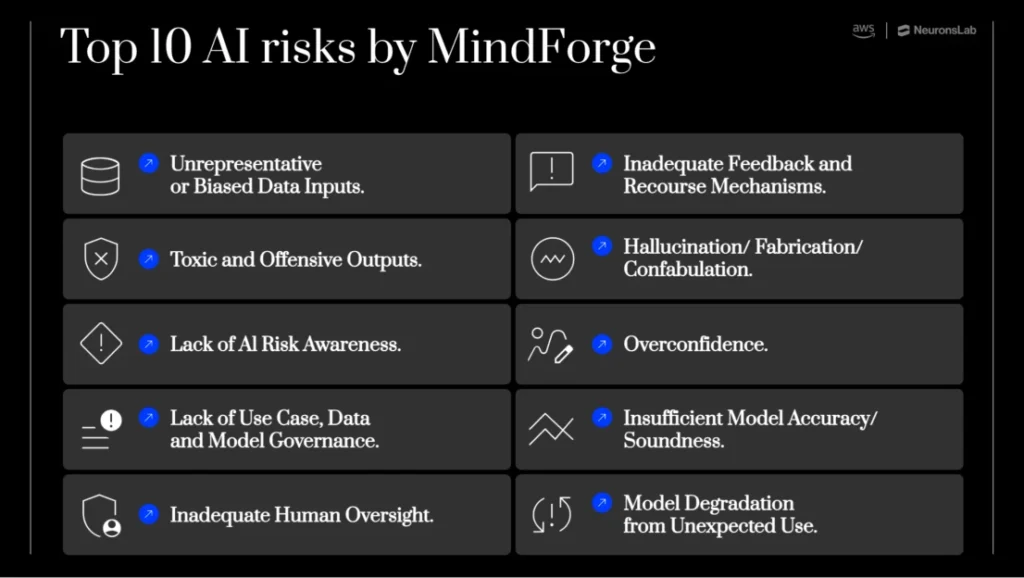
Caption: Ten common AI risks, from biased inputs and hallucinations to weak oversight, poor governance, and model decline over time.
These risks show that AI adoption is outpacing control structures, with only 30% of companies having responsible controls for current AI models even though nearly three-quarters have already integrated AI into initiatives across the organization.
This is why AI governance — a structured framework of policies, processes, and tools — allows you to set guardrails that make your AI systems safe, ethical, and compliant with regulations.
How to Set Up AI Governance in Financial Services
Setting up governance the right way matters because it determines how your entire AI system behaves. It’s the foundation that ensures you deploy controlled, auditable systems without increasing compliance and operational exposure.
As a BFSI, getting this right can be challenging. But a staged approach makes the process easier to manage and reduces the risk of gaps in oversight. Here’s a three-stage framework for setting up AI governance in financial services:
| Phase | Timeline | Key Actions | Outcome |
|---|---|---|---|
| 1. Establish the Governance Foundation | 1–3 months | Inventory existing AI systems and use cases Classify risk levels Map regulatory requirements across markets Define human accountability and approval ownership | A clear governance structure with defined controls, ownership, and regulatory alignment across all AI use cases |
| 2. Embed Governance into Workflows | 3–9 months | Define AI delegation boundaries Structure knowledge through context engineering Set up evaluation framework Implement traceability and auditability | Governance is built into systems and workflows, with controls, testing, and audit trails operating in production |
| 3. Scale Governance Across the Organization | 9–18 months (ongoing) | Reuse Agent Skills and governance controls Expand across departments and use cases Set up continuous monitoring Transition from assistants to governed AI agents | A repeatable governance system that scales across the organization with consistent controls and continuous oversight |
1. Establish a Strong Governance Foundation
The first stage is about creating a layer of control. You can do that by:
- Setting a baseline inventory of AI already in use. This includes models, assistants, agents, workflows, and vendor tools, from simple banking chatbots to more robust solutions like Microsoft Copilot or Claude Cowork.
- Classifying each use case by risk. Set a consistent framework for assessing how sensitive each AI system is. This includes mapping use cases to risk categories, such as those under the EU AI Act, so teams apply approval, oversight, and control requirements consistently. For example, an AI agent supporting KYC verification or credit decisions requires stricter controls than a low-risk internal productivity assistant.
- Mapping each use case to the relevant regulations in each market. Then reconcile those requirements into a single internal control structure. For multi-regional financial institutions, which often need to comply with overlapping frameworks across jurisdictions, this reduces duplication and lowers the risk of governance gaps and vulnerabilities.
- Defining a clear human accountability structure. AI can support decisions, but it can’t own them. Someone has to approve the use case, define the boundaries, handle exceptions, and remain accountable for how the system operates. This is crucial in regulated workflows like fraud detection, where BFSIs need to show not just what the system did, but who was responsible for the outcome..
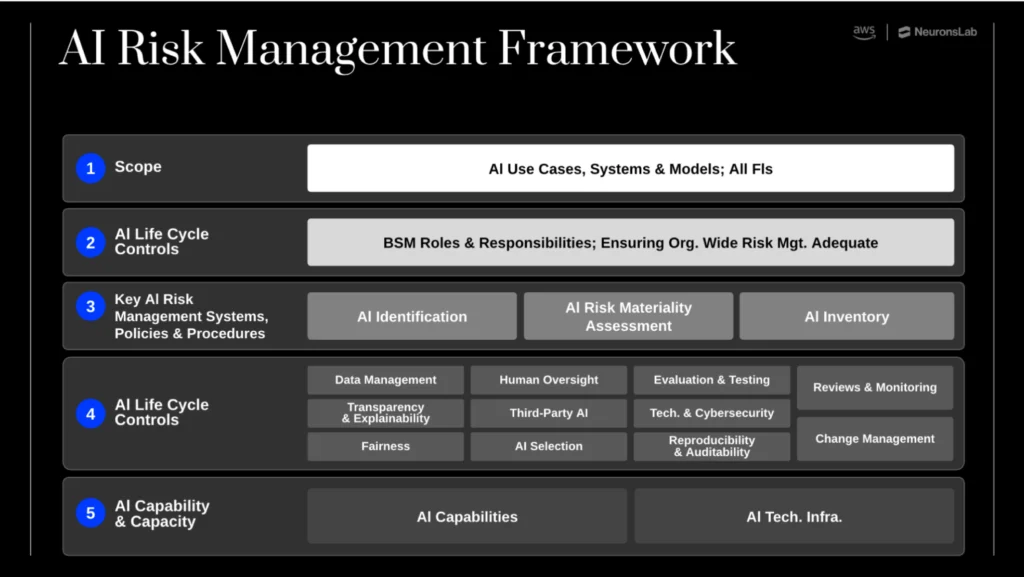
Caption: A structured framework for governing AI across scope, controls, risk assessment, real-time monitoring, and organizational capability.
By establishing these foundations early, you create a governance model you can trust to scale across markets and use cases.
2. Embed Governance Into Your Workflows
The next step is embedding governance rules into regulated workflows like onboarding, KYC or underwriting.
Start by defining where AI can assist and where humans must approve, and build those boundaries into your workflows.
Next, control the knowledge shaping the system’s behavior. This involves context engineering, which is organizing business rules, policies, and regulatory interpretation into a format AI can use to make consistent, auditable decisions.
Then, set up an evaluation framework that tests whether AI is:
- Following rules
- Moving through the right process
- Producing accurate outputs.
The framework can also provide full transparency into how AI behaves, which controls it applies, and why it produced a certain result. This ensures governance becomes part of how AI is built and deployed, rather than an add-on.
For example, in a loan underwriting workflow:
- AI gathers applicant data, analyzes financial documents, and produces a lending recommendation
- A credit officer approves the final decision
- The system applies credit policy rules, affordability thresholds, risk appetite, and regulatory requirements
- Evaluation checks confirm the correct sequence, rule application, and justification quality
- Every input, rule, and decision is logged, creating a full audit trail
3. Scale Governance Across The Organization
The third stage expands AI in a controlled way once you’re sure your governance model is already working.
For example, you can move from AI tools that help wealth managers search and summarize HNWI portfolios, to AI agents that act autonomously within governed boundaries to handle suitability reviews, flag portfolio risks, route exceptions to compliance or investment teams, and monitor ongoing adherence to client mandates.
To scale this safely, create Agent Skills: reusable, machine-readable packages of compliance rules, decision logic, validation checks, and audit requirements. They translate governed processes into instructions AI systems can apply consistently across workflows.
For example, the same document verification skill can support onboarding, KYC remediation, and periodic reviews without rebuilding the logic each time. This makes AI easier to scale without losing control, accountability, or consistency.
At this stage, monitoring also becomes an organization-wide control layer. Instead of only testing and evaluating individual workflows before deployment, you track whether AI behavior remains stable as use cases, data, and business conditions change. This includes:
- Drift detection: Checking if incoming data differs from AI’s training data
- Anti-overtrain checks: Verifying the AI has can still perform accurately on new, unseen scenarios
- Continuous monitoring and evaluating: Monitoring tracks production behavior over time, while evaluations validate outputs against defined standards and test cases.
Learn why AI evaluations are critical for validating performance before deployment and maintaining control in production in our guide, AI Agent Evaluation Framework: Why It Matters for BFSIs
Together, these controls help catch changes in behavior early and improve AI performance over time. By doing this, you move from reactive compliance to proactive control, where governance enables faster and safer AI deployment.
This staged approach gives you a clear path forward. The next step is putting the right foundations in place to support it.
What You Need To Set Up Governance
According to Gartner, 50% of generative AI projects in 2025 failed to reach production due to gaps in governance, including poor data quality and weak risk controls. To move AI from pilot to production, here’s what needs to be in place:
Controlled Data and System Access for Reliable, Auditable Decisions
AI governance only works if AI runs inside secure systems and uses reliable data. That means controlled access to your source systems, and integration with the platforms where work already happens, such as core banking systems and CRM platforms.
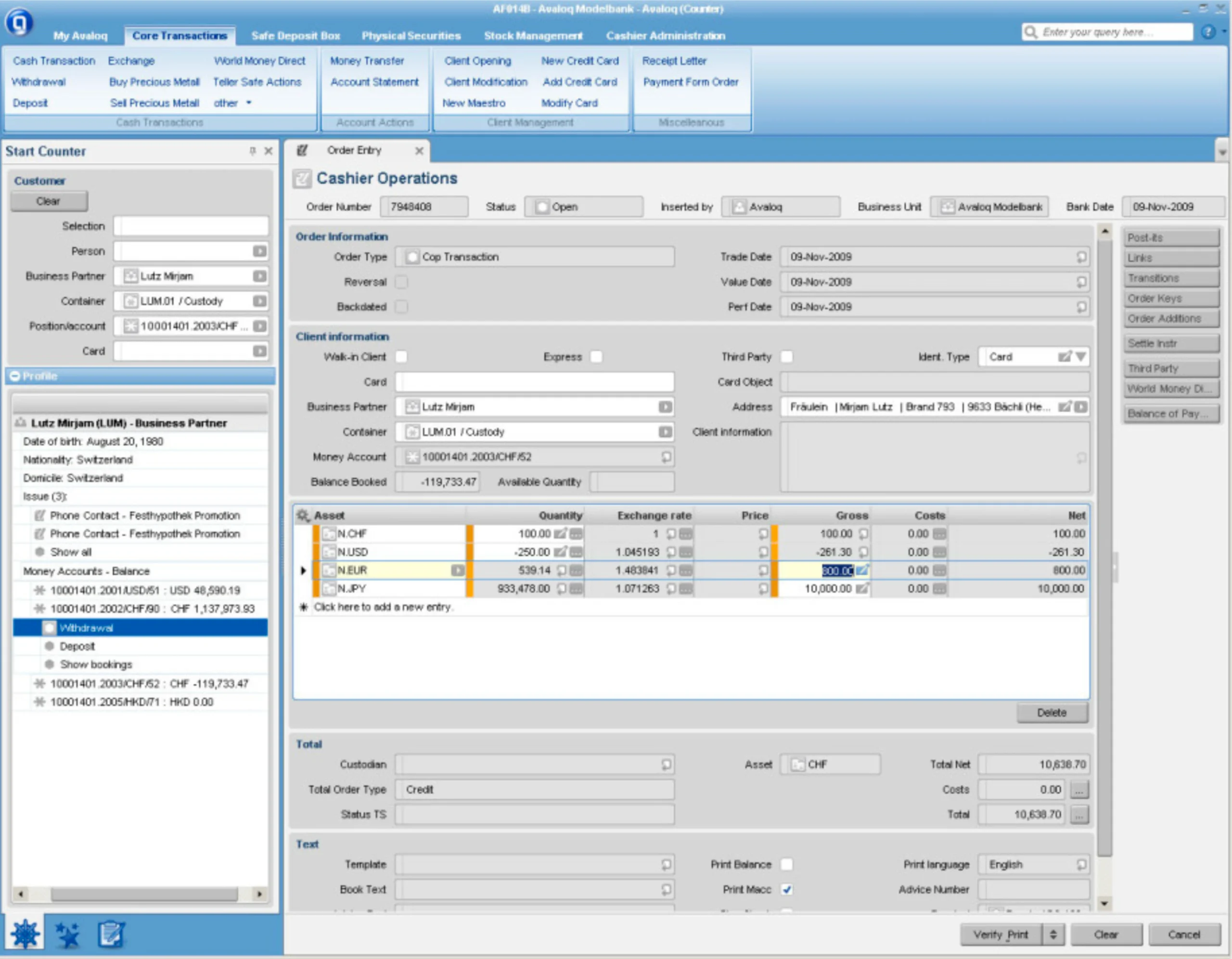
Caption: An example of a modern core banking system interface
By keeping AI within your core systems and control environment, you can enforce governance more easily. For example, you can manage permissions, log decisions consistently and apply approval steps at defined control points, such as before updating account details or approving a loan.
You also need a strong data foundation. This includes clear data lineage, consistent validation checks, and secure ways to store and process sensitive information.
These controls make it possible to trace where data came from, verify it is accurate and fit for use, and show how it influenced an AI-driven outcome. This creates an audit trail that allows you to prove how a decision was made when regulators such as the FCA, SEC, and MAS ask.
A Governed Knowledge Layer for Consistent Decision Logic
To govern AI properly, build a knowledge layer that captures your institutional expertise, regulatory interpretation, workflow logic, and expert judgment in a form AI can apply consistently.
Knowledge engineering gives your AI systems a controlled source of truth for how they should behave across real business processes. It structures policies, encodes regulatory interpretation into rules, and captures how experienced teams make decisions in a form that can be tested and validated.
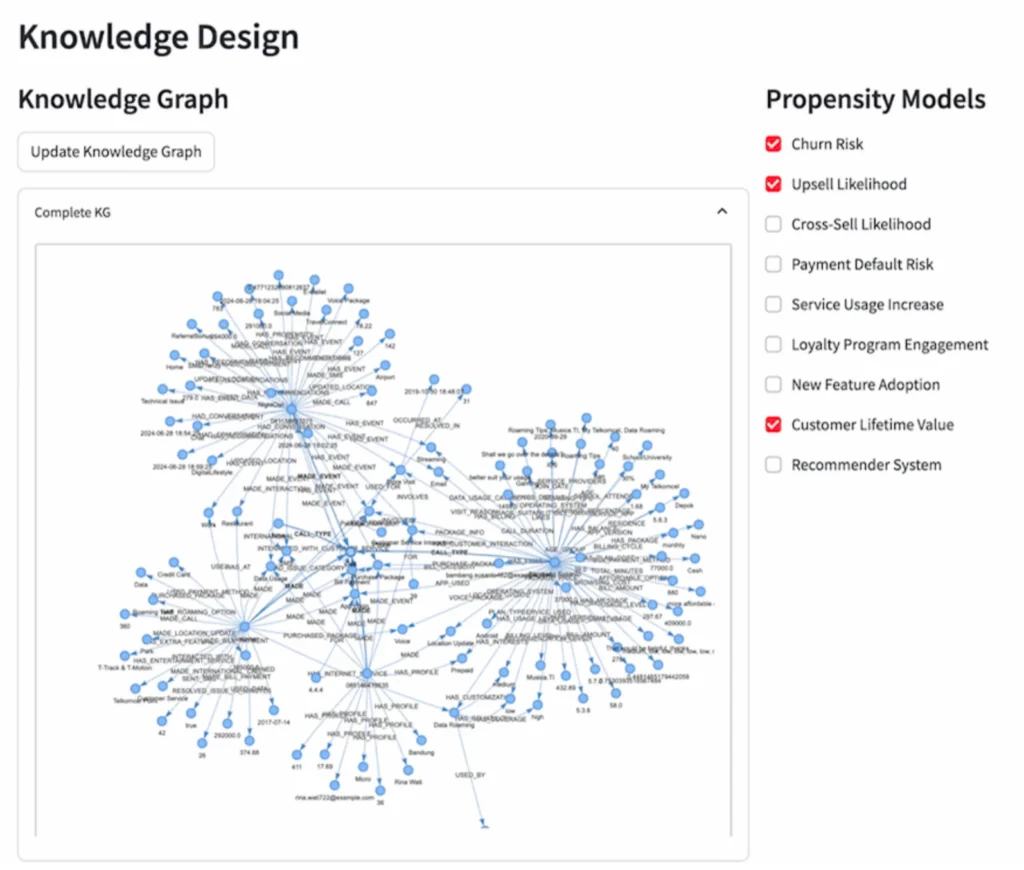
Caption: A knowledge graph setup used to map customer relationships, behaviors, and prediction use cases
You can turn that structured knowledge into agent skills — packaging compliance rules, validation logic, and audit requirements into components — that AI systems can apply consistently across workflows. This helps AI apply judgment more consistently across cases while reducing dependence on a small number of experts holding critical knowledge in their heads.
This means decisions become more consistent, new staff onboard faster, edge cases are handled correctly, and critical knowledge is preserved rather than lost when experienced employees leave.
A Validation and Evidence Layer for Continuous AI Evaluation
You also need a validation and evidence layer that shows whether AI is behaving correctly over time and gives risk, compliance, and audit teams the proof they need. This means having a structured way to test outputs, validate behavior, and measure decision quality.
A robust evaluation setup uses three types of checks:
- Deterministic: Rules-based checks that enforce hard compliance requirements, such as verifying all mandatory documents are present before a case proceeds in a KYC or onboarding flow.
- State-based: Process checks that verify AI follows the correct workflow steps in the right order, such as ensuring a loan underwriting agent collects data, validates inputs, and only then generates a recommendation.
- Rubric-based: Quality checks that assess outputs against expert judgment, including whether decisions are explained and justified the way a senior credit officer would expect.
Used together, they help catch different failure modes and give you a more reliable view of whether AI is behaving as intended.
To make these evaluations reliable, you need expert-approved reference cases, or “golden sets,” which define what correct looks like. These are used to test AI before deployment and re-test it as systems evolve, helping catch drift and performance issues over time.
This layer turns governance from static review into continuous validation, ensuring AI systems remain accurate and compliant in production.
The next step is understanding how to apply these components effectively in practice, which we cover in the following section.
What To Consider When Building AI Governance
When building AI governance in financial services, here’s what to consider:
Start With Governed Delegation Before Full Automation
Start by giving AI context-heavy tasks within defined boundaries while your team retains accountability. Moving straight to full automation increases the risk of control failures in financial services workflows. It also increases regulatory and reputational risk.
For example, AI can review identity documents, proof of address, and source-of-funds declarations against compliance rules, flag gaps, and route cases to a compliance officer for approval. This aligns with the EU AI Act’s requirement for human oversight in high-risk systems and NIST’s focus on managing AI-related risk across design, use, and evaluation.
It also lets you test AI in real workflows, see where it falls short, and expand its responsibilities only after controls are working.
Ensure Technical Flexibility
When governance is built around one vendor’s tools, protocols, or architecture, switching later becomes costly and disruptive.
Using open standards such as Model Context Protocol (MCP) helps you preserve the governance work you have already invested in, including rules, workflows, and controls, instead of rebuilding it from scratch. It also reduces vendor lock-in and gives you flexibility as AI technologies and business needs evolve.
Build Governance That Holds Up in Production
Many AI failures in financial services stem from gaps in specifications and context. Effective governance defines how decisions are made, including the rules, data, and judgment applied at each step.
To build governance that remains practical, scalable, and maintainable over time:
- Treat governance as an ongoing control system: AI systems evolve over time, so governance should include continuous monitoring and evaluation frameworks (evals) rather than one-off approval reviews.
- Pair platforms with operating methodology: Governance tools work best when backed by defined approval workflows, named control owners, escalation paths, and decision frameworks for teams like compliance, risk, and operations.
- Build in governance from the start: Embedding controls during solution design is far easier and more cost-effective than trying to retrofit approval logic, audit trails, and evaluation frameworks after deployment.
- Tailor controls to each use case: Different AI applications require different oversight levels based on their risk, complexity, and regulatory impact. So, a customer FAQ assistant should not follow the same oversight model as an AI system supporting anti-money laundering (AML) reviews, fraud investigations, or credit-related decisions.
- Use production-grade tooling for regulated workflows: Ensure the tools supporting AI deployment provide the security, auditability, explainability, and control standards financial institutions require.
This approach allows you to scale AI while maintaining control, consistency, and regulatory compliance.
Align Teams Early
In many BFSIs, risk, compliance, data, engineering, and business teams still work in silos, while domain experts who understand real workflows and edge cases are brought in too late. For governance to work, align these teams early so controls reflect real processes, acceptable outputs, and how edge cases should be handled from the start.
For example, compliance officers and onboarding teams can define how a KYC review should handle missing documents or unclear risk signals, while engineering teams translate that into systems, rules, and checks that fit the workflow and can be maintained by your in-house teams.
Build Internal Governance Capability
Ensure your teams know how AI systems behave, where their limits are, and how to review outputs properly.
A lack of human oversight can become a weak link in your control model. Compliance officers, fraud analysts, or operations reviewers may rely on AI outputs without the right judgment, causing similar cases to be handled differently and leaving the firm with decisions that are harder to defend during audits or regulatory reviews.
Building internal capability while setting up the other parts of AI governance can be difficult. Like many BFSIs, you might not yet have AI governance skills in-house. This is where an AI enablement partner specialized in financial services can help, bringing regulatory expertise, proven governance frameworks, and hands-on support to build capability within your teams.
How to Implement Governance in Financial Services with Neurons Lab
As a BFSI, the challenge is implementing good governance across your actual systems and workflows. With Neurons Lab, you can set up AI governance from foundation to deployment, with all the necessary considerations to run AI in production.
Neurons Lab is a UK and Singapore-based Agentic AI consulting firm serving financial institutions across North America, Europe, and Asia. As an AI enablement partner, we design, build, and implement agentic AI solutions tailored for mid-to-large BFSIs operating in highly regulated environments, including banks, insurers, and wealth management firms.
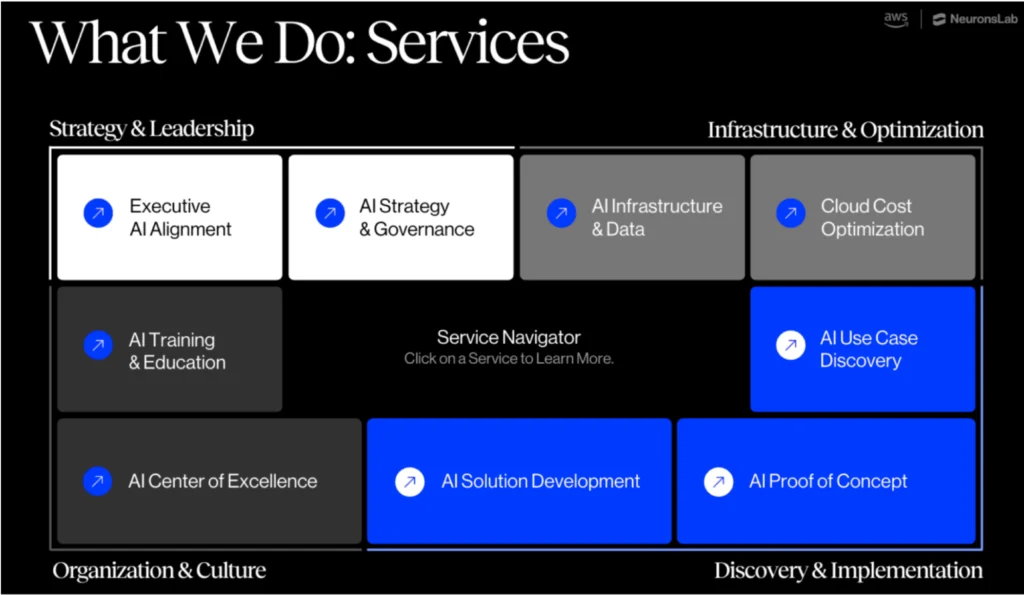
Caption: Neurons Labs end-to-end AI consultancy services
Trusted by 100+ clients, such as HSBC, Visa, and AXA, we co-create agentic systems that run in production and scale across your organization. Neurons Lab has produced governed AI agents validated across projects with BFSI clients in the EU, US and Asia, including compliance, credit risk, and customer operations use cases.
Here is how Neurons Lab helps you set up AI governance for your financial services firm:
Build a Strong Governance Foundation for Evolving AI Regulations with an AI Partner Specialized in BFSI
Applying AI governance consistently across legacy systems, regulated workflows, and multiple markets can be complex. With Neurons Lab, you can set up a repeatable governance foundation that works across your systems, workflows, and regulatory environments from the start.
You get end-to-end support, from defining a clear AI strategy and roadmap for governance to implementing controls directly in your data pipelines, models, and AI agents. Learn more about our AI strategy consulting services.
For example, you can embed approval rules, audit trails, and evaluation controls directly into an AI-powered KYC workflow, so every document check, risk flag, and escalation follows governed logic from day one.
With our BFSI expertise, you can align your governance around real workflows, risk models, and regulatory expectations across the markets you operate in. So rather than generic AI best practices, you map directly against regulations, such as the EU AI Act, SR 26-2, FS AI RMF, NIST AI RMF, and the ASEAN AI Guide.
You can also establish governance structures across your workflows, systems, and decision-making, so controls are easier to apply consistently in your day-to-day operations.
That means defining when KYC analysts must escalate AI-flagged onboarding cases, setting approval thresholds for fraud investigators reviewing suspicious transactions, or applying the same audit and traceability standards across AI systems used by compliance, risk, and operations teams.
This gives you a stronger foundation for AI governance, with less duplication, fewer control gaps, and a system that is easier to maintain across teams and markets.
Replace Static Reviews with Continuous AI Governance
Governance doesn’t stop at setup. You need a continuous way to test and validate how AI behaves in production. With Neurons Lab, you get visibility into how AI is performing, so you can catch issues early and keep systems working reliably.
You can set up a continuous evaluation framework with expert-approved reference cases (“golden sets”), ongoing monitoring, and three types of checks:
- Deterministic (test hard compliance rules)
- State-based (verify workflow correctness)
- Rubric-based (assess quality against expert judgment)
Together, these let you test AI before deployment, in production, and after every update, while catching different failure modes along the way. With Neurons Lab, you can also implement a traceability chain for every AI decision, so you can see which inputs, rules, and controls led to each outcome.
For example, during a fraud investigation, you see which transaction patterns and account activity the AI analyzed, what fraud rules it applied, and why it recommended escalation. This gives you a clear audit trail when risk, compliance, audit, or regulators ask for evidence, and reduces the risk of non-compliant decisions and regulatory intervention when AI outputs cannot be justified.
Testing behavior is only part of the equation. You also need to define how decisions should be made in the first place.
Preserve Expert Judgment for More Consistent Compliance Decisions
Governance also depends on how decision logic is captured and applied across the organization.
When regulatory interpretation and workflow judgment sit with individual experts like senior compliance officers, risk analysts, or financial crime investigators, you risk losing important decision logic when they leave. Neurons Lab helps you preserve their judgment before it’s lost and turn it into a system the institution controls and can operationalize.
Through our knowledge engineering, your subject matter experts extract how they make credit decisions, interpret compliance regulations, handle exceptions, apply judgment in complex cases, and structure this into rules that can be applied, tested, and reused.
We then help you turn that knowledge into reusable AI capabilities (‘Agent Skills’). This way, your teams gain a more consistent way to apply compliance logic and handle edge cases across workflows and departments.
Reuse and Scale AI Governance with a Proven Delivery Model
Without a repeatable delivery model, governance cannot scale. That means duplicated effort, inconsistent controls, and slower expansion.
With Neurons Lab, you move from one-off governance projects to a repeatable system your team owns and can use again and again. Through a proven delivery model, you get a structured way to deploy governed use of AI across processes like onboarding, underwriting or customer support without starting from scratch each time.
Governance patterns, evaluation criteria, and Agent Skills developed in one project, such as KYC review automation, can carry over to the next, whether that’s AML alert triage, fraud investigations, or credit operations. Each new use case builds on the last, enabling faster deployment, consistent controls, and easier governance across departments.
Our forward-deployed engineers work side by side with your technical teams to build and deploy inside your own infrastructure. This way, your team gains the hands-on knowledge to manage AI controls, update governance rules, run evaluations, and improve systems after deployment. You keep full ownership without becoming dependent on an AI provider or vendor to extend it later.
How a European Financial Institution Increased its Compliance Team’s Productivity by 50%
At a European financial institution, the compliance team needed to process thousands of KYC reviews every month, with each case taking an average of 30 minutes to complete manually.
Compliance rules were applied inconsistently across reviewers, with no audit trail for review decisions. And each time an experienced compliance officer left, the institution lost valuable institutional knowledge.
Working with Neurons Lab, the institution:
- Captured internal expertise: Over a structured seven-phase process, decades of tacit knowledge from senior reviewers were translated into machine-readable Agent Skills, preserving not just what to check but how to interpret regulatory requirements.
- Deployed governed AI agents: Agents apply deterministic compliance rules (ensuring all required documents are present), state-based checks to enforce correct workflow sequencing, and rubric-based quality scoring that reaches 85–90% alignment with senior reviewer judgment on nuanced cases.
- Set up continuous evaluation: With 50+ graders and 180+ test scenarios, every change to agent behavior is automatically tested before reaching production. Drift detection flags any drop in performance over time, keeping results consistent.
As a result, the institution has:
- Increased KYC review productivity by 50% with AI pre-screening routine cases and humans focusing on exceptions.
- Saved 80% on expansion costs as governance patterns from the KYC department were reused across the multiple departments at a fraction of the original investment.
- Preserved institutional knowledge in a reusable, systematized format, so the institution is no longer dependent on individual employees to retain critical compliance expertise.
- Ensured every AI decision is traceable, complying with EU AI Act requirements.
Get AI Governance Right with a BFSI Specialized AI Partner
Most firms across the financial services sector understand what AI governance should look like. The true gap is in the execution. Frameworks exist on paper but don’t translate into systems that run in production, pass audits, and scale across departments.
Closing that gap requires more than policy. It requires a structured way to translate governance into systems, workflows, and controls. The right AI enablement partner brings proven methodology, governance patterns, and evaluation frameworks refined across financial services deployments.
They build with your team, on your infrastructure, so that when the engagement ends, you own and operate independently with no ongoing dependency. The result is governance that’s built into your systems from the start, not layered on top, so your institution can scale AI confidently.
If you’d like to move from governance on paper to governance in production, get in touch with Neurons Lab today.
FAQs
What is the difference between AI oversight and AI governance in financial services?
The difference is that AI oversight is just one part of governance and focuses on human control, accountability, and decision approval. AI governance is the broader framework that includes risk classification, evaluation, traceability, monitoring, and oversight across the full AI lifecycle.
What internal teams should own AI governance in financial services?
AI governance in financial services should be shared across various internal teams, including risk, compliance, data, engineering, and business. Risk and compliance define the requirements, engineering implements controls, and domain experts across business units provide decision logic and regulatory interpretation.
What should financial institutions look for in an AI governance partner?
Financial institutions should look for an experienced AI enablement partner that can turn governance into working systems, not just policies or tools. The right partner brings hands-on support, proven methodology, and frameworks, and builds on the institution’s own infrastructure. That way, governance can scale and be reused without vendor dependency.
What are examples of AI governance in financial services?
Common examples include ensuring KYC and AML reviews have full audit trails, where every decision is traceable from each KYC or AML requirement to result. Another example is continuous evaluation systems that test AI before deployment, in production, and after each update.
Sources:
- https://artificialintelligenceact.eu/high-level-summary/
- https://www.federalreserve.gov/supervisionreg/srletters/SR2602.htm
- https://cyberriskinstitute.org/artificial-intelligence-risk-management/
- https://nvlpubs.nist.gov/nistpubs/ai/nist.ai.100-1.pdf
- https://asean.org/wp-content/uploads/2024/02/ASEAN-Guide-on-AI-Governance-and-Ethics_beautified_201223_v2.pdf