



AI in Capital Markets: A Practical Guide
AI in capital markets helps firms scale operations, automate workflows, and act on real-time data to improve performance and reduce risk.
Agentic AI initiatives in banking often start from two different directions:
Then, how your bank operates only compounds this structural gap. Each division runs its own customer journeys, teams, and priorities, while core technology and AI decisions remain centralized.
This winds up fragmenting AI initiatives, duplicating efforts, and running pilots that fail to scale across your organization. There’s also governance to consider, ensuring AI works reliably and compliantly without putting your customers at risk or your brand reputation and regulatory on the line.
At Neurons Lab, we’ve seen how navigating this complexity can stall AI agent initiatives before they deliver any real results. As an AI-exclusive enablement partner with deep financial services expertise, we specialize in helping banks build and deploy agentic AI across their divisions, with a clear path from identifying the right use cases to scaling secure, compliant, production-ready systems.
We’ll explain how agentic AI works in banking, where it delivers measurable impact, and what it takes to implement and scale production-ready systems across your organization.
In this article:
Want to get started with implementing agentic AI across your bank’s divisions? Book a call with us today.
Agentic AI changes how work gets done in banks. Instead of supporting individual tasks, it executes complete workflows across systems, teams, and decision points. To understand why this is different, it helps to look at the different capabilities of artificial intelligence.
Machine learning uses AI models to find patterns in data and get better at a specific task, while generative AI (GenAI), often powered by large language models, builds on that by creating new content like text or images. Both are reactive, meaning they rely on prompts to produce an output each time.
Agentic AI is different because it can plan, take action, and manage multi-step workflows on its own, enabling autonomous decision-making.
For example, instead of a relationship manager manually researching a client, drafting an email, logging activity in CRM, and scheduling follow-ups, an autonomous AI agent can handle the entire sequence:
Agentic AI handles the workflow independently, streamlining end-to-end processes, with human intervention coming in only at key decision points.
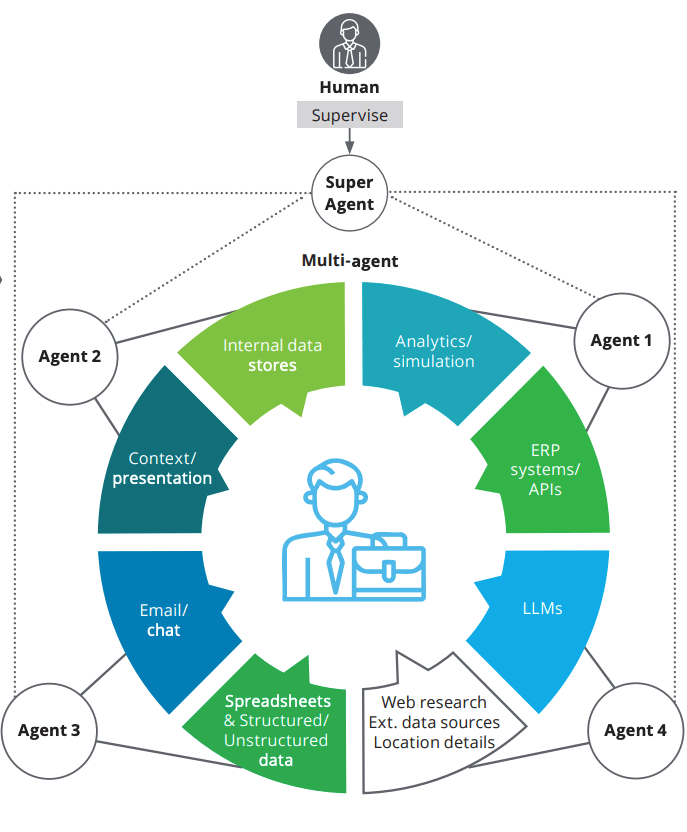
What this means for you is a significant shift in your operation model. Your employees go from executing repetitive tasks to supervising workflows and higher-value decision making (e.g., approving complex credit decisions or advising high-value clients). And your teams move from isolated tasks to completing end-to-end workflows in minutes.
This shift leads to two key benefits:
Agentic AI gives banks the ability to meet rising customer demands for more instant, personalized service at scale, without adding headcount. For customers, the main benefit is fast, always-available service.
If a customer’s card has been stolen, instead of waiting on a human who might not be free, an AI agent can access client data and any relevant context in seconds and take immediate action before any further losses occur.
And if a customer is applying for a loan, an AI agent handles all the background checks, pulls the relevant data, and escalates to a human loan officer for final approval, cutting a process that used to take days down to minutes.
This allows banks to deliver faster, more consistent service while improving customer engagement and reducing operational pressure on front-line teams.
Agentic AI drives productivity, cuts repetitive processes, and supports better decisions without replacing the people who make them. According to a recent BCG study, autonomous agents have the potential to increase retail banks’ profitability by 30% and reduce costs up to 40% by 2030.
The opportunity extends well beyond retail banking. Across every retail, corporate, commercial, and private banking division, back-office teams can rely on agentic AI to carry out complex workflows like extracting information from documents, analyzing individual cases, and escalating exceptions for human review while maintaining full audit trails.
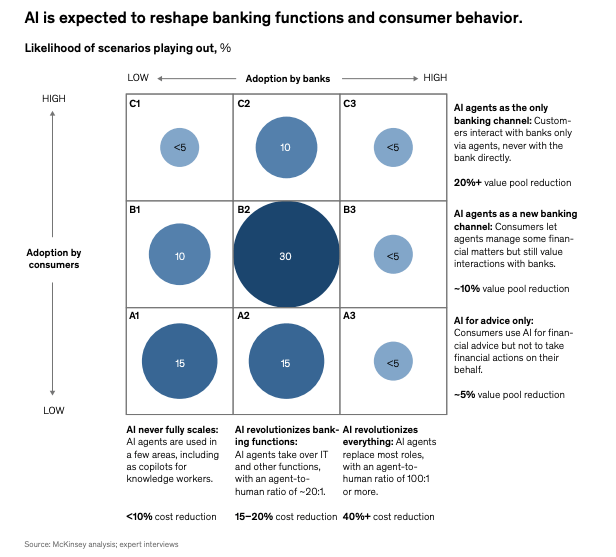
This creates a shift in AI-driven operational efficiency, where teams handle more volume with higher accuracy and full auditability.
The gains from agentic AI don’t stop at a single use case. They come from applying agentic AI across entire customer journeys and banking operations.
In banking, those journeys differ across divisions like wealth management, retail, and corporate banking, each with its own processes, constraints, and priorities.
And across all banking divisions, agentic AI typically applies across the full customer lifecycle, from acquisition and onboarding to ongoing servicing and support.
Below is how leading banks apply agentic AI across key divisions, with representative use cases for each.
Agentic AI in wealth management takes on the administration, preparation, and compliance work that eats into portfolio managers’ time for growing client relationships.
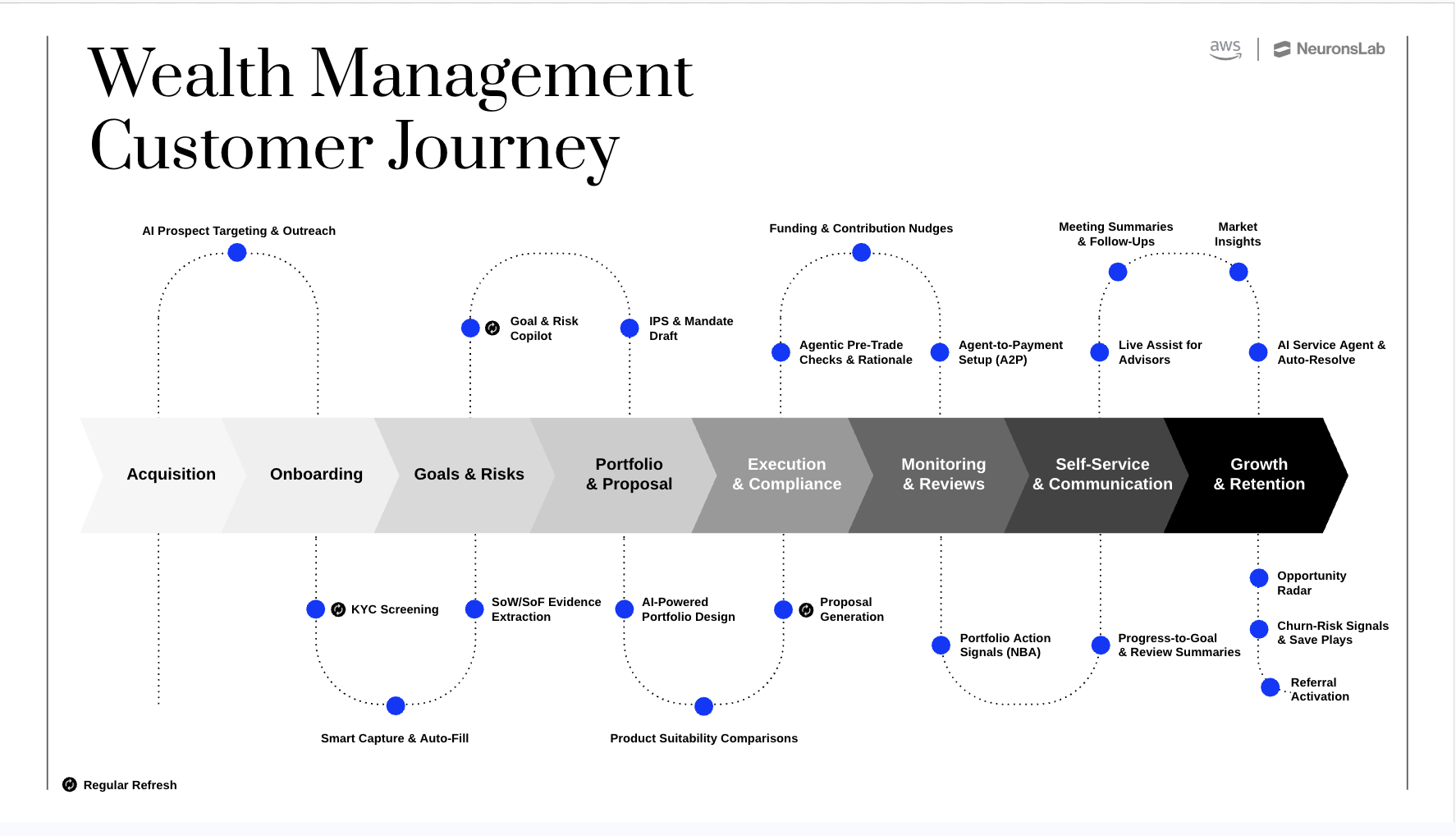
For example, before a client meeting, an AI agent can pull together relevant client data from banks’ internal systems, analyze markets in real time, identify gaps against the investment strategy, and prepare a tailored briefing with recommended actions for the relationship manager.
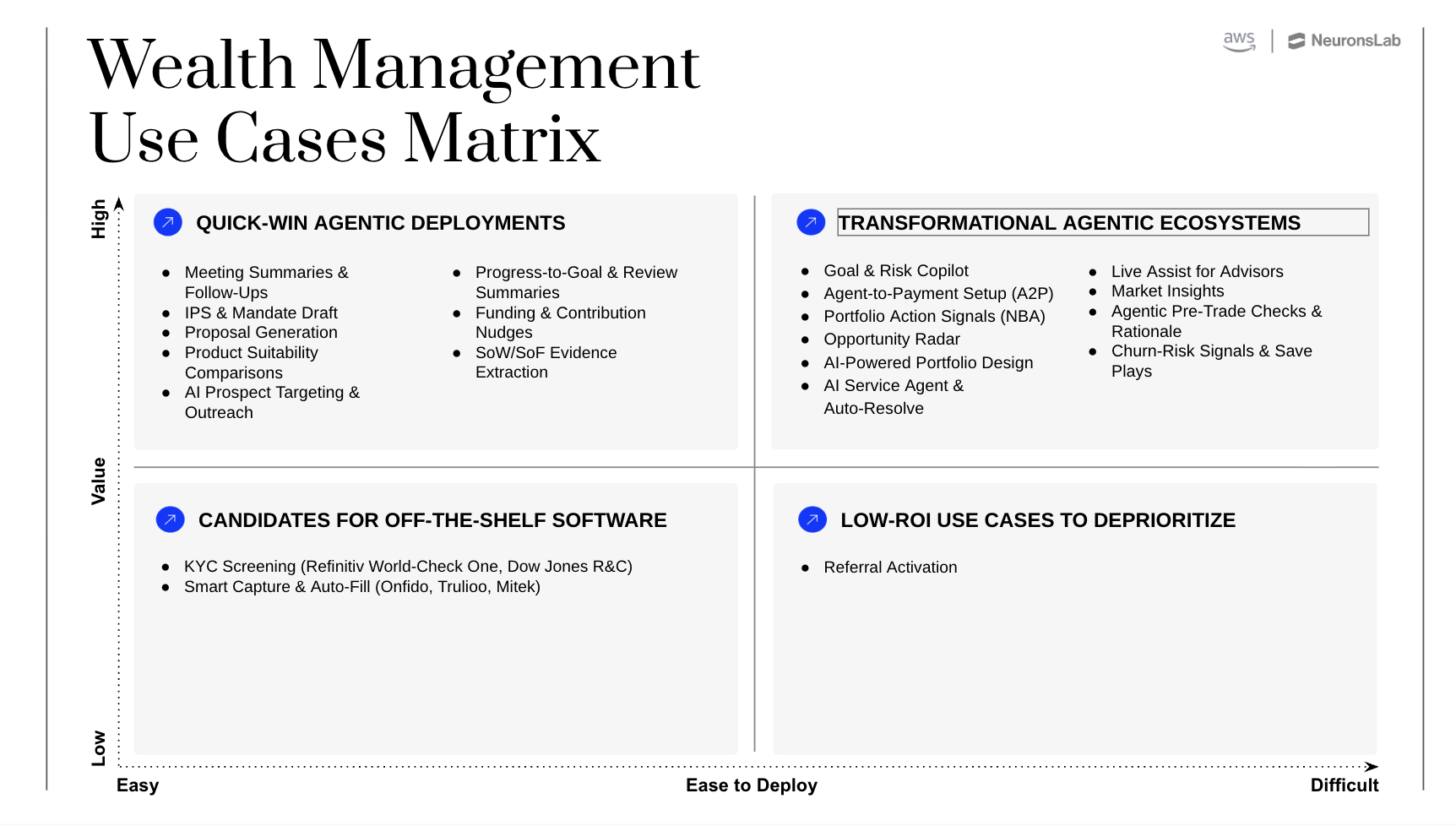
More examples include:
For a deeper look at the use cases and benefits of agentic AI in wealth management, explore our full guide on how wealth management firms can use AI.
In retail banking, unlike traditional AI or chatbots, agentic AI manages high volumes of routine interactions and processes end-to-end, so banks can serve more customers without adding cost or sacrificing service quality.
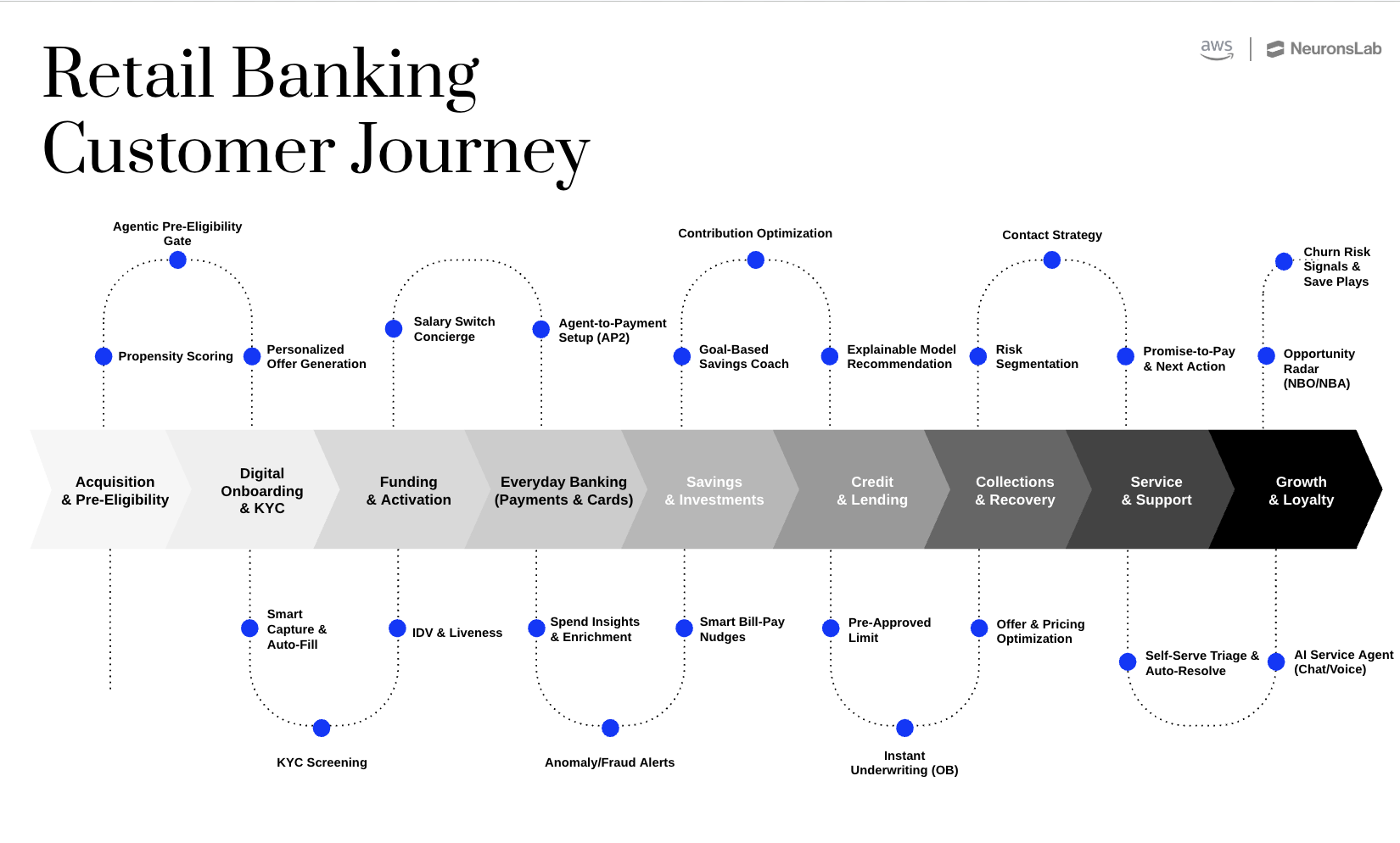
For example, when a customer applies for a loan, an AI agent can retrieve account data, verify identity, assess eligibility, analyze supporting documents, initiate approval workflows, and follow up with the customer, while coordinating with customer support agents for accountability.
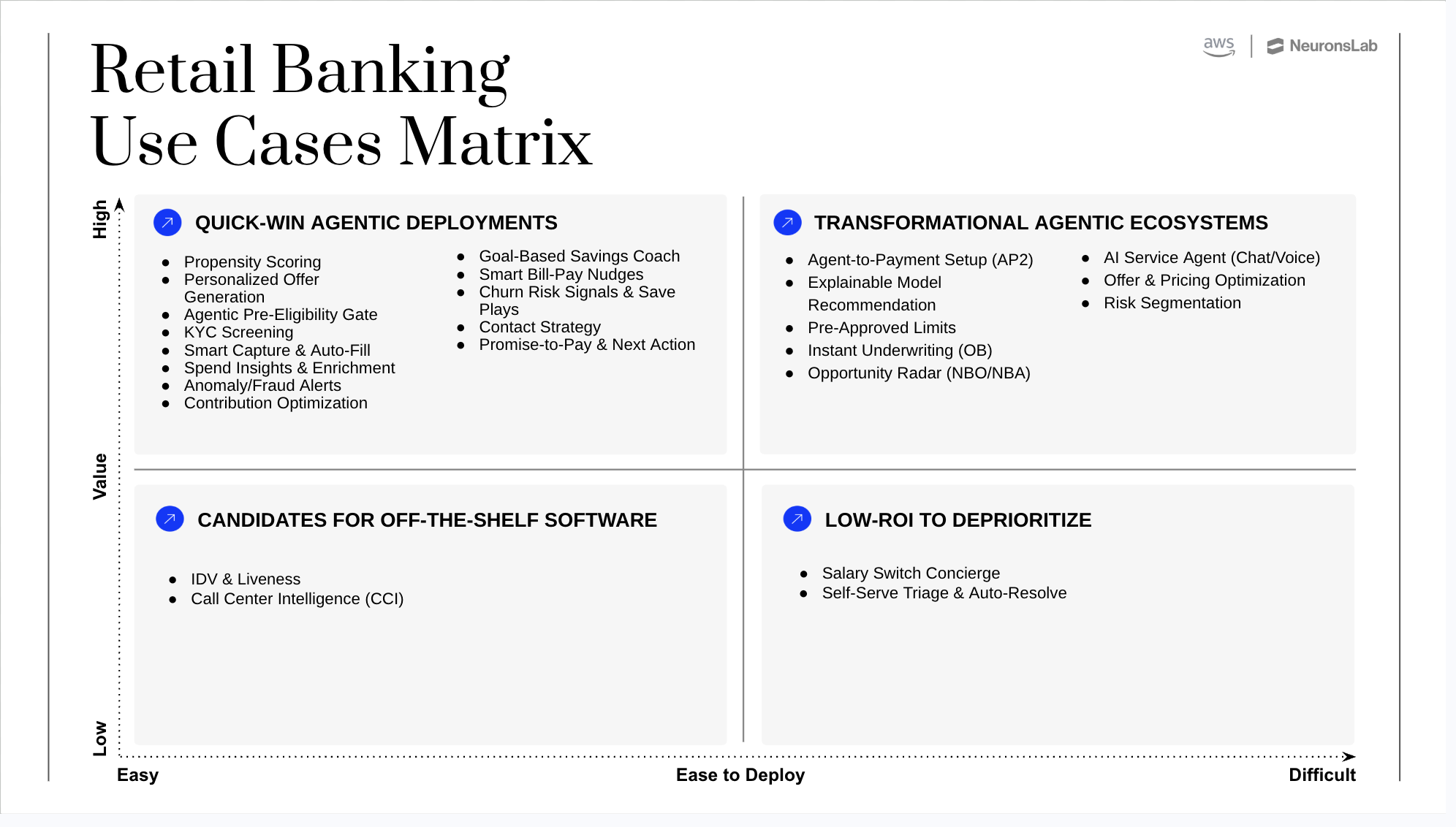
Additional use case examples for retail banking include:
Agentic AI significantly improves how banks serve small and medium-sized businesses.
It can take on the multi-step, time-consuming tasks that slow down employees and create unnecessary friction for small businesses.
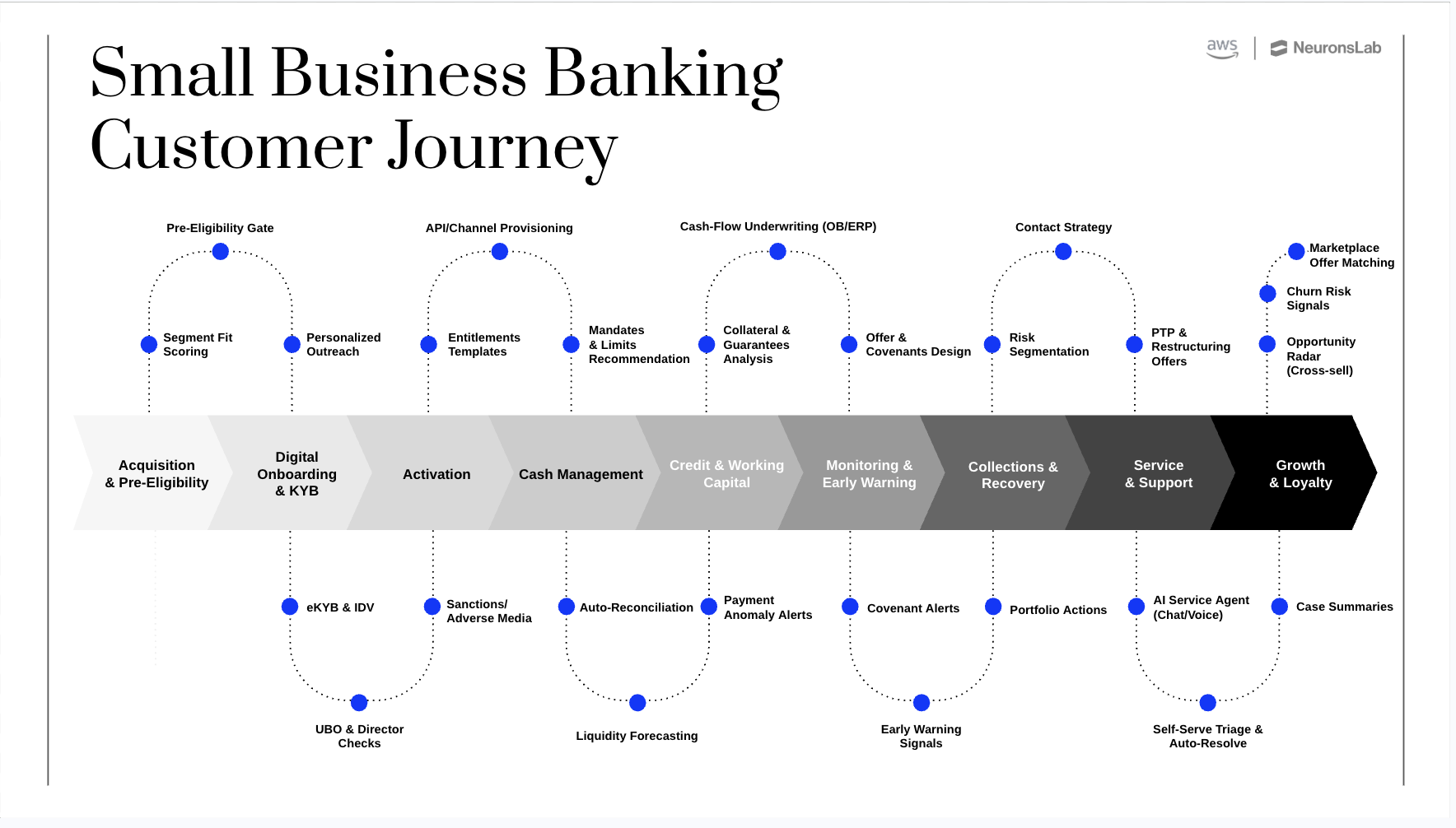
For example, when a small business applies for working capital, an AI agent can pull data from accounting software, analyze cash flow trends, make risk assessments, structure loan terms, and initiate approval workflows. After disbursement, it continues to monitor transactions, flag early warning signs, and recommend interventions if risk increases.
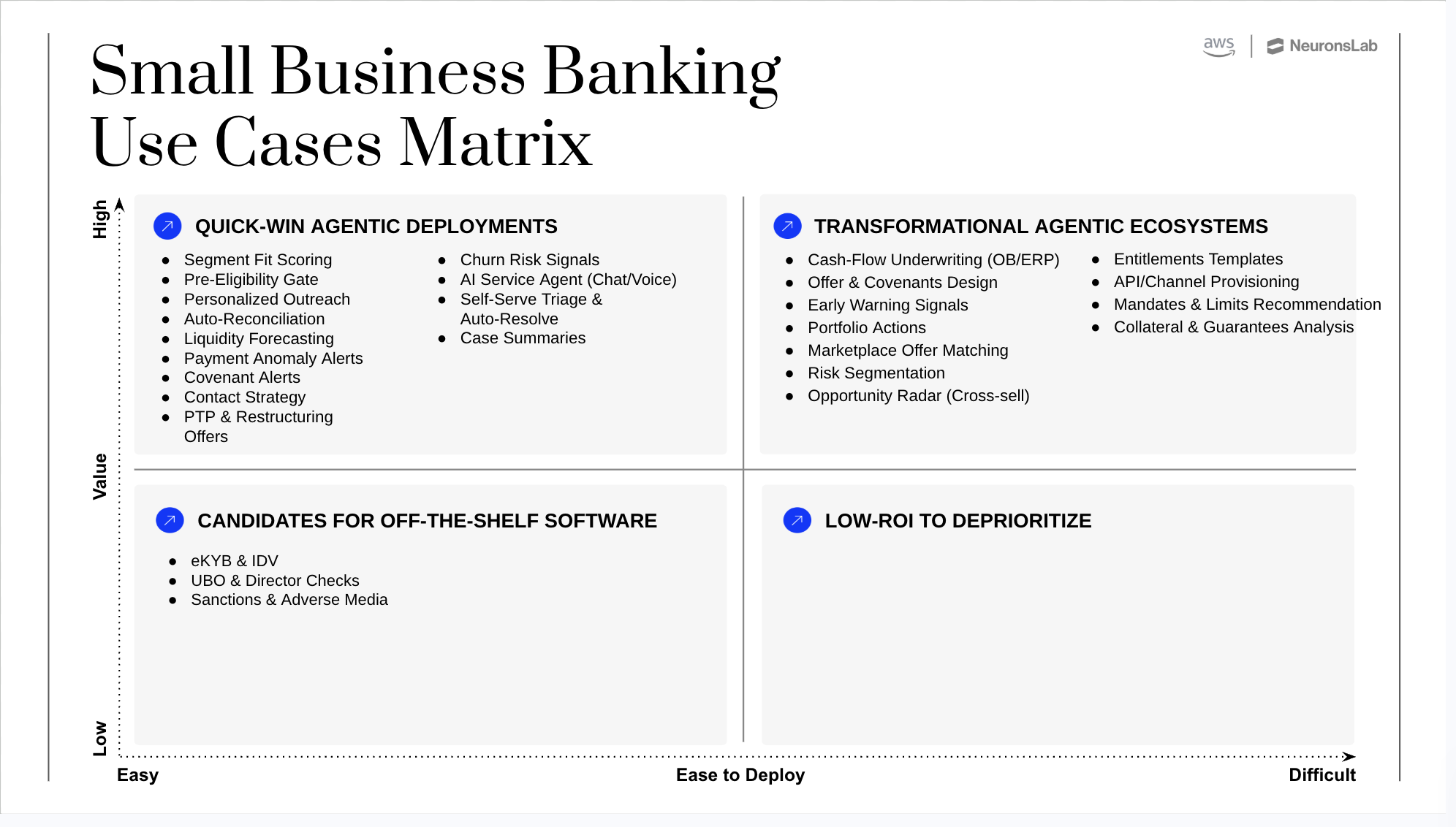
Other key use case examples for small business banking include:
Agentic AI takes on the complex, document-heavy work in corporate banking. It pulls data across multiple systems, coordinates across teams, and navigates regulatory requirements. This frees up relationship managers and operations teams for client-facing and strategic work.
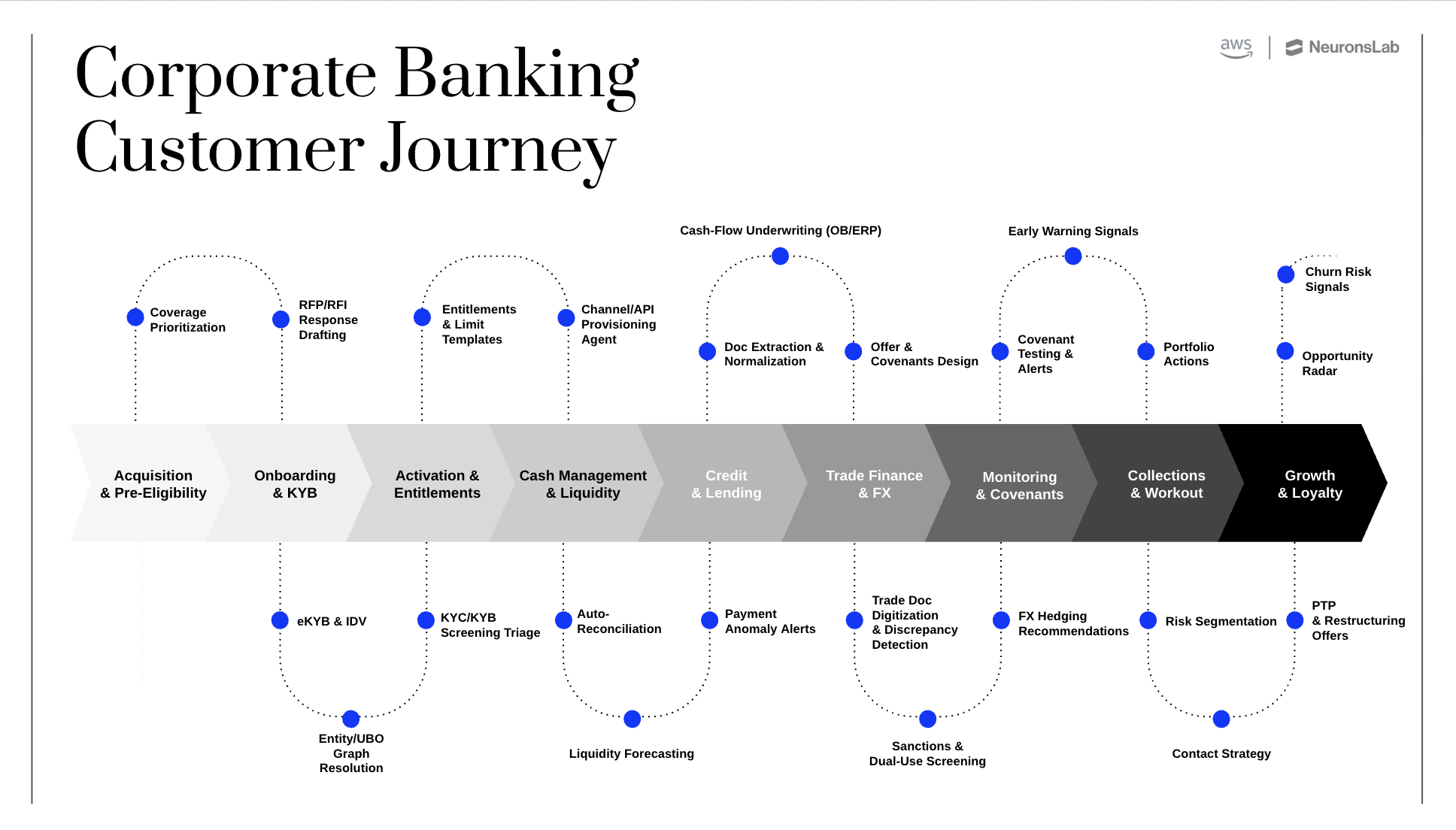
For example, during transaction monitoring, AI flags anomalies in real time and routes them to the right team for investigation while tracking resolution and automatically updating risk profiles.
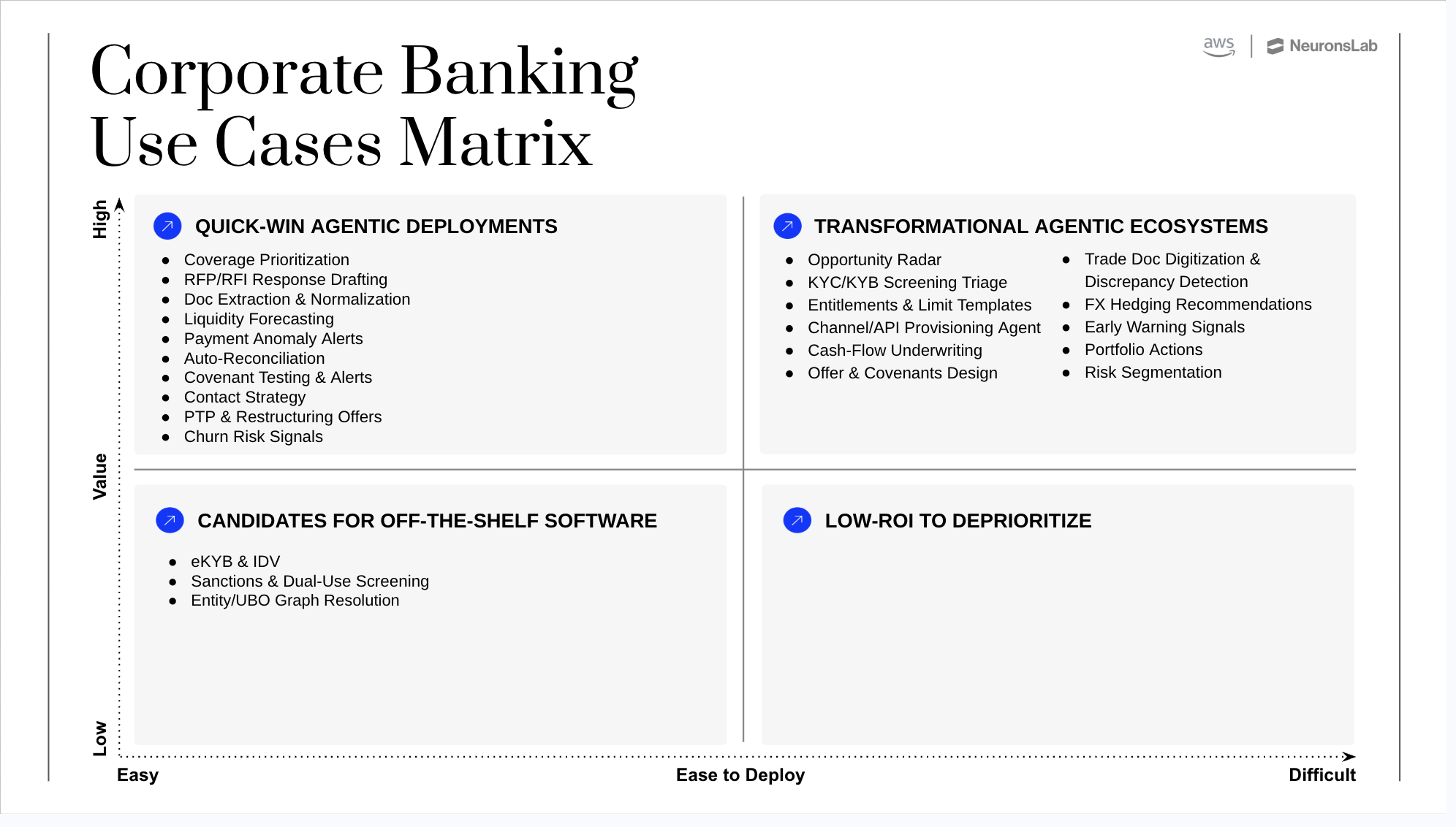
Other applications for corporate banking include:
In private banking, relationship managers spend a significant portion of their time on administrative tasks, portfolio monitoring, and compliance checks. Agentic AI can handle these tasks, giving managers more capacity to focus on the strategic advice and relationship building that high-net-worth individuals (HNWIs) typically expect.
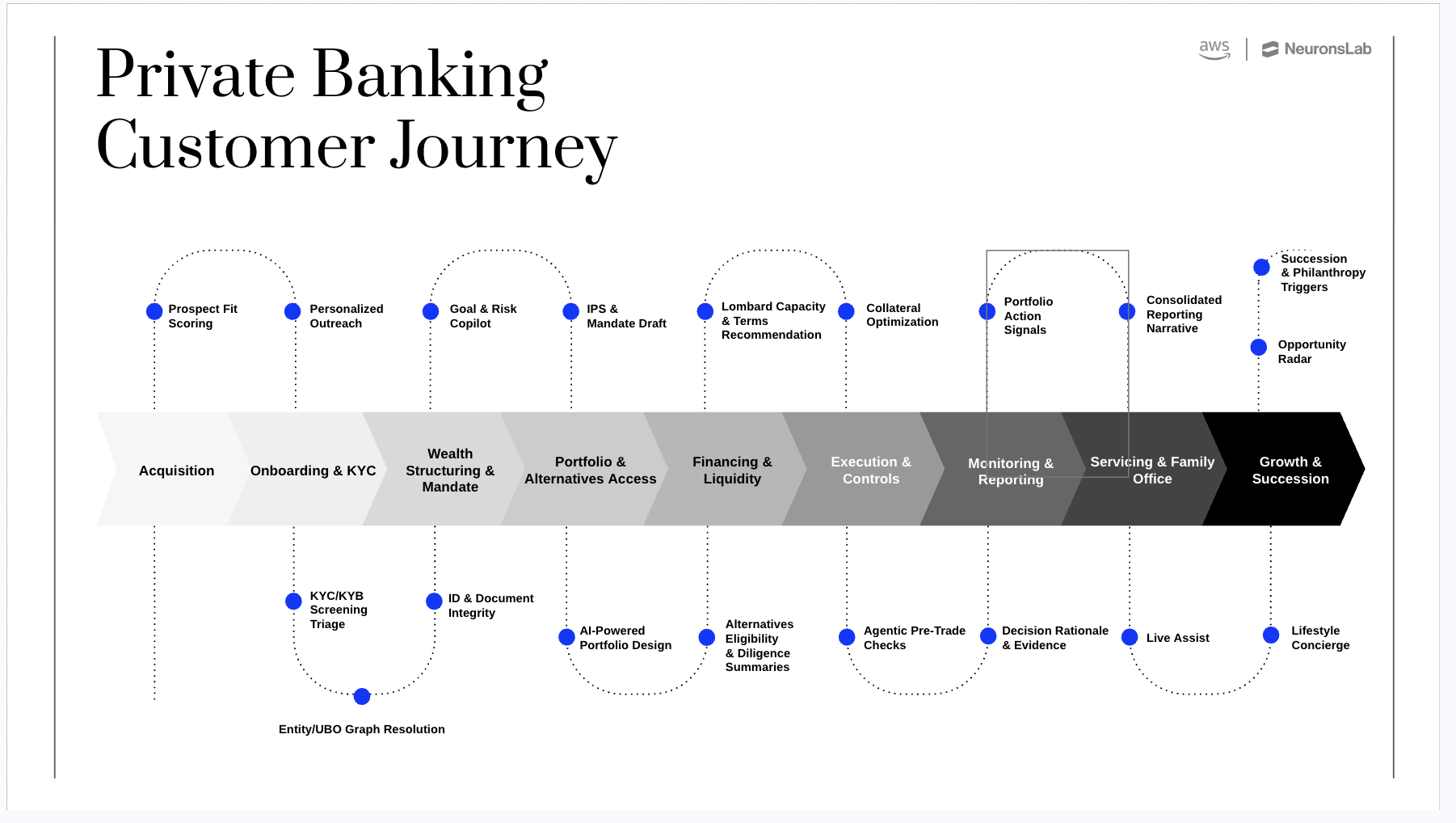
For example, when reviewing a client portfolio, an AI agent can assess allocations, identify drift from the investment strategy, generate trade recommendations, run pre-trade compliance checks, and prepare a rationale for the relationship manager before execution.
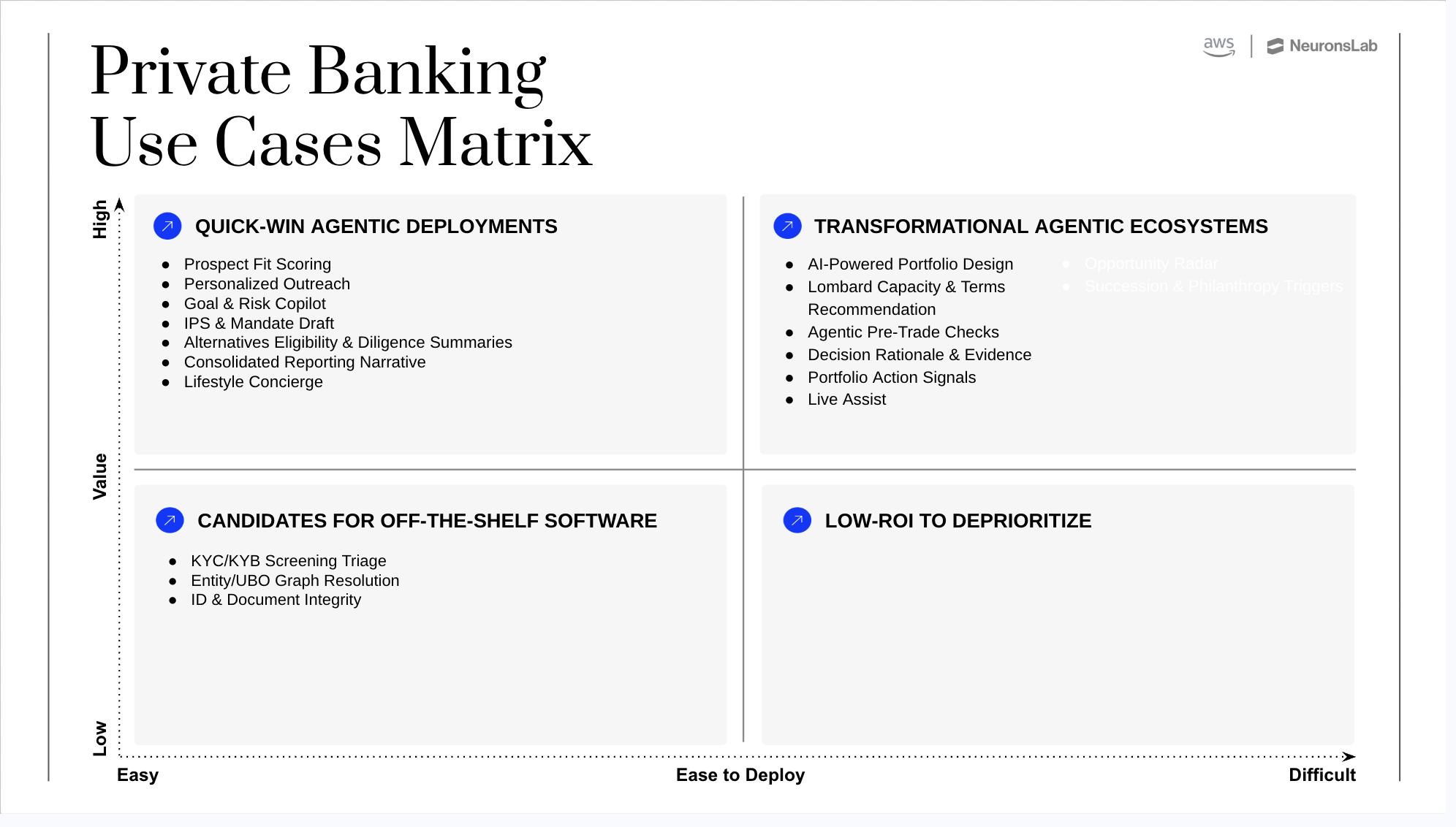
Other key use case examples for private banking include:
To explore how AI can empower your relationship managers (RMs) to serve more clients, grow AUM, and reduce costs, learn how AI can help RMs increase client capacity by 30%.
The use cases we’ve explored show just how much of the complex, time-consuming work agentic AI can take on across banking divisions. To implement them, there are a number of factors to consider, which we cover next.
The use cases above show where agentic AI delivers value. Implementing it successfully, however, requires careful planning across systems, teams, and governance.
The following considerations determine whether your initiatives scale into production or remain stuck at the pilot stage:
Some banks start with isolated pilots, but this limits impact. Agentic AI works best when applied across the full customer journey rather than in isolated use cases.
If you only optimize one step in the journey, like KYC for HNWI onboarding, the business impact from that one touchpoint is minimal. You’ll see greater value when you use it to speed up and personalize the full customer journey from acquisition all the way through to service, growth, and loyalty.
The same logic applies internally. The real benefits come from compounding applications across all the complex tasks your teams handle every day.
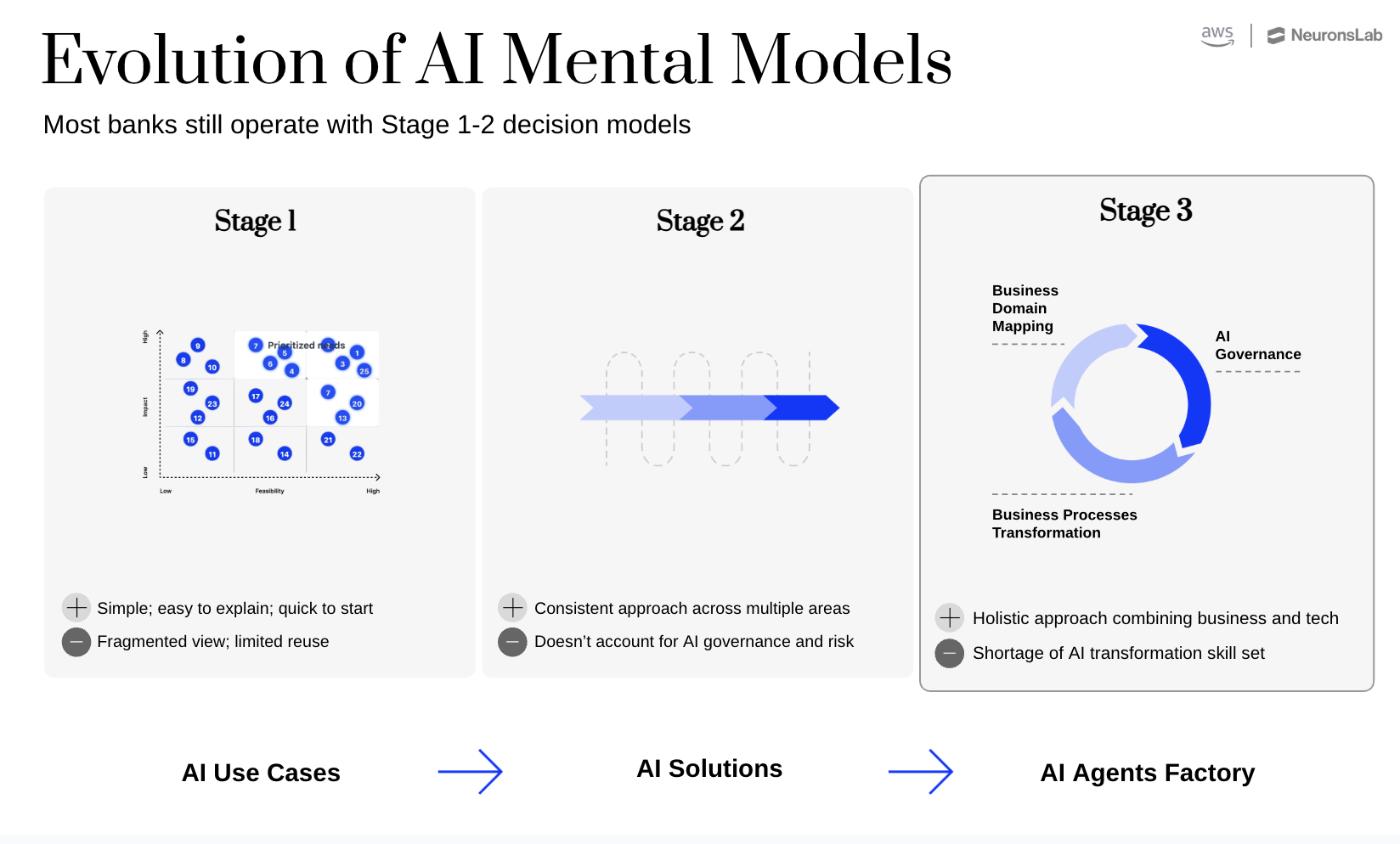
This is where agentic AI goes beyond incremental gains to creating significant business impact across revenue, efficiency, and customer experience.
Banks need a unified AI governance framework that covers the entire organization, aligning teams, systems, use cases, and risk management processes with regulatory requirements from the start.
Governance defines guardrails for what each agent is allowed to do, what data it can access (via permissions), and how decisions are tracked and reviewed under human oversight. It also aligns centralized and division-led initiatives and prevents fragmentation across departments.
In turn, this prevents high-risk failures, such as data leaks, hallucinations, unintended biases, and unauthorized actions, that can quickly damage customer trust and breach regulatory standards. You’ll also have the foundation you need to scale AI safely across your organization.
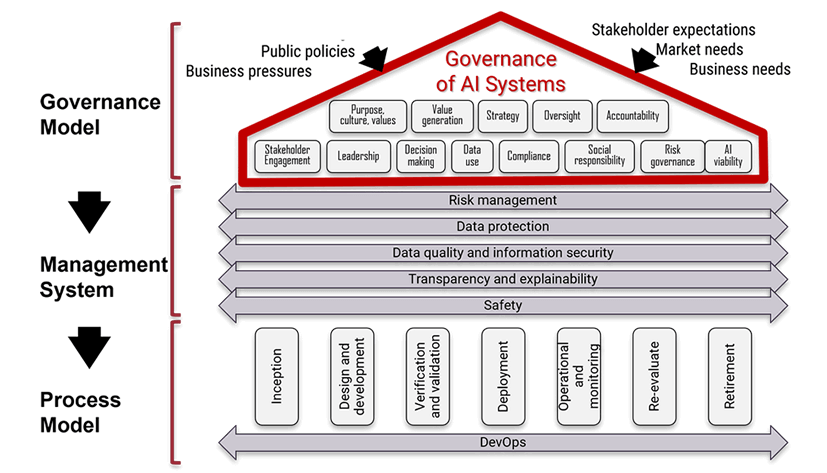
Without this foundation, scaling agentic AI introduces risk faster than it creates value.
When implementing agentic AI, it helps to think about AI costs as a phased investment. So, for example, you can expect to pay anywhere from $40,000 to $80,000 for a first pilot. From there, moving into full solution development brings higher costs. This can typically run from $250,000 to $750,000, depending on complexity.
And as you scale across departments, costs increase with scope. That’s because expanding from a single use case, like fraud detection and monitoring, to multiple areas like onboarding, payments, and compliance adds more data, workflows, and oversight.
There are other costs to keep in mind, such as data infrastructure, maintenance, and even change management or training costs, which can start from $10,000 and grow depending on the complexity of your implementation.
Understanding this cost structure upfront helps you build a realistic business case and avoid underestimating your total investment.
Because banking is high stakes and strictly regulated, you need to evaluate the entire agent, not just the final output. However, agentic AI is harder to evaluate than traditional systems because it makes decisions across multiple steps, pulls from different data sources, and interacts with various tools along the way. The outcome is shaped by its reasoning at each step.
That means you need visibility into how the system works end to end. This includes the data it uses, how it reasons through tasks, and how reliably it moves between tools and actions.
To do this successfully, you’ll need to set up structured AI evaluations that test your AI systems across key metrics like accuracy, speed, cost, and decision quality. You’ll also need to involve multiple teams in the process.
Technical teams are typically responsible for evaluating speed, cost, and integrations, while SMEs like investment analysts and compliance officers review outputs, edge cases, and how AI performs over time. Done consistently at regular intervals, evaluations ensure your agentic AI systems remain reliable, auditable, and aligned with both business strategies and regulatory expectations.
Implementing agentic AI across multiple departments is a significant undertaking, and you’ll need the right team in place because it goes beyond traditional IT implementation. In practice, that means technical and business roles working together.
For example, you’ll need subject matter experts (SMEs) across your departments, such as relationship managers or investment analysts, who understand how work actually gets done. Because SMEs don’t just validate outputs, they’re critical in defining agent logic and behavior.
These SMEs translate their expertise into the logic your agentic AI systems can be built on, so agents reason and act in ways that reflect real workflows. You’ll also need a technical team of architects and engineers to actually build and integrate this across your AI systems.
Both teams will then need to work together to ensure AI performance is reliable and improves over time. Like most banks, you might not have these skill sets in-house yet. Working with an experienced AI consultancy can bridge that gap and get your teams where they need to be.
Without this combination of domain and technical expertise, agentic AI systems fail to reflect real workflows and struggle to deliver consistent results.
When you’re up against operational complexity, it might seem easier to build separate AI solutions for each use case or division. However, you’ll want to avoid this, as isolated agents that can’t be reused mean you’re rebuilding from scratch every time.
This drives up your AI development costs, creates governance gaps, and produces fragmented systems that are hard to scale, audit, and control in a highly regulated banking environment.
Instead, plan to scale from day one. This means designing your AI systems from the start to be reusable and governed centrally, so each new use case builds on what’s already there rather than starting over.
You’ll scale AI across divisions faster, reduce costs, and your agentic AI compounds in value across your entire organization over time, instead of remaining siloed within individual use cases.
The use cases and considerations above highlight both the opportunity and the complexity of implementing agentic AI in banking. Moving from isolated pilots to production systems that scale across divisions requires the right combination of strategy, engineering, and domain expertise.
This is where Neurons Lab supports banks. With Neurons Lab, financial institutions overcome operational complexity and scale compliant agentic AI systems across divisions.
Neurons Lab is a UK and Singapore-based Agentic AI consultancy serving financial institutions across North America, Europe, and Asia. As an AI enablement partner, we design, build, and implement agentic AI solutions tailored for mid-to-large BFSIs operating in highly regulated environments, including banks, insurers, and wealth management firms.

Trusted by 100+ clients, such as HSBC, Visa, and AXA, we co-create agentic systems that run in production and scale across your organization. By working with us, your bank can do the following:
As a bank with multiple divisions, competing leadership priorities, and different expectations across departments, knowing where to start with agentic AI and which use cases to prioritize can be difficult.
Through our discovery and mapping process, we work with you to turn the complexity you face across different departments, stakeholders, data sources, and applications into a clear AI roadmap.
Combined with executive alignment training, you’ll be able to identify high-value opportunities and know exactly which use cases to prioritize to get the most value out of AI.
Our AI and financial services expertise also means you get guidance on the right AI approach for each use case. That way, you’re not trying to use agentic AI when machine learning or generative AI would work better, and ensure agentic systems are used where they create the most value.
With a structured path, aligned stakeholders, and the right AI approach for each use case, you can move from planning to deployment faster and with less risk.
When AI is built in isolation for each banking division or use case, it remains siloed. There’s no shared infrastructure to build on, so every new deployment starts from scratch, and AI costs pile up.
With Neurons Lab, you get a system to reuse integrations, data connectors, agents, and AI tools you’ve already built, so every new deployment builds on what’s already there rather than starting over.
You do this through our AI Agent Factory, where you can configure and customize pre-built capabilities for specific tasks, then combine them to handle complex workflows across your banking divisions.
Because these skills are reusable, you build a library that makes every future AI deployment faster and cheaper.
Instead of solving one problem at a time, you’re building multi-agent systems that can scale across divisions, with benefits that compound as AI capabilities are reused across customer journeys and workflows.
If teams view agentic AI as a threat, they work around it or push back entirely, negatively impacting implementation. Neurons Lab helps you build trust through transparency, involvement, and structured evaluations.
We do this by involving your teams in the AI implementation process from the start. Our Forward Deployed Engineers (FDEs) work alongside your teams to extract their expertise and translate it into production-grade agent protocols that are built directly into your infrastructure.
That means your employees are not handed finished AI systems they don’t know how to use, trust, or oversee. It also means you can deploy auditable agentic systems with clear decision trails and human accountability loops, which are essential for regulatory compliance.
We then help you put strong evaluation frameworks in place, replacing guesswork with systematic testing for accuracy and hallucination monitoring. Your teams get clear visibility into how AI behaves, so they can improve its performance over time.
This transparency helps employees feel comfortable delegating context-heavy tasks to AI. It also enables them to see AI as a tool that supports rather than replaces them, which leads to more trusted adoption.
At a major Asian bank, relationship managers (RMs) were spending too much time on manual tasks, compliance checks, and pulling data from disconnected systems. The bank also wanted to grow RM capacity and client coverage without increasing headcount.
Neurons Lab deployed ARKEN, an agentic AI platform built on AWS, in just 8 weeks. ARKEN pulls data from three legacy systems into a single, RM-ready knowledge layer.
From one conversational interface, the bank’s RMs now handle daily opportunity prioritization, market intelligence, meeting prep, and personalized product recommendations. The result is more consistent, personalized client engagement at scale, as well as:
Not only does this show how agentic AI allows banks to scale client capacity and service quality without increasing headcount, it’s also a clear example of how agentic AI moves from isolated efficiency gains to measurable business outcomes at scale.
Agentic AI can change how banks operate, from how they acquire and serve customers to how their teams work day to day, across every division and function. As shown throughout this article, the value comes from applying it across full workflows, aligning governance, and building systems that scale beyond isolated use cases.
But the real challenge is identifying and executing opportunities in a way that works within the complexity and regulatory constraints of banking. Without the right approach, many initiatives remain fragmented or fail to move beyond the pilot stage.
Neurons Lab supports banks in closing this gap. We help you identify high-impact use cases, build production-ready agentic systems, and scale them across your organization with the governance, infrastructure, and domain alignment required in the financial services industry.
If you’re evaluating where to start or how to scale existing initiatives, it’s worth exploring what this could look like in your organization. Book a call with us today.
The timeline depends on your implementation approach. Building in-house can take months due to the complexity involved. But with an experienced AI partner like Neurons Lab, you can deploy production-ready systems in weeks by using pre-built components, proven architectures, and structured delivery frameworks.
You can get employees to adopt agentic AI in banking by involving them in every step of the implementation process. This means building their expertise into AI systems while developing their AI skills at the same time. When employees see AI handling their most tedious workflows and freeing them up for more specialized work (like client relationships and complex approvals), they’re far more likely to trust it and use it.
Agentic AI can integrate with your existing banking systems and infrastructure. Modern agentic AI solutions are typically added as a layer on top of your existing legacy infrastructure using APIs and data connectors. A partner like Neurons Lab can handle this integration step, along with governance and evaluation frameworks, so your agentic AI systems are accurate, reliable, and compliant.
It shifts employees from doing the work to overseeing it. Rather than spending hours on manual workflows, employees become the human in the loop, remaining accountable for AI outputs, applying their expertise to ensure AI is working as expected, and refining its performance over time.
AI in capital markets helps firms scale operations, automate workflows, and act on real-time data to improve performance and reduce risk.
Microsoft Copilot for Finance delivers strong out-of-the-box gains, but requires customization to handle complex, regulated financial workflows.
Explore top AI agent platforms for financial services. Learn how BFSIs build scalable, compliant AI agents and automate complex workflows.
Discover AI for compliance in banking. Reduce false positives, speed up KYC reviews, and create auditable compliance workflows with AI.
Here is how banks, insurers, and fintechs can budget for AI with scenarios and cost drivers—subscriptions, overages, infrastructure, and ownership