



Agentic AI in Banking: How to Get Started
Agentic AI in banking helps banks automate workflows, improve customer service, reduce costs, and scale secure AI across divisions.
If you’re researching the use of AI in capital markets, you’re probably looking to understand where artificial intelligence can create a measurable impact. That’s because across your investment, trading, research, and technology teams, you’re seeing the same challenges:
These are all gaps you can measure with clear metrics because they show up in missed opportunities, slower execution, and limited capacity to scale. Yet many firms struggle to move beyond isolated AI experiments. Without a clear approach to implementation, your AI initiatives remain stuck in pilots instead of improving performance across the value chain.
Neurons Lab works with capital markets firms to turn AI from isolated use cases into production systems. With deep financial services expertise, we help teams improve analytical performance, scale operations, and deploy AI systems that deliver measurable outcomes under real market constraints.
In this article, we’ll help you understand how to get started with AI in capital markets by covering:
Want to get started with adopting AI across key capital market workflows? Contact us today to get started.
Key capital market workflows still rely on manual processes, primitive risk models, and tools that break down at scale. The result is:
AI addresses these directly by improving how quickly your teams access information, how much work they can handle, and how early they can act on risk signals.
Here are the key four benefits in detail:
Research teams and traders gather data from market feeds, financial statements, analyst reports, and internal models. But this process can eat up hours of their day. While they might already be using AI tools like Claude or Perplexity for finance for some of this research, the data needed remains fragmented. By the time insights are ready, the market may have already moved.

AI systems can bring market data, internal models, forecasting signals, and external data together in real time to deliver relevant insights when there’s still time.
For example, with agentic AI, research teams can identify emerging signals across multiple datasets, while traders can assess whether a trade is still viable or already crowded by other capital market participants. This reduces the risk of entering a trade too late, when most of the profit opportunity has already gone.
With faster access to the right information, research teams can identify opportunities earlier, traders can act on market conditions in real time, and portfolio managers can make better capital allocation decisions.
This shift from delayed analysis to real-time insight creates an immediate advantage. The next constraint, however, is capacity.
Once your capital markets teams have better information, the next obstacle is how much work they can process. A lot of time is still spent on manual work:
But these workflows limit how many assets you can analyze, how many trades you can execute, and how fast you can scale.
AI can change this by automating and coordinating complex, multistep workflows and core functions across these teams.
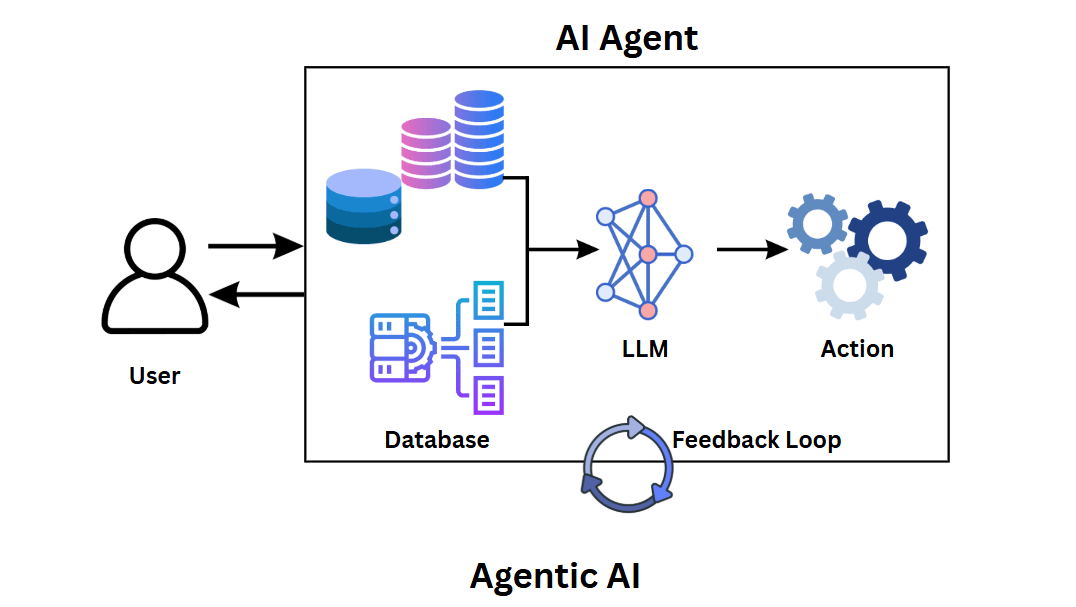
For example:
With AI, your firm has the ability to scale research coverage, increase trading capacity, and support more clients and assets without increasing team size.
As your teams process more data and execute more trades, your competitive advantage depends on how quickly and accurately your models adapt and how deeply you understand market signals. However, many firms still rely on limited datasets, static models, and workflows that can’t keep up with market speed.
This makes it harder to identify patterns, respond to market changes quickly, or uncover insights that competitors may miss.
AI changes this by expanding both the depth of data and the speed of analysis.
With AI, your teams can analyze larger volumes of market data and incorporate alternative signals or non-traditional data sources (e.g., sentiment analysis, consumer behavior, external activity, social media signals) to detect changes before they appear in financial results. At the same time, AI can update your models continuously as new data arrives.
Your teams can also understand market dynamics in real time with AI. By analyzing liquidity, order flow, and participant behavior, traders can avoid crowded positions and act before opportunities are fully priced in.
This means your trading teams can enter markets earlier, respond to market disruptions faster, and uncover sources of alpha that are difficult for competitors to replicate.
Faster models and deeper data improve performance, but they also increase exposure. That makes risk management the next critical layer.
Capital markets firms face a constant stream of risks, from market volatility and portfolio exposure to liquidity shifts. Many risk systems rely on static models and limited datasets, making it harder to detect emerging threats before they impact portfolio performance.
AI can analyze portfolios and market conditions in real time via predictive analytics, automatically flagging concentration risk, market risk, overexposure to specific sectors, correlated trades, and changes in liquidity conditions. Instead of waiting for periodic risk analysis, your risk and portfolio management teams get signals the moment conditions change, giving them time to act before a problem compounds.
So if your positions are becoming too correlated or a specific sector is starting to show signs of stress, AI can detect that shift early and signal the need for defensive trades or rebalancing. It can also monitor for broader market regime changes, so your teams aren’t caught off guard by shifts that static processes would have missed entirely.
The result is more proactive risk management that gives your teams better information faster. This allows you to protect performance, allocate capital more effectively, and respond to changing conditions with confidence.
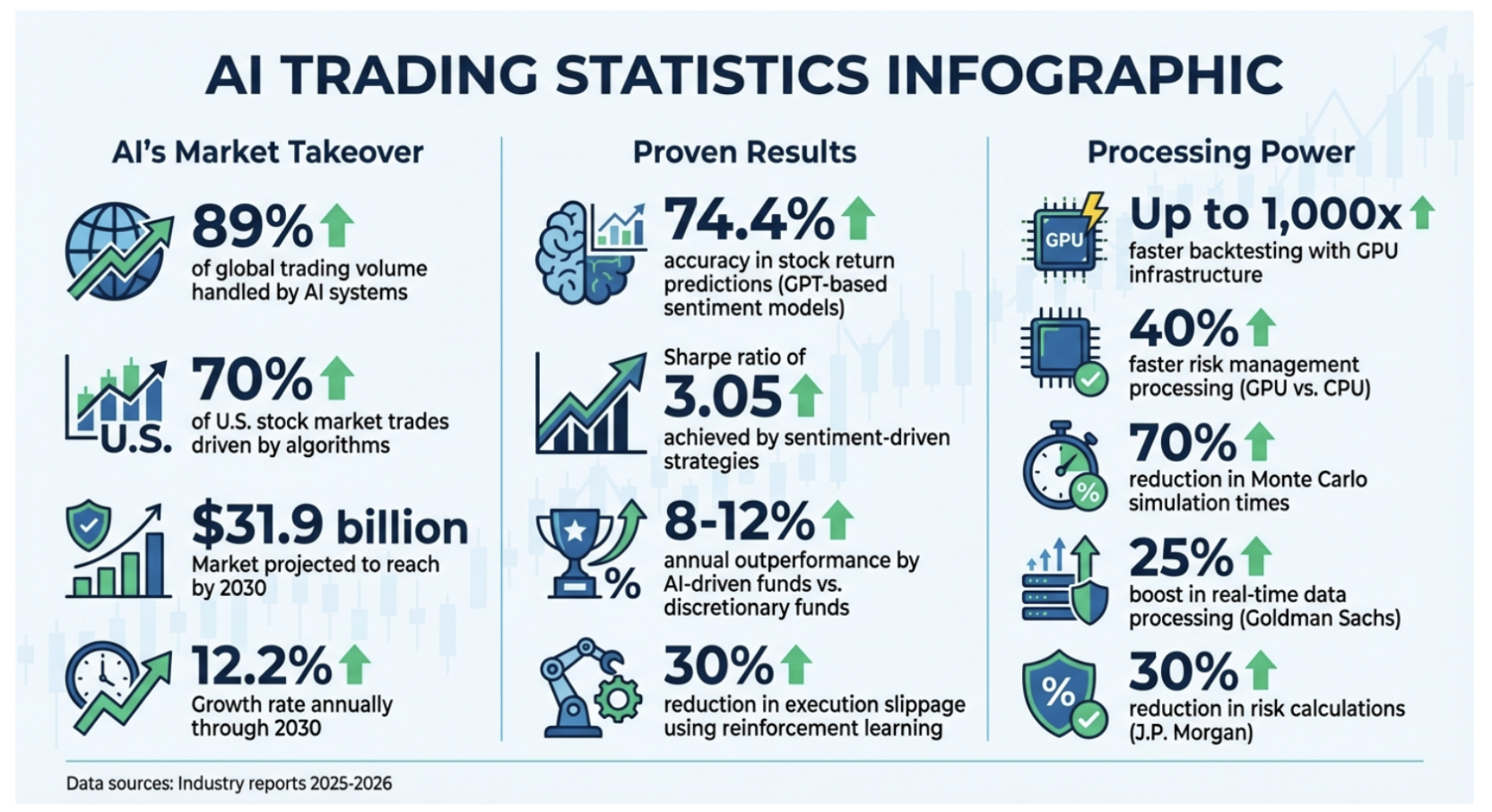
These benefits are not merely theoretical. They map directly to specific workflows across capital markets teams. To understand how this works in practice, it helps to break AI applications down by where they sit in your organization.
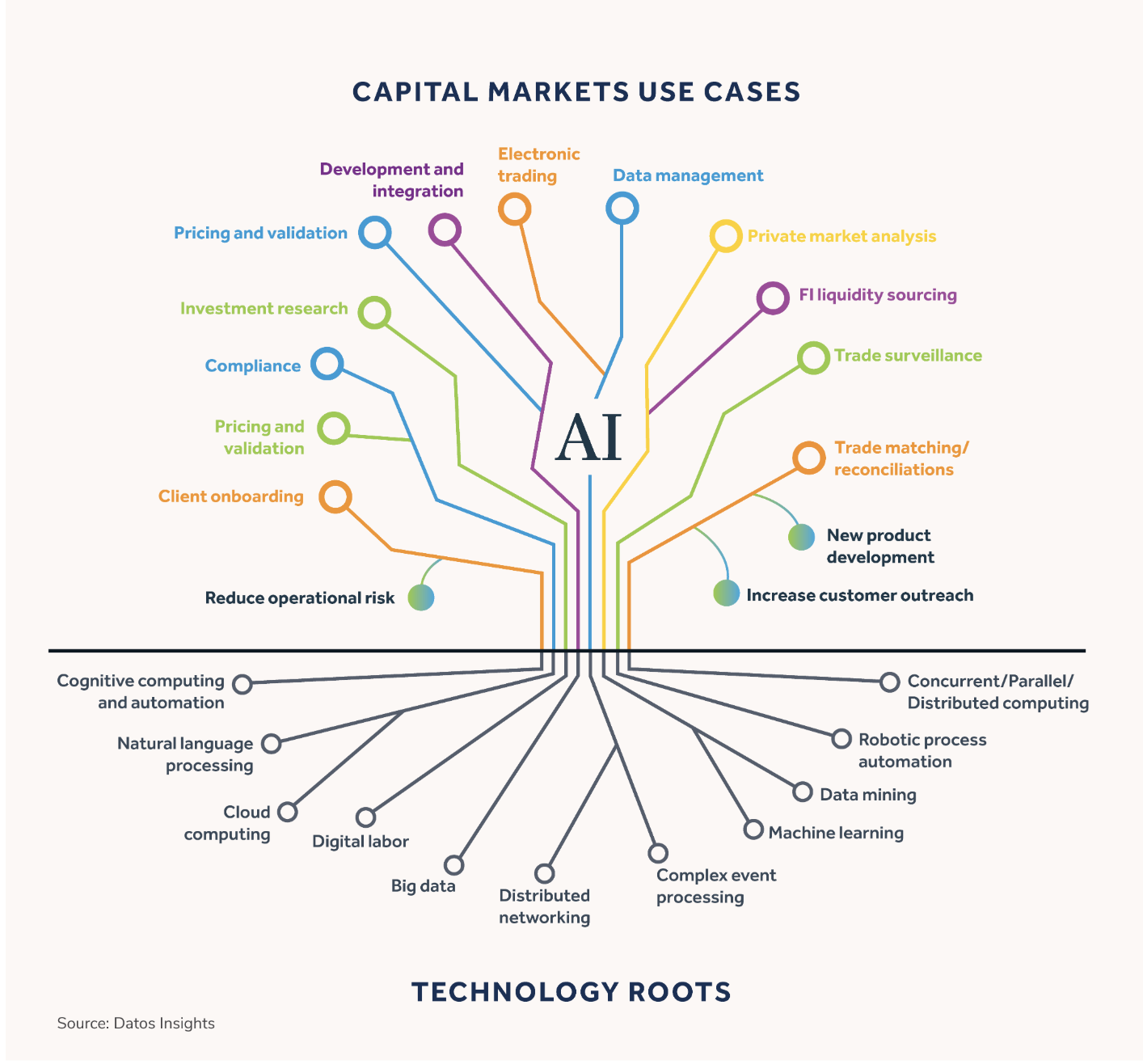
AI in capital markets does not sit in a single function. AI supports both public markets, such as stocks, crypto, and bonds, and private markets like private equity and venture capital. It supports every major team involved in investment decision-making, execution, and client coverage, including:

Across these areas, AI applications generally fall into two groups: front office and back office, which we explore below.
AI can support customer-facing sales and relationship management teams across key areas like client engagement, understanding goals, and more.
1. Identify client opportunities based on portfolio and market conditions. AI can analyze client portfolios, recent activity, and market movements to identify where outreach is most relevant. For example, if a client is overexposed to a sector under pressure, the system can suggest specific hedging or reallocation ideas and prompt relationship managers to act.
2. Prepare client briefings and investment updates faster. AI can pull together relevant market data, client history, and product information into proposal-ready content and data-supported trade ideas, so your teams spend less time on preparation and more time closing deals.
3. Automate reporting, compliance checks, and follow-ups. AI can generate accurate, formatted client reports from your existing data systems in minutes. It can also run pre-trade compliance checks, draft order notes, and flag anomalies (e.g., for anti-money laundering checks), so every decision stays documented and defensible to regulators.
4. Deliver more personalized communication at scale. Instead of generic market updates, AI can tailor outreach to each client’s portfolio, interests, and recent activity. Relationship managers can automate follow-up tasks after meetings too, keeping every client interaction timely and well-documented.
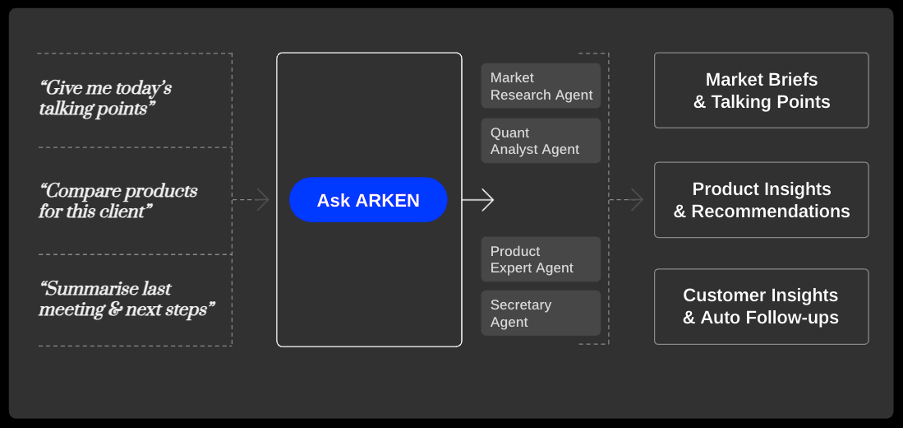
While front office teams focus on client engagement and revenue generation, most performance gains still come from improving how research, trading, and portfolio decisions are made internally.
Behind every client interaction is a set of internal workflows that determine performance. This is where AI has the deepest operational impact. For example, it can:
Portfolio managers can use AI to analyze open positions and figure out the best way to allocate capital across trades. That includes clustering trades into similar groups, spotting when positions are too correlated, and identifying opportunities to rebalance or introduce less correlated positions to reduce portfolio risk.
Beyond improving workflows, AI can help firms spot behavioral patterns. When hundreds of firms rely on the same Excel formulas or valuation frameworks, their behavior becomes predictable. AI can analyze trading activity, positioning, and participant responses to market events to uncover new or overlooked opportunities.
These use cases show where AI fits across capital markets workflows. But the challenge is implementing AI in a way that delivers consistent performance across teams.
This is where most firms struggle.
Most capital markets firms already understand where AI can be applied. The difficulty lies in execution.
Moving from use cases to production systems requires clear problem definition, the right data strategy, and alignment between business and technical teams.
Before implementing AI, here’s what to consider:
As a capital markets firm, you’re well-placed to start with clearly measurable problems. For example, it might be that you’re:
Understanding performance gaps first helps clarify what you actually need from an AI solution. So, if the problem is slow drafting of client emails or summarizing market reports, an out-of-the-box tool might solve it.
But if the problem is that your risk models aren’t adaptive enough, that may require a custom machine learning solution. Without that clarity upfront, you might end up investing in the wrong type of AI.
Once you understand where performance is falling short, the next question is whether your data is sufficient to improve it.
There’s more data available for AI to use than most firms in financial markets realize.
Rather than relying only on financial statements and market reports, AI can analyze large volumes of alternative signals and unstructured data like satellite images, Google reviews, Reddit discussions, and anonymized credit card data to detect patterns that signal changes in company performance earlier than traditional financial indicators.
For example, if satellite images show fewer cars in a shopping center’s parking lot month over month, that might signal demand is falling long before it shows up in earnings. These early signals allow your teams to act sooner, but most firms have yet to integrate this type of data into their workflows.
With the right data in place, the next decision is how to operationalize AI capabilities across your organization.
Next, consider whether you’ll build or buy.
Buying and training your teams on a tool is quicker and makes sense if your human resources are limited or focused on other priorities.
Building custom AI takes significant time and resource investment. But if your technical team has the capacity and your firm sees a competitive advantage in building your own infrastructure, risk management, or trade execution, you’re well-placed to build.
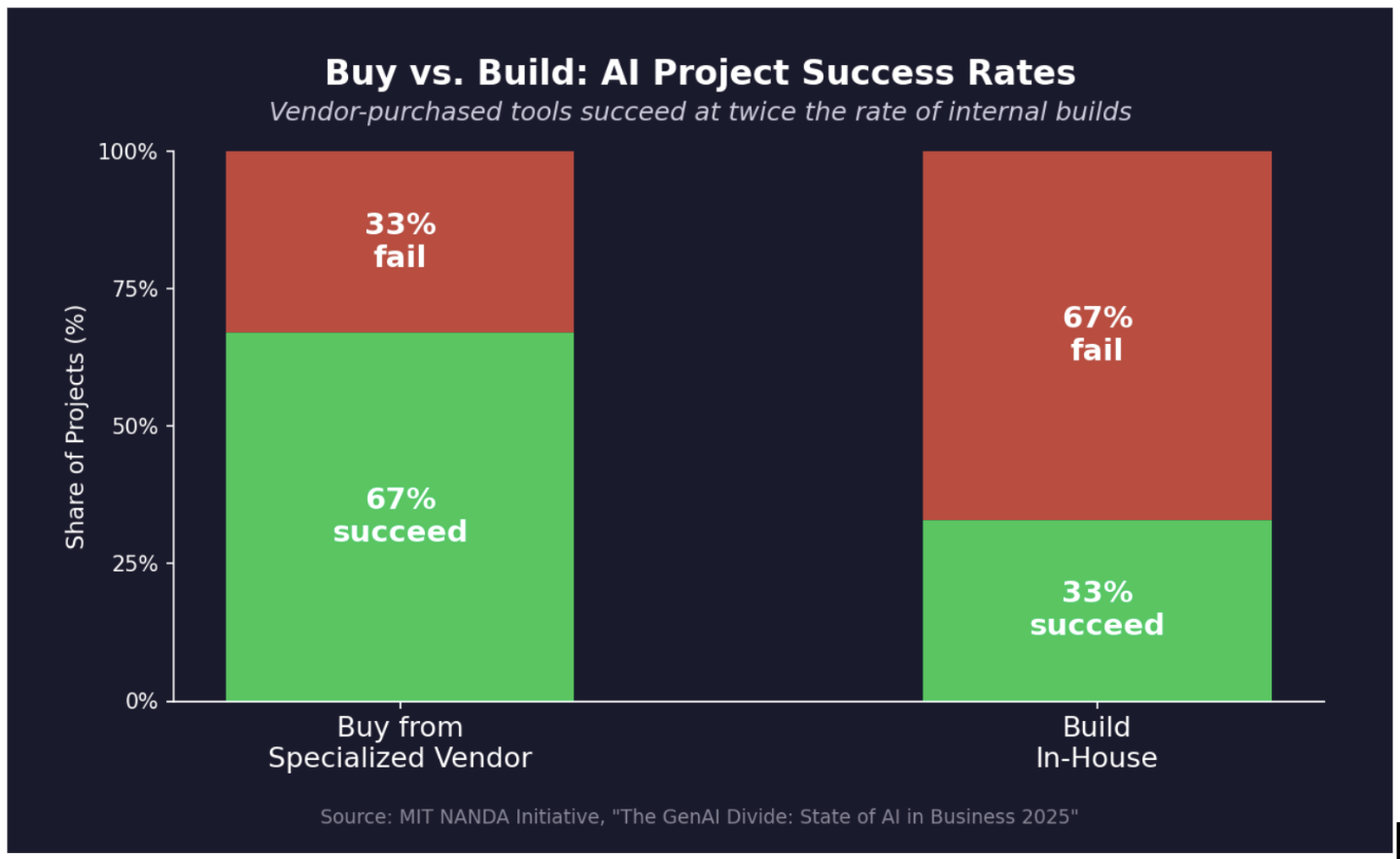
Either way, you’ll need to think about governance and evaluation frameworks, and make sure your AI models are built with the right financial context and aligned with key stakeholders to scale your AI solution across teams.
Regardless of whether you build or buy, the effectiveness of your AI systems depends on how well they understand financial markets.
Generic AI models often misinterpret signals because they lack financial context.
In most fields, data is deterministic. For example:
Financial data, however, is non-deterministic, meaning the same number can tell a completely different story depending on the context around it.
For example, if Apple trades at $1000, whether that figure is high or low depends on how it compares to other tech companies, where it sits relative to market benchmarks, and whether it meets investor expectations.
Finance data requires financial domain expertise, so you need to build your AI models with a deep understanding of how financial markets behave. That way, teams can make decisions based on outputs they can trust.
But getting this right, alongside everything else we’ve covered, is challenging.
These are specialized areas that most capital markets firms need external help with, whether they’re buying a tool or building from scratch. Getting these elements right requires financial domain expertise, structured implementation, and a clear path from pilot to production.
This is where many capital markets firms look for an experienced partner.
Once you’ve identified the right use cases and constraints, the next challenge is execution.
Most capital markets firms struggle to move from pilots to production systems that deliver consistent performance under real market and regulatory conditions.This is where a structured implementation approach becomes critical and where Neurons Lab can help.
Neurons Lab is a UK and Singapore-based Agentic AI consultancy serving financial institutions across North America, Europe, and Asia.
As an AI enablement partner, we design, build, and implement agentic AI solutions tailored for mid-to-large BFSIs operating in highly regulated environments, including banks, insurers, and wealth management firms. Trusted by 100+ clients, such as HSBC, Visa, and AXA, we co-create agentic systems that run in production and scale across your organization.

With Neurons Lab, you can implement AI for capital markets in a compliant and scalable way. By partnering with us for your AI strategy in capital markets, you’ll be able to:
Most financial teams are still running portfolio and trading analysis in Excel and basic tools that weren’t built for the complexity of modern markets.
With deep financial markets expertise, Neurons Lab ensures AI systems that are grounded in how financial markets actually behave. This means your teams can act on outputs confidently across workflows like portfolio optimization, risk modeling, and trade execution analysis.
For example, a global asset management firm struggled with unreliable out-of-sample portfolio performance and a slow trading strategy development process that made it hard to act on market opportunities in time.
With Neurons Lab, the firm built an advanced backtesting framework using scenario-based and cross-validation techniques, alongside market structure algorithms built on hierarchical clustering to give the firm more accurate estimates of market data and fundamentals.
As a result, the firm saw improved Sharpe ratios and reduced drawdowns, and cut the time it took to develop and deploy new financial strategies.
Neurons Lab also helps you ensure your AI outputs are traceable, validated, and aligned with internal risk and regulatory compliance requirements. You’ll get structured evaluation frameworks that support testing, monitoring, and explainability, helping to improve your AI systems so they get better over time.
Once your systems produce reliable outputs, the next challenge is applying the right AI approach to each workflow.
One of the most common reasons we see AI initiatives fail is misalignment between the problem and the technology used to solve it.
Capital markets workflows require different types of AI:
Neurons Lab helps you map each workflow to the right approach, so your investment in AI directly improves performance.
So, rather than costly guesswork or experimentation, you get a partner that understands exactly how to apply AI across research, trading, portfolio management, and client coverage workflows to drive measurable improvements in areas like relationship management, trade execution, and risk management.
For example:
Most AI vendors specialize in one or the other, but with Neurons Lab, you’ll know when to apply both and where they create the most value. This ensures your AI initiatives are tied to measurable outcomes from the start.
With the right approach in place, the next challenge is scaling these systems across teams and workflows.
Scaling AI quickly and reliably across your firm is difficult without the right systems or frameworks. The challenge is consistency—many capital market firms rely on tools or models that work well for small groups but break down as adoption grows.
For example, even a well-built Excel model may work for 10 people, but it becomes difficult to maintain and govern across larger teams.
This is the challenge our AI Agent Factory is designed to solve. It provides a structured way to build, reuse, and scale AI systems across your firm, helping you:
This way, rather than solving one use case at a time, you get a framework for building and scaling multiple AI systems that compound across your organization.
This approach is already delivering measurable outcomes across capital markets workflows for our clients.
A fintech serving investment banks, buy-side investors, and financial markets teams was facing several challenges with its equity capital markets (ECM) teams in analyzing deal flow and accessing market intelligence.
This workflow included:
Neurons Lab developed an AI-powered ECM automation platform that automated routine processes like deal analysis, report generation, and market intelligence workflows. It cut data processing time dramatically through intelligent automation and parallel agent orchestration.
Teams could also query deal data and generate reports in natural language, with alerts for market opportunities delivered in under 30 seconds and response times for complex deal analysis queries in under 45 seconds. Additionally, all outputs included source citations and clear decision trails, meeting institutional investor compliance requirements.
As a result, the firm saw the following measurable operational efficiency and productivity gains:
This shows what happens when AI moves beyond isolated use cases and becomes embedded in core workflows.
Read more on How This FinTech Achieves Real-Time Deal Intelligence with Agentic AI
The impact of AI can redefine how capital markets firms operate, from speeding up access to investment insights and automating manual workflows to catching risk earlier, scaling institutional expertise, and improving how firms serve their clients.
With Neurons Lab, you get both an experienced AI enablement partner and a proven system for scaling AI across your organization. We help you realize value from AI by bringing the financial context your systems need and guiding you through building, deploying, and scaling compliant solutions.
If you’re ready to explore what AI can do for your capital markets workflows, book a call with us today.
Key examples include traders in public markets using AI to analyze order books and spread large trades across multiple exchanges without moving the market. And research teams handling private markets use AI to evaluate assets like real estate portfolios or private businesses, benchmarking performance and assessing risk.
AI won’t replace traders and analysts. Instead, it will help them do their jobs better. Traders will use it to analyze order books faster and execute trades more precisely, which means better entry points and stronger returns. Analysts will use it to build better models and evaluate more assets in less time, which means spotting opportunities before competitors do.
Firms should look for deep domain expertise in financial markets, proven AI experience with generative AI, machine learning and agentic AI, expert guidance and a proven framework for scaling AI across th
Agentic AI in banking helps banks automate workflows, improve customer service, reduce costs, and scale secure AI across divisions.
Microsoft Copilot for Finance delivers strong out-of-the-box gains, but requires customization to handle complex, regulated financial workflows.
Explore top AI agent platforms for financial services. Learn how BFSIs build scalable, compliant AI agents and automate complex workflows.
Discover AI for compliance in banking. Reduce false positives, speed up KYC reviews, and create auditable compliance workflows with AI.
Here is how banks, insurers, and fintechs can budget for AI with scenarios and cost drivers—subscriptions, overages, infrastructure, and ownership