
If you’re researching the best LLMs for finance and financial analysis, you’re likely looking to implement financial AI across your firm to achieve business outcomes like greater efficiency and productivity. But in choosing your financial LLMs, you may be uncertain about:
- Choosing a large language model that ensures better accuracy, cost predictability, scalability, and integration with complex workflows and systems, while reducing hallucination risks.
- Proving AI defensibility to regulators, internal auditors, and senior leadership with clear governance frameworks and risk controls.
- Deploying artificial intelligence quickly without increasing risk, including data leaks, security gaps, compliance issues, or inconsistent use across business units.
As an AI enablement partner with over 100 AI projects delivered across financial services, we can help you navigate these decisions. To understand the different models and what to consider for your AI implementation, we’ll cover:
- The Best Large Language Models for Finance and Financial Analysis: An Overview
- Best OpenAI Models
- Best Google Models
- Best Meta AI Models
- Best Anthropic Models
- Best DeepSeek Models
- Benchmarking LLMs: Which Models Work Best for Finance
- What to Know Before Choosing A Large Language Model for Finance
- When to Choose a Model In-House or Turn To An External Partner?
- Why Choose and Integrate Your LLMs with Neurons Lab
- FAQs
Want to integrate custom AI solutions powered by LLMs across your operations for measurable results? Get in touch with us today.
The Best Large Language Models for Finance and Financial Analysis: An Overview of 6 Series
Large language models (LLMs) are a type of generative AI and natural language processing (NLP) system trained to predict and generate text based on input prompts. Large language models in finance power everything from banking chatbots to AI assistants and can reason, summarize, and act when integrated with external tools. In the table below, we compare the key differences, capabilities, and use cases each LLM in finance is suited for.
Note: The table and list below summarize model families and typical strengths, but they should not be treated as a ranking. Selection should be based on evaluation against your workflows, cost constraints, and governance requirements. See the benchmarking section for performance evidence and limitations.
| Model | Capabilities | Reasoning | Cost and Speed | Ideal Financial Use Cases |
|---|---|---|---|---|
| OpenAI GPT-5.x and GPT-6.x series | Four GPT-6 tiers (Astra, Sol, Terra, Luna) plus the earlier GPT-5.5 and GPT-5.6 models. Context window of about one million tokens, agent and tool use, and visual reasoning and computer use in Terra. | Deep multi-step reasoning in the top tiers (Astra, Sol). Smaller tiers are built for focused tasks. | Price falls from Astra to Luna. Smaller tiers are built for speed and volume. | Multi-step analysis, financial forecasting support, and agent workflows tied to internal systems (Astra, Sol). Document-heavy work with charts or computer use (Terra). High-volume summarization and extraction (Luna). |
| Google Gemini 4 series | Argon is Google’s most capable model, with a one-million-token window shared across input, thinking, and output. Available through the Gemini API and Google AI Studio. Carbon has limited access. | Three adjustable thinking levels (low, medium, high). Built for complex coding, agentic workflows, math, and science. | Higher-priced Google tier. Thinking tokens are billed as output. | Complex analysis across many documents, agent-based automation, and multi-step work that needs reliable tool use. |
| Google Gemini 3.8 Flash | Lower-cost Gemini model with multimodal input, including documents and PDFs. | Strong capability for its cost. Lighter than Argon on harder multi-step work. | Lower cost and faster than Argon. | High-volume document intake, extraction, and first-pass analysis. |
| Meta Muse series | Muse Spark Open has open weights (816 billion total parameters, 42 billion active), a one-million-token context window, and text, image, video, and audio input. Muse Wonder is a proprietary API model. Muse Wonder Full is subscription only. | Reasoning and tool use across the family. Wonder is the proprietary tier and Spark Open is the open-weight tier. | Spark Open can be self-hosted on very large hardware or used through hosted APIs. Wonder Full has no per-token price. | Teams that need open weights or must keep data in their own environment (Spark Open). Proprietary API use (Wonder). |
| Anthropic Claude 5.5 series | Opus 5.5, Sonnet 5.5, and Haiku 5.5. Context window of one million tokens, up to 128,000 output tokens, text and image input, and tool use. | Adaptive thinking steered by an effort setting. Opus is built for long-running agentic and knowledge work. | Opus has the highest price and moderate speed. Sonnet is mid-priced and fast. Haiku has the lowest price and is the fastest. | Analyst assist, document synthesis, and agent workflows (Opus, Sonnet). Classification, extraction, and routing at volume (Haiku). |
| DeepSeek V4.1 Flash | Open weights under an MIT license, with a one-million-token context window. Available through DeepSeek’s API or self-hosted. | Competitive with leading closed models on finance agent tasks (see the benchmarking section). | No per-token fees when self-hosted, though infrastructure and operating costs apply. | Firms that want to run a model inside their own infrastructure and can support their own validation and governance. |
1. Best OpenAI models
GPT-5.x and GPT-6.x Series
OpenAI’s current API catalog lists four GPT-6 models:
- Astra is the most capable
- Sol offers near-Astra performance at a lower cost
- Terra is built for visual reasoning and computer use
- Luna is the most efficient model for high-volume work
All four have a context window of about one million tokens. The earlier GPT-5.5 and 5.6 models (also called Sol, Terra, and Luna) still appear in current benchmarks.
For finance teams, Sol and Astra suit multi-step analysis, Financial Planning and Analysis (FP&A) forecasting support, and agent workflows tied to internal systems. Terra fits document-heavy work that involves charts or computer use, and Luna fits high-volume summarization and extraction. OpenAI states that business data is not used for training by default.
2. Best Google Models
Gemini 4 series
Google positions Gemini 4 Argon as its most capable model for complex coding, agentic workflows, math, and science work. It has a one-million-token window shared across input, thinking, and output, with three thinking levels (low, medium, and high). It is available through the Gemini API and Google AI Studio, though not on the free tier.
Gemini 4 Carbon is a second Gemini 4 model, and access is limited to select users for now.
Gemini 3.8 Flash
Gemini 3.8 Flash is the more cost efficient Google option. It suits high-volume document intake, extraction tasks such as named entity recognition, and first-pass analysis, with Argon reserved for harder multi-step work.
3. Best Meta AI Models
Muse series
Meta offers many Muse models, with each delivered differently.
Muse Spark Open, released in October 2026, is the open-weight model. It has 816 billion total parameters (42 billion active per token), a one-million-token context window, and accepts text, image, video, and audio input. The weights are on Hugging Face and run on Amazon SageMaker, Google Cloud Model Garden, Microsoft Foundry, and several hosted APIs.
Muse Wonder is a proprietary model sold through an API. Muse Wonder Full is sold by subscription through Meta’s Muse Code product and has no per-token API prices, so a firm can’t call it the way it would call other models.
4. Best Anthropic Models
Claude 5.5 series
The Claude 5.5 series has three models, all of which have a one-million-token context window, up to 128,000 output tokens, and text and image input:
- Claude Opus 5.5 is built for long-running agentic and knowledge work, and Anthropic recommends it as the starting point for most workloads.
- Claude Sonnet 5.5 balances speed and capability for everyday coding, agent, and enterprise tasks.
- Claude Haiku 5.5 targets high-volume, latency-sensitive work such as classification, extraction, and routing.
5. Best DeepSeek Models
DeepSeek V4.1 Flash
DeepSeek V4.1 Flash is an open-weight model released in October 2026. Its weights are available on Hugging Face and ModelScope under an MIT license, and it offers a one-million-token context window. This makes it one of the open-source LLMs a firm can run inside its own infrastructure instead of sending data to an outside API. Firms in regulated markets should expect their vendor-risk teams to review where the model comes from (which we cover in the governance section below).
Benchmarking LLMs: Which Models Work Best for Finance
To understand how well today’s large language models actually perform on financial tasks, we reviewed four benchmarking studies that test current models on financial work as well as the study that first measured the problem. While the model performance scores below were checked in November 2026, leaderboards update often so treat them as a snapshot.
The results all align on one point: even the best models fall short of what a regulated workflow requires, especially when a task needs retrieval, tool use, or multi-step numerical reasoning.
1. Vals AI – Finance Agent (version 2.1)
Vals AI tests whether AI agents can do the work expected of an entry-level financial analyst. The test set has 449 questions on public company SEC filings across nine categories, including qualitative and quantitative retrieval, market research and projections, comparables, earnings analysis and financial modeling.1 Each agent gets six tools (SEC EDGAR search, web search, an HTML parser, an information retriever, a calculator, and a price history) and two hours per task.
Five models scored within one point of one another at the top:
- Claude Opus 5.5 (67.85%)
- Gemini 4 Argon (67.66%)
- Muse Wonder Full (67.58%)
- Claude Sonnet 5.5 (67.28%)
- Gemini 4 Carbon (67.16%)
With a gap that small, it’s impossible to name a clear winner. The best agents score around two-thirds on Vals’ partial-credit scale, meaning a fair share of answers is still wrong or incomplete without grounding and review.
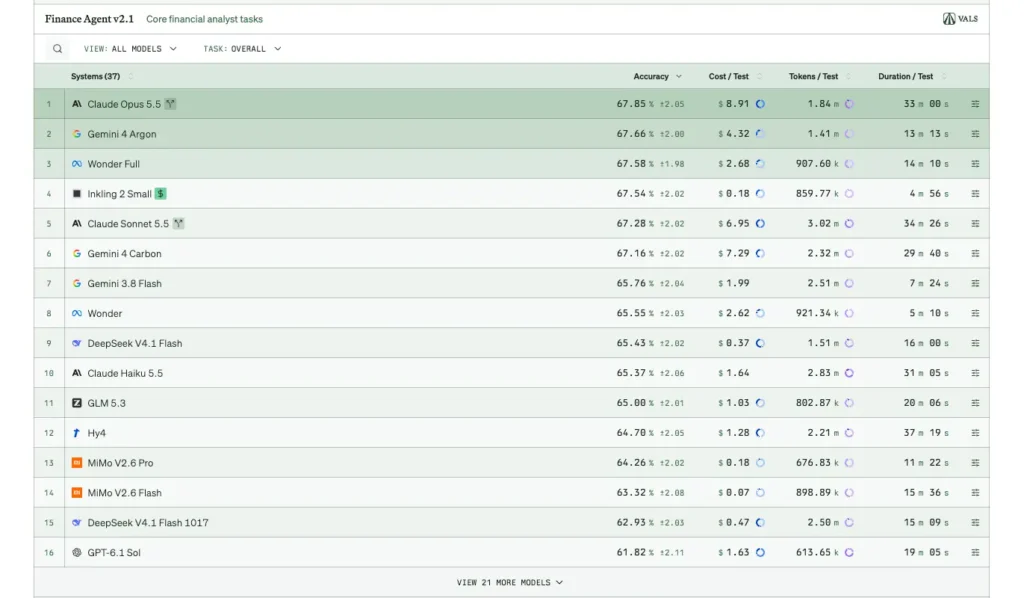
Image source: Vals AI
Gemini 3.8 Flash (65.76%) and DeepSeek V4.1 Flash (65.43%), the lower-cost and open-weight options, rank sixth and eighth, within about two points of the leaders.
Vals also publishes a Finance index that combines Finance Agent with an Excel modeling benchmark and a tax research benchmark.2 Gemini Carbon leads it at 67.05% ahead of Claude Opus 5.5 (65.59%), Gemini 4 Argon (64.89%), and Claude Sonnet 5.5 (64.53%).
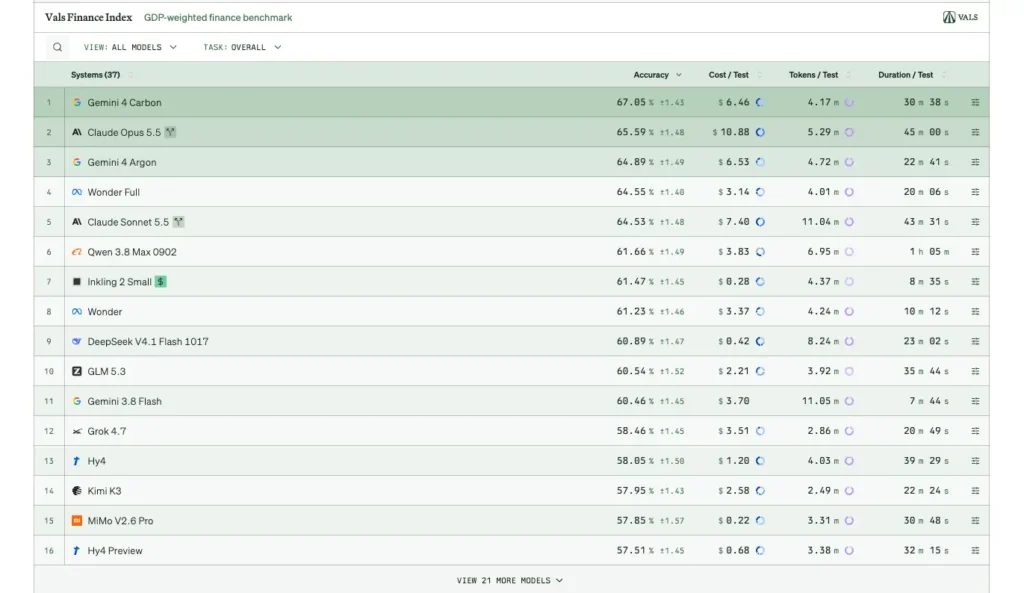
Image source: Vals AI
No OpenAI model placed in the Vals AI v2.1 top ten.
2. AI Multiple
AI Multiple tests financial reasoning on 238 hard questions from the Finance Reasoning dataset.3 Each question tests numerical reasoning through multi-step calculation with financial formulas. The latest update covers 96 models and tracks cost and output tokens next to accuracy.
Claude Opus 5.5 and Muse Wonder tied for the top score at 91.60% (218 out of 238 correct). Opus 5.5 did it at a cost of $3.25 for the full test, against $8.41 for Muse Wonder. GPT-5.6 Sol Pro and Gemini 4 Argon followed at 90.76%, then GPT-5.6 Sol at 90.34%. Cheaper models stay close. GPT-6.1 Terra scored 86.97% for $0.46, and Claude Haiku 5.5 scored 85.71% for $0.15. That is roughly five to six points below the top score at about one-seventh to one-twentieth of Claude Opus 5.5’s cost.
But token use does not predict accuracy. Grok 4.6 and GPT-5.6 Sol both scored 90.34%, but Grok used about six times as many output tokens (704,035 versus 117,735).
This benchmark has two limits: its dataset is public and may have appeared in training data, and it has not established whether the tie between Claude Opus 5.5 and Muse Wonder at the top holds across repeated runs.
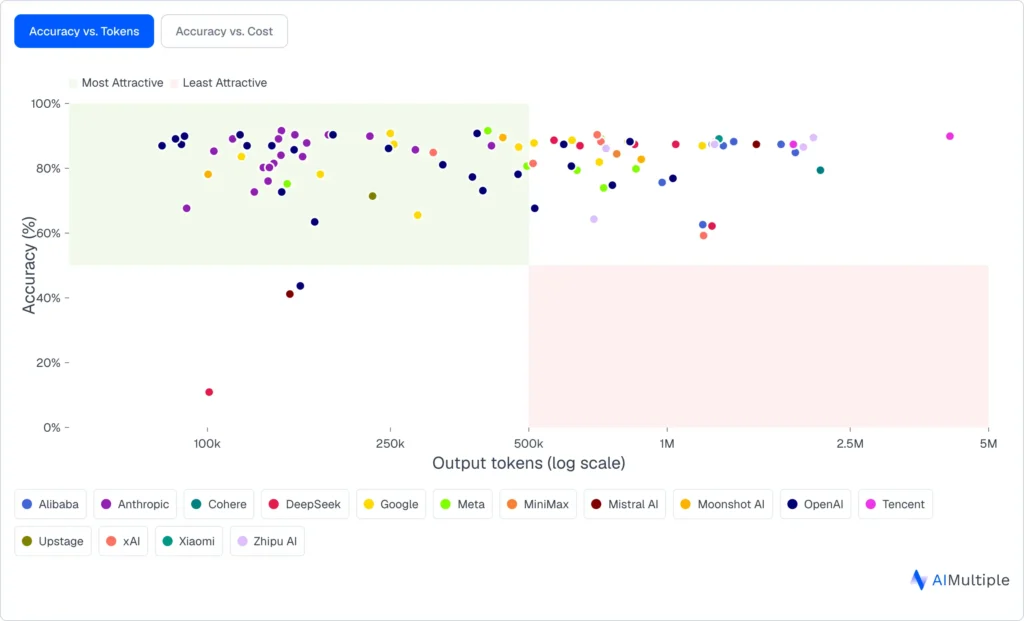
Image source: AI Multiple
3. BizFinBench.v2
BizFinBench.v2, from HiThink Research and Shanghai University of Finance and Economics, uses 28,860 questions drawn from real user queries in Chinese and US equity markets.4 It has eight offline tasks, such as financial quantitative computation, event logic reasoning, and financial report analysis. It also has two online tasks: stock price prediction and portfolio asset allocation.
The best model in the study, GPT-5, reached 61.5% accuracy, against 84.8% for financial experts. The authors say that falls short of what business use requires. The models tested include GPT-5, Gemini-3, Claude Sonnet 4, and Grok-4, so the paper predates the current generation. Read it as evidence of the gap between model and expert, not as a current ranking.
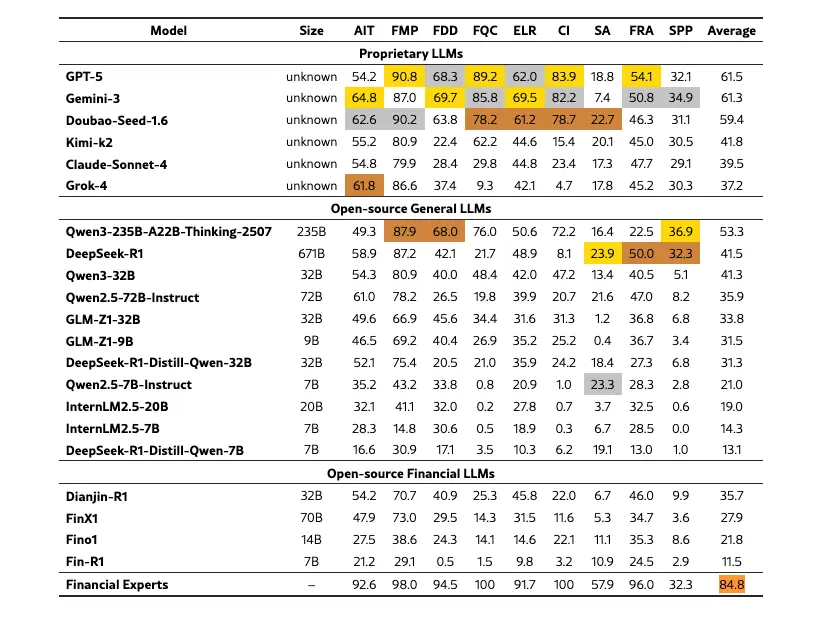
Image source: BizFinBench
4. FinGAIA
FinGAIA compares model outputs directly against human performance.5
It tested 10 models (nine closed-source and one open-source) across 407 finance-related tasks spanning securities, funds, banking, insurance, futures, trusts, and asset management.
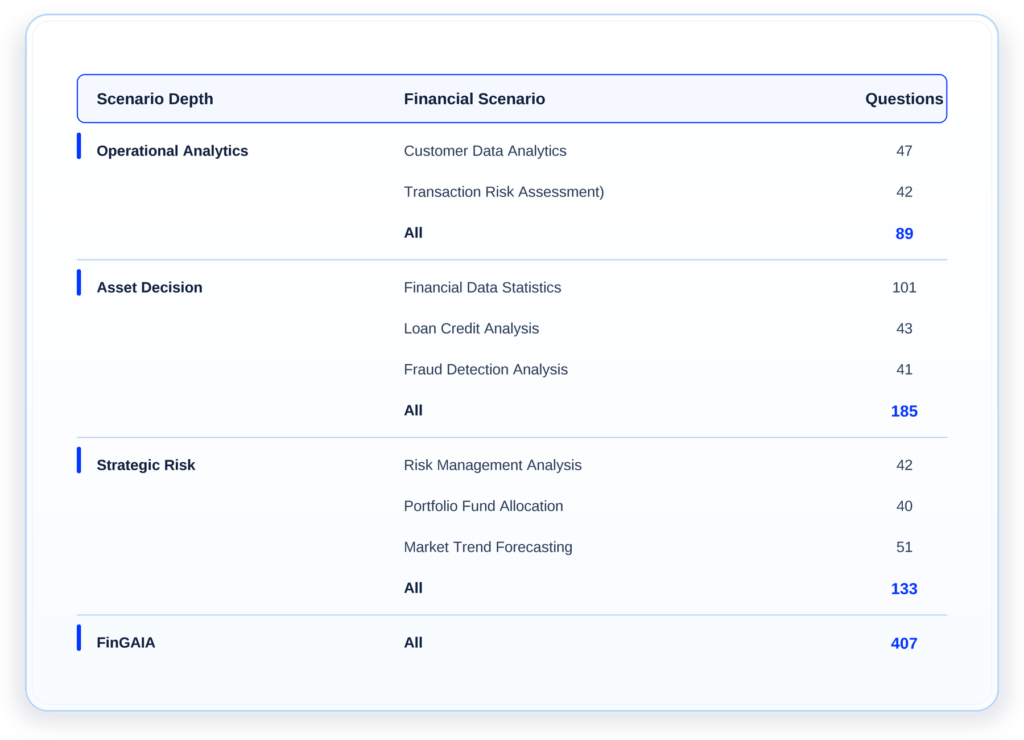
Table 2: Distribution of Financial Scenarios. This table systematically presents the distribution of FinGAIA tasks across three progressively complex financial scenario categories. Specifically, the Basic Business Analysis category contains 89 tasks, Asset Decision Support includes 185 tasks, and Strategic Risk Management covers 133 tasks, resulting in a total of 407 carefully annotated tasks. This structured presentation enables precise evaluation of the benchmark’s ability to simulate the increasing complexity of real-world financial environments through tiered task design. Image source: FinGAIA
ChatGPT (DeepResearch) achieved the highest overall accuracy in this evaluation, but its performance still lagged behind experienced human experts. This was particularly evident in strategic risk scenarios. The study also found that market forecasting and fraud detection remain difficult areas for most models, with ChatGPT showing comparatively stronger results in fraud detection but still achieving only 39.0% accuracy.
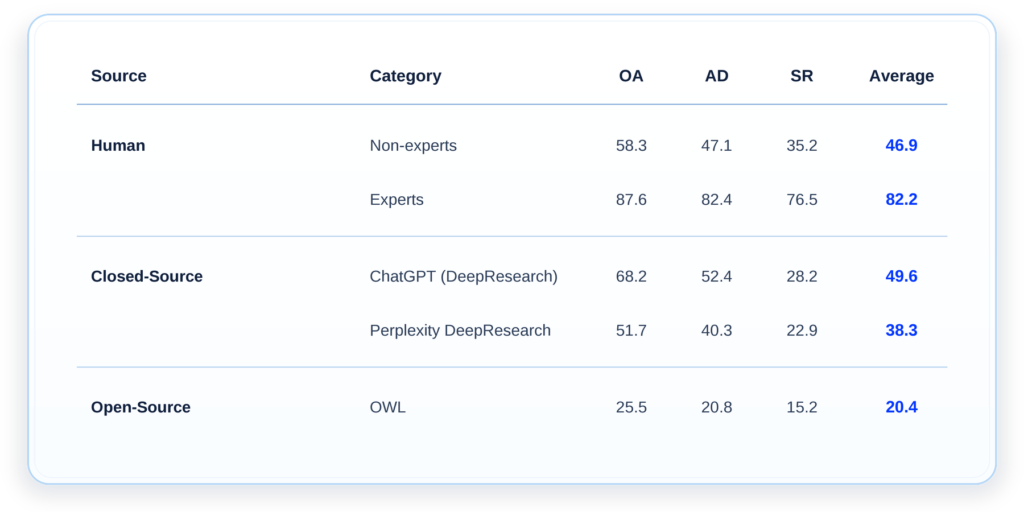
Table 4: Performance comparison across non-experts, experts and Agents. OA refers to Operational Analytics. AD means Asset Decision. SR represents Strategic Risk. Image source: FinGAIA
In zero-shot settings (when the model is evaluated without task-specific examples, fine-tuning, or additional configuration), the best-performing model reached an overall accuracy of 48.9%. While this exceeded the performance of finance undergraduates, it remained well below that of finance PhDs. The study dates from 2025, so its models are older than those in the first three benchmarks.
5. FinanceBench
FinanceBench (Patronus AI, Contextual AI, Stanford University) was one of the first financial question answering tests for LLMs, using real financial questions. It tested 16 leading models using 10,231 finance-specific questions grounded in publicly available materials such as SEC 10-Ks, 10-Qs, 8-Ks, earnings reports, and earnings call transcripts.6
GPT-4-Turbo combined with retrieval failed in 81% of questions, and Llama 2 failed at the same rate under similar conditions.
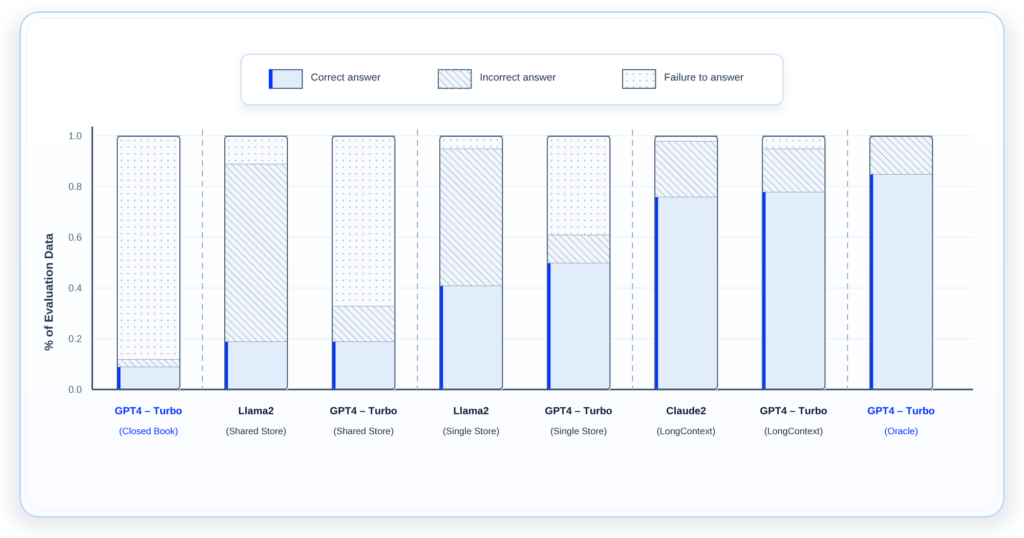
Figure 3: Performance of 8 model configurations on FINANCEBENCH human eval sample (n=150). The Oracle setting and the Closed Book setting are highlighted in red as these represent unrealistic evaluation scenarios that only serve as reference points. Image source: FinanceBench
Passing long documents directly into the model lowered failure rates to 21% for GPT-4-Turbo and 24% for Claude-2, though the authors noted this is often impractical because of latency, cost, and document size.
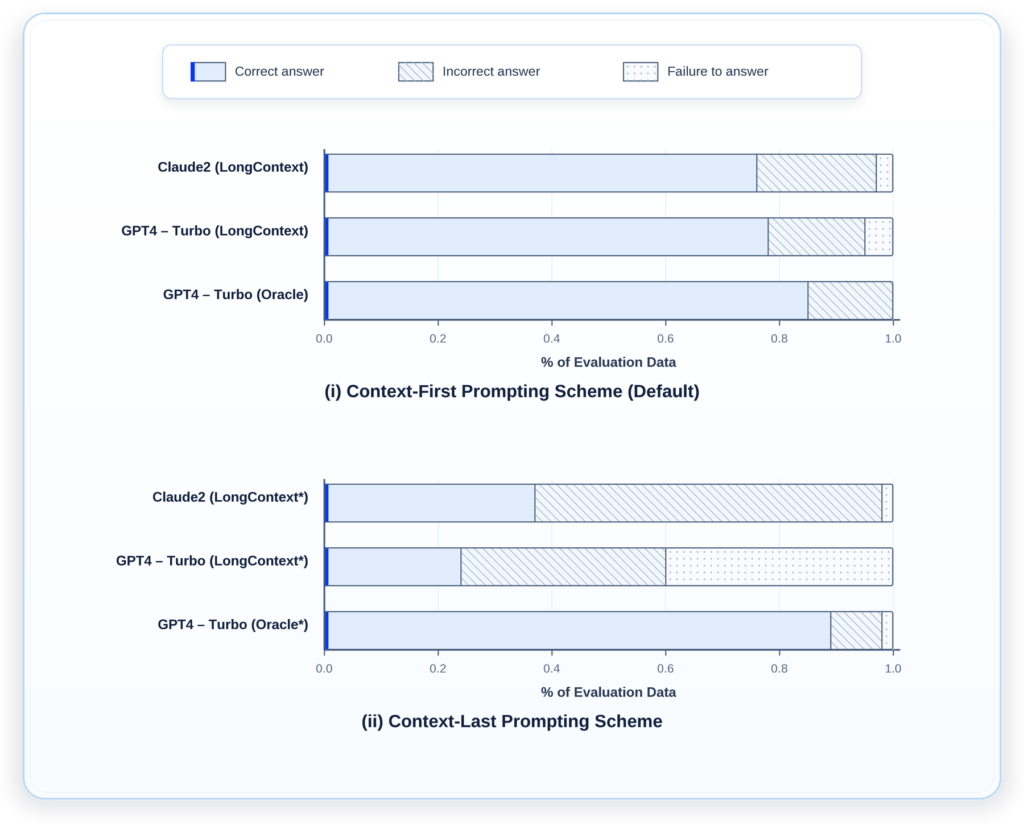
Image source: Finance Bench
These are 2023-era models, so the numbers do not describe today’s performance. The agent-based financial benchmarks above test the same weak points (retrieval and long filings) on current models.
Benchmark Signals For Finance LLM Selection (Based On The Studies Cited Above)
| What the benchmarks suggest | Strong models mentioned | What that means in practice | Notes / limits |
|---|---|---|---|
| Accuracy on finance agent tasks | Claude Opus 5.5, Gemini 4 Argon, Muse Wonder Full, Claude Sonnet 5.5, Gemini 4 Carbon | Better for workflows that combine retrieval, tool use, and analysis of company filings | From Vals AI Finance Agent v2.1. The top five are too close to name a winner. Scores are not comparable with earlier versions. |
| Accuracy on broad finance work | Gemini 4 Carbon, Claude Opus 5.5, Gemini 4 Argon, Claude Sonnet 5.5 | Better for teams whose work mixes research, Excel modeling, and tax questions | From the Vals Finance Index. Carbon access appears limited. |
| Accuracy on complex finance reasoning | Claude Opus 5.5, Muse Wonder, GPT-5.6 Sol Pro, Gemini 4 Argon | Better for multi-step calculations and logic-heavy analyst questions | From AI Multiple. The dataset is public and may have appeared in training data. |
| Cost and accuracy efficiency | GPT-6.1 Terra, Claude Haiku 5.5, Claude Opus 5.5 | Lower-cost tiers stay within roughly five to six points of the top score at a fraction of the price, so a cheaper model may meet your accuracy threshold | From AI Multiple. Cost and token use are per test run, not your production cost. More tokens did not mean higher accuracy. |
| Lower-cost and open-weight options | Gemini 3.8 Flash, DeepSeek V4.1 Flash | Close behind the leaders on agent tasks, which makes them candidates for high-volume or self-hosted use | From Vals AI Finance Agent v2.1. Open-weight models still need your own validation and governance. |
| Gap to human experts | No model closes it | Even the best models fall short of financial experts, so human review stays in the workflow | From BizFinBench.v2 and FinGAIA. Both tested models older than the current generation. |
| Retrieval and grounding reliability | No clear winner | Retrieval and tool use are often where answers fail, so budget for evaluation and guardrails | From the Vals AI agent tasks and FinanceBench. |
| Long-document “just put it all in the prompt” | Long context helped, but failures remained | Feeding whole documents can improve accuracy but may be too slow or costly at scale | From FinanceBench, which tested 2023-era models. |
What This Means for FSIs
While LLMs in finance can save time, accuracy is still uneven, especially when the task depends on retrieval, tool use, or multi-step reasoning.
The best-performing models tend to do well on structured reasoning and summarization, but even top models can fail when they have to pull the right evidence, follow a workflow, or operate over long, messy documents. For FSIs, this shifts the focus from “Which model is best?” to “Which model is best for this workflow, under these controls?”
That’s why model selection and governance need to be designed together. You want the most cost-efficient model that meets your accuracy threshold, wrapped in grounding, access controls, human approval gates, and auditability.
What to Know Before Choosing A Large Language Model for Finance
The model you choose will power your AI workflows, automation, agents, or agentic systems. It’s what interprets requests, reasons through problems, and generates responses. This means the wrong choice can have serious implications for cost efficiency, reliability, output quality, and security. Here’s what you need to know when choosing a model:
Align Your Model Selection With Your Use Case
Different models have different capabilities, so what works for one use case may not be optimal for another. Choosing the wrong model can lead to issues like:
- Unnecessary costs from over-provisioning if you don’t understand which model is suitable for your use case. For example, you might choose GPT-6 Astra for simple tasks like email summarization or market sentiment analysis, just because it is the most advanced model. But a lighter and more cost-effective model, such as GPT-6 Luna or Gemini 3.8 Flash, would have been a better option.
- Mismatching a model with your planned architecture. Let’s say you want to build a multi-agent system. A lightweight model like Claude Haiku 5.5 or GPT-6 Luna can handle routing and extraction steps, but for long-running or demanding agent work, Anthropic and OpenAI position their top models (Claude Opus 5.5 and GPT-6 Astra) as the stronger default.
- Capability gaps in everyday workflows. For example, document-heavy tasks like onboarding, KYC, policy review analysis, and more can break down if your chosen model has a limited context window. The model may cut off or ignore parts of a long PDF, leading to missed information and incorrect outputs.
Analyst tasks also differ in what they demand from a model. Equity research often means reading long filings and call transcripts, so context window size matters. Discounted cash flow work connects many calculations, so numerical accuracy matters more than speed. Scenario analysis repeats those calculations across several cases, which raises token use and cost. Budgeting tasks tend to be repetitive and high volume, so a lighter model may meet your accuracy threshold.
Whatever task you start with, define the workflow, the architecture, and the documents involved first, then choose the model that fits them.
Ensure Governance Because General-Purpose LLMs Aren’t Specific to Financial Services
Models from OpenAI, Meta, Anthropic, Google, and DeepSeek are not domain-specific financial LLMs (FinLLMs). They are general-purpose foundation models trained on broad datasets, meaning they aren’t purpose-built to understand financial instruments, firm-specific rules, or regulatory requirements. They also don’t know your internal data, clients, or processes, which means they can hallucinate or produce outputs that are not aligned with your internal standards.
While custom assistants (e.g., Custom GPTs in ChatGPT) let you configure instructions, connect internal documents or a vetted internal knowledge base, and integrate tools to improve consistency and relevance, they do not change the underlying model or eliminate hallucinations. They constrain behavior rather than retrain the model, so outputs still require validation. You still need to ensure strong data governance, cybersecurity controls, and access management.
Although fine-tuning uses additional machine-learning training to improve consistency and task-specific performance, it does not remove base model limitations. Fine-tuned models can still produce incorrect outputs. They can also introduce risk if training data is incomplete or biased. In highly regulated financial services use cases such as credit scoring, these models require stronger governance, including model validation, testing and monitoring, documentation, model risk controls, and clear approval pathways.
Embed Controls for Compliance
Models like GPT-6 Sol, Claude Sonnet 5.5 and Gemini 4 Argon can accelerate compliance tasks by summarizing financial statements, extracting key points, reviewing content, drafting regulatory materials, and supporting financial reporting.
However, they can’t replace formal controls or be allowed to function as a black box. To remain compliant, you still need transparent documented rules, clear financial decision logic aligned with CFO oversight, structured approval flows, human oversight, and audit trails.
Ensure AI Defensibility to Regulators
Strict compliance requirements around AI data security and privacy mean you’ll need to be able to defend your model to regulators.
You must be able to explain how your chosen model works, what data it can access, how you test it, and how you monitor it to ensure reliability.
Regulators will expect you to have strong governance, transparency, testing protocols, auditability, bias checks, fallback plans, and clear boundaries around model capability and risk.
When to Choose a Model In-House or Turn To An External Partner for Help
An in-house approach can work for low-risk, standalone tasks, such as drafting internal content or summarizing documents, where you don’t need to train or fine-tune a model on your own data.
But for more complex financial use cases, even just generating market insights to personalize client investment proposals requires evidence. This includes model performance on your real-world documents, its reliability in following tools and controls, what it costs at scale, and how you will defend it to auditors and regulators.
A consultancy can help with selecting a model by running a structured evaluation and translating results into a model choice you can justify. It can then support implementation by integrating the model with your systems, establishing governance frameworks, and applying prompt engineering for reliable, accurate outputs.
You’ll find that turning to an external partner for help is more effective if:
- You need a structured model evaluation. A partner can benchmark models on your workflows for accuracy, behavior, reliability, latency, and cost.
- You need a decision you can defend. Partners help provide evidence such as tests, thresholds, monitoring, audit logs, and change control that leadership, internal audit, and regulators expect.
- You need the right architecture-model match. Partners help choose the lowest-risk, lowest-cost setup that still meets your use case. This could mean any of the OpenAI, Google, Meta, Anthropic, or DeepSeek models.
- You want faster time-to-value without creating new risk. Partners with experienced delivery in regulated environments reduce delays, performance issues, and control gaps, while getting you from POC to production in weeks instead of months.
Even if you have the in-house capability to choose and integrate models, you can still benefit from external support. For example, external specialists can help validate and compare model options, assess trade-offs around accuracy, AI cost, and risk management. They can also deliver quick results while your internal team stays focused on its core work.
If you choose this route, the next step is selecting an AI enablement partner that can support you in meeting your regulatory, operational, and strategic goals.
Why Choose and Integrate Your LLMs with Neurons Lab
Neurons Lab helps Financial Services firms move from AI experimentation to AI adoption at scale.
As an AI enablement partner serving organizations across the US, Europe, and Asia, Neurons Lab combines executive training, AI adoption programs, and custom AI agent builds to support secure, practical deployment. Clients build operational AI capability aligned with core workflows, governance, and business priorities.
Trusted by 100+ clients, including HSBC, Visa, and AXA, we’ve accelerated AI integration in banking, wealth management, private equity, investment firms, fintechs, and other highly regulated industries.
Here’s how we help you choose the best LLMs for finance and financial analysis and get the most out of them:
Get Hands-On Guidance on Choosing the Right Model and Custom Solutions from an AI-Exclusive Partner
By partnering with our AI-exclusive consulting firm, you’ll have the hands-on support you need across the entire AI lifecycle. This means you’ll have help whether it’s choosing the right model, setting up an AI strategy and roadmap, building PoCs, or deploying and scaling production-grade solutions.
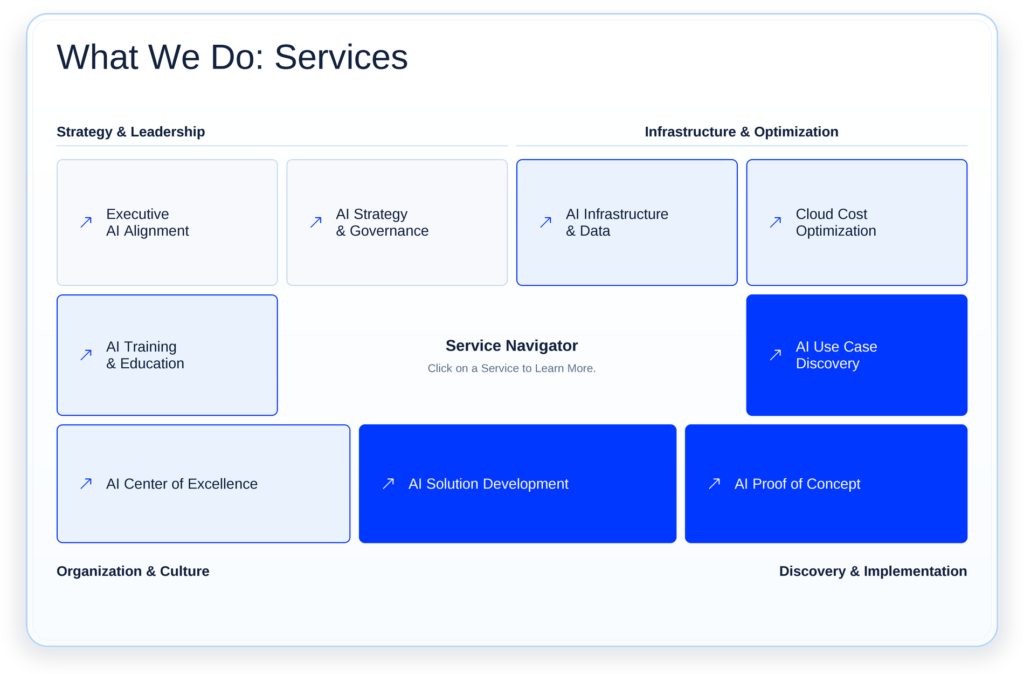
Neurons Lab’s end-to-end AI development and consultancy services
Our co-innovation approach also ensures that you can build your own AI development team or train your existing teams. Your teams will learn AI agent evaluation frameworks (AI evals), prompt engineering, and other essential skills to work confidently with AI through our workshops and practical resources. This ensures you develop internal capability that prevents vendor lock-in, empowering your firm for long-term success.
Securely Adapt Your Model With A Systems Integrator Specialized in Financial Services
On their own, general-purpose models struggle to reliably handle complex workflows without proper grounding, tool access, and governance. This often leads to generic or inconsistent outputs and higher compliance risk, particularly when models are not connected to authoritative internal data or controlled systems with auditability and human oversight in place.
As a systems integrator with deep financial services expertise, we understand both FSI workflows and the industry’s complex regulatory landscape. This means you’ll be able to adapt your AI models for use cases, such as insights generation for financial analysts, automated market trend and investment analysis for portfolio managers, or a copilot for finance teams or relationship managers.
From building retrieval-augmented generation (RAG) systems on your proprietary data to fine-tuning models for specialized tasks and designing role-specific workflows with agents, guardrails, and prompts, you’ll have expert support throughout.
You can also be confident your custom AI business solutions are backed by governance frameworks, prompt engineering best practices, and data foundations aligned with regulatory standards, such as GDPR, OCC, MAS, and ISO/IEC 27001, making them deployable at scale.
For example, if you’re a wealth management firm, you can create a single conversational interface for your relationship managers that uses your chosen LLM together with a custom agentic AI system to pull from internal systems, market data, and compliance-approved sources. Instead of consulting multiple sources, your finance professionals can simply prompt this system to receive instant, source-backed insights that would otherwise take hours of manual research.
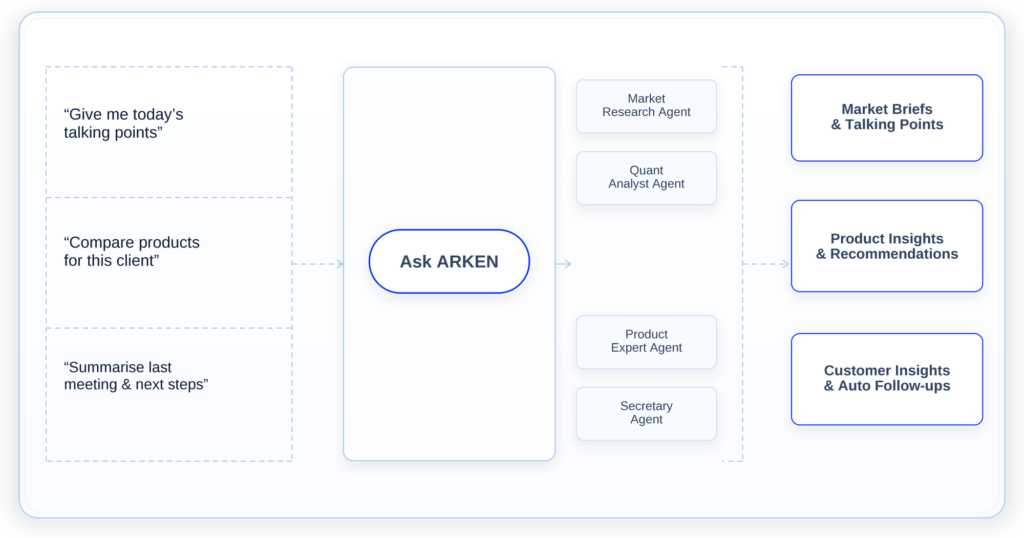
Neurons Lab’s custom agent transforms simple prompts into market briefs, product insights, and client follow-ups, enabling more personalized recommendations
A large Asian bank is currently using a solution like this. The results include 30% more client capacity per wealth manager without adding headcount, more consistent client engagement, and improved NPS scores of 15 to 20%.
Fast-Track AI Deployment With Boutique Agility And AI Accelerators
With our global network of 500+ engineers with expertise in RAG, orchestration, multi-agent systems, and MLOps, you’ll be able to deploy your model quickly without compromising accuracy, security, or compliance.
Our boutique structure further enables faster decision-making and delivery of AI integration paths and unified data foundations. And by using customizable accelerator solutions built on tested code, reusable components, and pre-built integration and reasoning layers, you’ll be able to adapt out-of-the-box models to your systems and go to production in 2 to 4 months.
Work with an AI And Financial Services Expert that Helps You Choose and Integrate The Best Model
Model choice is critical for performance, cost efficiency, compliance, and long-term scalability. As we’ve covered, the best model depends entirely on your use case: simple workflows may need lightweight models, while complex tasks, multi-agent systems, or long-document analysis require more powerful models with larger context windows and stronger reasoning.
Whatever provider you choose, your model must meet strict requirements around data privacy, security, auditability, and regulatory compliance. Beyond choosing a model, there’s still the complexity of governance, testing, monitoring, and ensuring an AI-driven solution aligns with your systems and fits your existing workflows.
That’s why working with an experienced AI and financial services enablement partner can set you up for success. The right partner understands the FSI regulatory environment, designs compliance into the solution from day one, and knows how to test, build, and deploy LLM-powered systems that are secure, compliant, and work as intended.
If you want to move beyond the limitations of out-of-the-box models and build compliant custom AI solutions that meet your unique needs and drive measurable results, contact us today.
FAQs
How do large language models like OpenAI’s GPT-6 series work in finance?
LLMs in finance, like OpenAI’s GPT-6 models, generate responses by predicting the next piece of text based on patterns they learned during training. For example, in finance, GPT-6 Sol might generate a summary of a quarterly earnings report, including the balance sheet, or draft an investment commentary by identifying and reproducing patterns common in financial reports and market analysis.
Is there a finance-specific LLM?
There isn’t a separate large language model specific to finance or available as a standalone product; there are finance-focused versions (sometimes called FinLLMs) and applications, such as BloombergGPT or Claude for Financial Services.
Can a large language model access or learn from my private financial data?
No, a model can’t access or learn from your private financial data unless you grant it access to your private data or intentionally fine-tune it based on your own training dataset. With pro-level accounts in LLM tools like Claude or ChatGPT, your data is protected by enterprise-grade privacy, access controls, and governance, and is not shared or used to retrain base models.
Sources:
- https://www.vals.ai/benchmarks/fabv2-1
- https://www.vals.ai/benchmarks/finance_index
- https://aimultiple.com/finance-llm
- https://arxiv.org/html/2601.06401v2
- https://arxiv.org/html/2507.17186v1
- https://arxiv.org/pdf/2311.11944
- https://openai.com/business-data/
- https://blog.google/innovation-and-ai/models-and-research/gemini-models/introducing-gemini-4-carbon/
- https://www.lindy.ai/blog/muse-wonder
- https://openai.com/gpt-5/
- https://developers.openai.com/api/docs/models
- https://ai.google.dev/gemini-api/docs/latest-model
- https://research.meta.ai/blog/muse-spark-open
- https://platform.claude.com/docs/en/about-claude/models/overview
- https://platform.claude.com/docs/en/models/opus-5-5/overview
- https://platform.claude.com/docs/en/models/sonnet-5-5/overview
- https://platform.claude.com/docs/en/models/haiku-5-5/overview
- https://huggingface.co/meta-models/Muse-Spark-Open-816B-A42B
- https://huggingface.co/meta-models/Muse-Spark-Open-816B-A42B/blob/main/LICENSE.md
- https://huggingface.co/deepseek-ai/DeepSeek-V4.1-Flash-1017
- https://research.meta.ai/blog/muse-wonder
- https://www.deeplearning.ai/the-batch/meta-releases-wonder-opens-spark
- https://venturebeat.com/technology/meta-unveils-muse-spark-open-the-new-top-u-s-open-weights-model-and-it-runs-on-two-paired-mac-desktops