
If you’re researching machine learning (ML) for financial fraud detection, it’s likely that:
- Your current rule-based approaches push too many legitimate transactions into manual review, driving up analyst hours per case and still can’t keep up as fraud tactics change, undermining new client trust and damaging existing relationships.
- You also need to ensure auditability and explainability across all fraud decisions for your teams and regulators.
But what’s the best way to solve these problems with ML: a fraud-specific off-the-shelf tool, extending the artificial intelligence (AI) systems you already have in place or building one from scratch?
The most important thing isn’t so much the tool or model you use, but the data that feeds your ML system, whatever the approach. As an AI-exclusive enablement partner specialized in financial services, we go into depth on what this looks like in practice and what financial services firms need to put in place for ML to be effective for fraud detection.
In this article:
- How to Make Machine Learning Effective for Fraud Detection in Financial Transactions
- The Key Types of Fraud Machine Learning Can Detect
- What To Consider Before Implementing Machine Learning for Financial Fraud Detection
- How Neurons Lab Helps FSIs Get Started with ML for Financial Fraud Detection
- How a Global Insurance Leader Built A Custom Claim Analysis Solution To Combat Fraud
- FAQs
Want to get started with machine learning for fraud detection in your financial services firm? Neurons Lab can help. Get in touch with us today.
How to Make Machine Learning Effective for Fraud Detection in Financial Transactions
ML works differently from the traditional rule-based systems most financial firms already use.
Instead of only matching activity against a fixed set of conditions, it can learn to recognize confirmed fraud patterns from historical cases, or learn what normal looks like across your data, and flags any unusual deviations.
That second capability, known as anomaly detection, is what lets machine learning catch fraud even when the pattern hasn’t shown up in your data before. This is something a rule-based system, or a model trained only on past fraud, can’t do on its own.
But the model itself is only one part of what makes this work. How well you turn raw transaction data into the right signals is what separates a strong ML system from a weak one.
Here’s how you can build a strong machine learning system for fraud detection:
1. Define Your Business Problem and Adopt a Hybrid Detection Approach
Start by identifying the specific problem you want ML to solve since this will lead you toward the right detection approach. This can range from lowering your alert rate and raising precision at review capacity to catching unfamiliar attacks and detecting suspicious activity faster.
In many cases, solving it well means combining two detection methods instead of just choosing one:
- Classification, which uses supervised models trained on labeled data from confirmed fraud cases to recognize known patterns.
- Anomaly detection, which uses unsupervised models to learn normal behavior from unlabeled data and flag activity that differs from it, even when nothing similar has been seen before.
Combining the two also solves a common structural issue with fraud data, which is class imbalance: confirmed fraud that typically makes up a fraction of a percent of all transactions. With only a few confirmed cases to learn from, a classification model struggles to see beyond those examples and is less reliable in catching fraud that doesn’t resemble those specific cases. Since anomaly detection doesn’t depend on having enough confirmed fraud cases to train on, it becomes a necessary counterweight to classification.
This is how a hybrid approach lets you catch what you’ve already learned to recognize while staying alert to what’s new. Your specific goal will determine how much weight each side gets. For example, raising precision at your team’s review capacity on already-known fraud leans more toward classification, and catching unfamiliar attacks leans more on anomaly detection. Neither approach replaces the other, but their balanced use determines the data, features, models, and success measures you’ll need going forward.
2. Understand and Combine your Data for More Accurate Fraud Detection
Connecting as much data as possible across your systems gives a machine learning system more context to work with than analyzing any single source alone.
The main types of data to focus on are:
- Tabular: Transaction amounts, locations, timing, and other structured properties
- Graph: Relationships between accounts, people, devices, or cryptocurrency wallets
- Sequential: Customer login, session, and transaction behavior over time
- Text: Documents submitted for KYC and applications
- Image: Identification documents and insurance claim photos
- Audio and video: Voice or video deepfakes, speaker verification, and call centre activity
That context is what makes detection more accurate. A transaction that looks normal on its own may only become suspicious once it’s compared against other connected data.
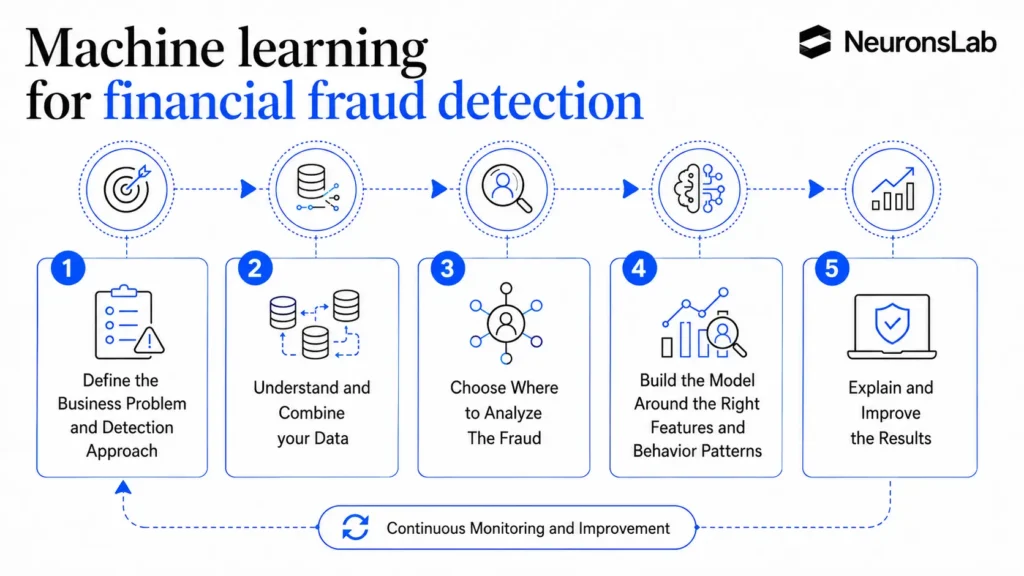
3. Analyze Fraud at the Level Where It’s Visible
Fraud isn’t always detectable in a single transaction on its own. It may only become visible once you look beyond the transaction itself, at levels such as:
- Entity level, which considers the specific account or person the transaction is tied to
- Relationship level, which looks at whether the account connects to different entities or even known bad actors
- Sequence level, which shows how that transaction or customer activity unfolds over time using the sequential data identified in step 2.
For example, money laundering often needs both a relationship-level and a sequence-level view at once, since it only becomes visible once you see unusual transfers moving across a network of connected accounts over time. These behaviors then become the basis for the next step, building features: the input variables used by ML models to make a prediction or decision.
4. Build the Right Features into the Model
When you know which behavior you want to detect, turning the relevant raw data like a transaction amount or timestamp into the right features ensures your model can lower your false positive rate, improve money laundering detection, or catch unfamiliar fraud schemes.
That might mean how far a purchase is from a customer’s usual location, how much a transaction differs from their normal spending, or how soon a transaction follows a login, a pattern common in account takeover.
Constructing signals like these is the hard part. Most off-the-shelf tools focus on the model, but models are the commodity because anyone can license one. The differentiation happens in feature engineering, deciding which signals reveal fraud and building them from your own data.
5. Keep the Model Accurate as Fraud Evolves
Once the model is live, ongoing feedback and continuous performance monitoring help keep detection accurate as fraud and customer behavior change.
In practice:
- Each transaction, account, or case is given an interpretable risk score.
- Investigators record whether the alert identified fraud, produced a false positive, or flagged unusual but legitimate behavior.
- They feed these outcomes back into the system to give future model updates better examples to learn from.
- It then becomes clearer when customer behavior, incoming data, or fraud tactics start moving away from the patterns the model learned.
This feedback loop gives you two things: a clear record of what the model predicted and what actually happened, so investigators can understand why the system flagged something, and a signal for when the model needs updating or retraining.
It’s worth planning for one complication ahead of time: fraud confirmation rarely happens instantly. A transaction is often confirmed as fraud weeks later, such as when a customer disputes it, a chargeback occurs, or an investigator closes a case. That means when you retrain the model, the transactions used most likely won’t have confirmed outcomes yet, so their labels can’t be fully trusted.
Teams can handle this either by holding back the most recent batch of transaction data until labels have had time to settle, or by using investigators’ provisional calls as a stand-in signal until the confirmed outcomes arrive.
The Key Types of Fraud Machine Learning Can Detect
Which data, level of analysis, and detection approach works best all depends on the type of fraud you’re dealing with. Here’s how that plays out across the fraud types financial services firms deal with most.
Payment Fraud and Account Takeover
Changes in how a customer normally pays, logs in, or uses their account can signal fraud before an individual transaction looks obviously suspicious. ML uses pattern recognition, predictive analytics and adaptive learning to detect those changes as customer behavior evolves:
- Payments fraud: ML supports real-time analysis by comparing transactions with previous spending behavior, location, device, and other signals to spot payments that fall outside a customer’s normal activity. This gives firms a chance to stop suspicious payments before funds leave the account.
- Account takeover: Device information, session activity, and other behavioral biometrics give ML signals it can use to detect unauthorized access, even when valid credentials are used. Firms can then catch attacks before a fraudster locks a customer out or drains their account.
Identity, Onboarding, and Application Fraud
ML spots inconsistencies or signs of manipulation across the information customers submit. For example:
- Identity and onboarding fraud: By analyzing KYC documents and images during identity verification, ML can uncover identity theft, forged documents, or mismatched information. That way, firms avoid onboarding fraudulent customers who go on to cause losses down the line.
- Application fraud: Differences between an application and its supporting records give ML signals it can use to identify misrepresented identity or risk. Firms can then avoid losses from approving loans, mortgages, or other products based on false information.
Money Laundering, Mules and Sanctions Evasion
Suspicious financial activity often only becomes visible across several accounts or transactions. ML can connect activity across these relationships and sequences to surface what individual transaction checks may miss.
- Money laundering: Looking across transaction sequences and relationships between parties, ML can expose unusual fund movements firms typically can’t see when viewing transactions separately.
- Money mules: ML flags accounts linked to suspicious parties or unusual patterns of incoming and outgoing transactions. This helps firms stop funds from moving further through mule networks.
- Sanctions evasion and terrorist financing: By mapping transactions and relationships across parties, ML can uncover links to sanctioned entities, restricted jurisdictions, or suspicious networks. Firms can then review potentially illicit transactions before funds reach the intended recipient.
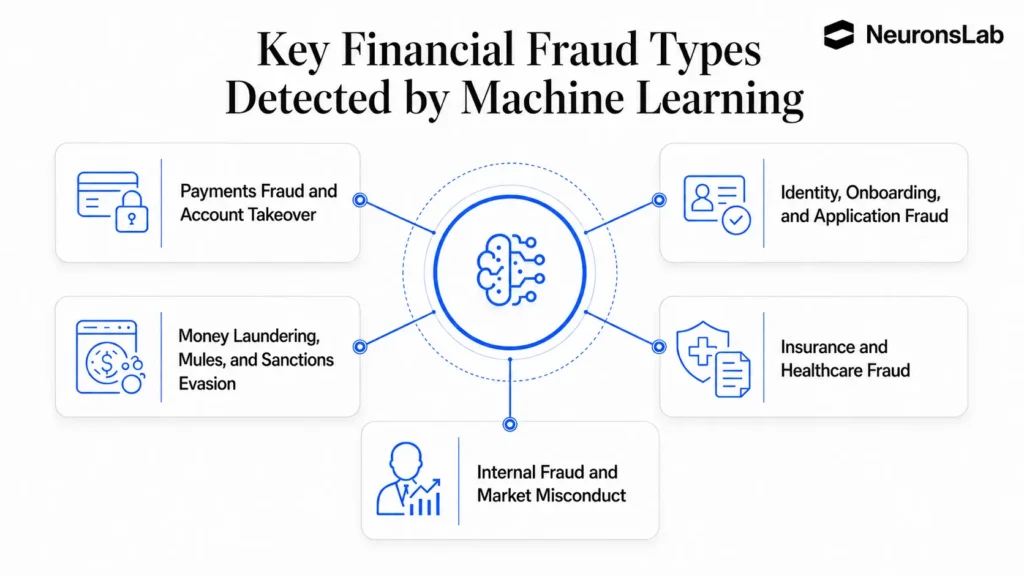
Insurance and Healthcare Fraud
Fraud tends to show up as a mismatch between what a customer reports and the documents, images, history, or other evidence supporting it. ML analyzes these sources at scale to find inconsistencies:
- Insurance claims fraud: Claim details, supporting documents, and previous activity give ML several sources to compare for false information or altered evidence. This helps firms spot fake claims sooner and reduce losses from fraudulent payouts.
- Insurance application fraud: By comparing application data with historical or external records ML flags when applicants may have misrepresented their identity or risk. This reduces the chances of issuing policies or setting premiums based on false information.
- Healthcare fraud: ML compares claim histories, billing data, patient records, and supporting documentation to spot cases where claimed treatments or services don’t match the available evidence. Firms can then prevent payouts for false or unsupported treatments.
Internal Fraud and Market Misconduct
Employee access, trading records, account activity, and relationships between participants often carry the behavioral context needed to identify activity outside normal internal or market behavior. With ML, firms can analyze these signals together to uncover unusual behavior and connections that may need investigation.
- Internal fraud: After learning normal patterns for employee access and account activity, ML flags unusual transactions or behavior. Firms can then stop internal fraud in its tracks and reduce losses from employee misuse.
- Market manipulation: Using transaction sequences, participant relationships, and activity across several accounts, ML can reveal coordinated behavior. This helps firms shut down manipulation schemes before they distort the market or trigger regulatory action.
- Insider trading and accounting fraud: ML identifies patterns or connections that differ from normal trading or financial activity. As a result, firms can catch misconduct early and limit the financial and reputational damage it causes.
Emerging fraud: Deepfakes and Social Engineering
Audio, video, voice, and interaction data can contain signs of impersonation that conventional identity checks miss. ML can compare those signals together to detect synthetic media or suspicious behavior during an interaction.
- Voice and video deepfakes: By analyzing speech patterns, voice biometrics, and videos for artifacts consistent with synthetic or manipulated media, ML helps verify that the person on a call or video is who they claim to be. That way, firms can stop deepfake-driven account access or high-value transaction approval.
- Social engineering: To catch manipulation attempts before agents mistakenly approve unauthorized actions, ML analyzes call audio and interaction patterns for signs of impersonation or pressure.
Across all these fraud types, tactics continue to evolve. Unlike static, rule-based systems, ML helps firms keep pace with these changes and move from reactive to more proactive fraud defence. But what do firms need to be aware of before putting machine learning into practice?
What to Consider Before Implementing Machine Learning
Understanding how ML works for fraud detection is one thing. Putting it into practice is another, and it comes back to your data. Here’s what needs to be true about your data, your existing rules, and your governance before an ML system can deliver.
Get Your Data Quality and Labels Right From the Start
Even a strong detection approach and well-chosen features can’t outperform bad underlying data. Before building a system, it’s important that the data you rely on is accurate, consistent, and complete.
This means checking whether confirmed fraud cases are labeled consistently across teams and systems, whether records for the same customer or account line up across different data sources, and whether teams understand what a given field means and how reliable it is.
For example, if one team labels a case “confirmed fraud” while another logs a near-identical case as “false positive” for inconsistent reasons, a model trained on that history learns the wrong lesson from both.
Poor data quality doesn’t just slow implementation down. It means building a system on a foundation that can’t be trusted, no matter how strong the model or features end up being.
Use Machine Learning Alongside Existing Rules
Your existing fraud rules still have value, even when you introduce machine learning. Having both running at the same time allows the system to catch known risks while also looking for unusual behavior and new fraud patterns.
For example, a rule might flag any bank transfer over $10,000, while a model can catch several $9,000 transfers spread across multiple accounts to stay below that threshold.
Removing established rules too early can affect operational efficiency, weaken current controls, and leave gaps in your firm’s fraud defences.
Design Governance and Explainability From The Start
Building governance and explainability into the system from the start makes it easier to trace decisions, apply the right controls, and keep a clear record of how each case was handled.
For example, if your system flags a P2P transfer as possible money laundering, investigators must be able to see which signals influenced the risk score. They should also be able to record the final outcome and show exactly how the case was handled.
Trying to retrofit these controls later on can weaken detection and make it harder to defend fraud and AML decisions to regulators.
Bringing these elements together is where financial services firms struggle. Hybrid detection, clean and labeled data, the right features, and governance, all need to be coordinated across fraud, compliance, and data teams that don’t usually work in the same way.
This is where a partner with both financial services expertise and machine learning experience can make the difference, connecting these pieces into one working system while making sure your own team can run it going forward.
How Neurons Lab Helps FSIs Get Started with ML for Financial Fraud Detection
For many financial services firms, the challenge lies in deploying an effective, compliant fraud detection system. Neurons Lab closes this execution gap by guiding firms through the process from initial planning to implementation.
As an AI enablement partner serving organizations across the US, Europe, and Asia, Neurons Lab combines financial services expertise with AI engineering, delivering executive training, AI adoption programs, and custom AI agent builds to support secure, practical deployment.
Clients build operational AI capability aligned with core workflows, governance, and business priorities. Trusted by 100+ clients, including HSBC, Visa, and AXA, we’ve accelerated AI integration in banking, wealth management, private equity, investment firms, fintechs, and other highly regulated industries.
Partnering with us helps you:
Define Your Business Problem and Adopt a Hybrid Approach With FSI Experts in Machine Learning
Adding ML to your systems can be challenging when you haven’t clearly defined your business problem or the right fraud detection strategy. Neurons Lab makes the process easier by helping you shape a hybrid approach around your specific needs.
Our financial services and AI experience means you work with a partner that understands both ML and regulated financial services workflows. As a result, we can help you get started with AI for financial fraud detection based on our expertise and a deep understanding of your business strategy and needs.
Through our tailored AI adoption program, you identify which problem to address first, such as missed fraud slipping through, an alert rate that’s burning through your review capacity, slow detection, or unfamiliar attacks. This keeps investment focused on the areas where machine learning can strengthen fraud detection most.
Our experts help you assess the quality and availability of data across your systems so you can plan around it. We also help you determine how much your system should lean on classification versus anomaly detection for your specific problem. That way, your system is built around the signals you have and weighted for the fraud you’re trying to catch.
In this phase, you’ll also decide how much of your existing rule-based system should keep running alongside ML, since removing established rules too early can leave gaps in your fraud defenses that a new model hasn’t yet learned to cover.
Mapping the required integrations across your existing tools and processes is a key part of your adoption program. It gives you a clear view of how machine learning will fit into your current fraud operations before development begins, reducing the risk of disconnected systems or unnecessary workflow changes.
You also define the scope, requirements, and measurable outcomes upfront. This reduces the risk of investing in the wrong system, and allows your existing operations to keep running as expected.
If you need help in putting your newly defined ML system in place, you can choose to use our forward-deployed engineers who embed directly with your teams. This speeds up time to value and avoids handing off a finished system your team doesn’t know how to use. It also removes the lock-in risk of buying a vendor tool you can’t maintain. Instead, knowledge transfers continuously during the build, so your team can operate and extend the system on their own once we step back.
Lower Your Alert Rate and Catch Evolving Fraud by Building Around Your Own Data
Like many financial services firms, your current fraud systems may be driving up analyst hours per case and still struggling to keep up with evolving fraud tactics. Once you’ve decided on the right hybrid balance, Neurons Lab helps you build the actual ML system around it, starting with your data and feature engineering.
Through custom AI development, we prepare and connect the data identified during the adoption discovery phase to make detection accurate. This includes combining established rules with anomaly detection, so your existing controls and the new model work together.
We then engineer the features that help your model separate genuine fraud from legitimate activity. The system can then raise precision at your team’s review capacity, detect known and emerging threats, and score suspicious activity in real time. That way, your teams act sooner and move from reactive to more proactive fraud detection.
With our production-grade delivery, we also help you build a feedback loop. Teams learn to track detection performance continuously, using accuracy benchmarks and evaluation checks to catch model drift before it erodes precision at review capacity or misses more fraud. This keeps detection reliable as fraud tactics change.
Keep Every Fraud and AML Decision Explainable and Audit Ready
Every AI-assisted fraud or AML decision has to be explainable and traceable, not just to a general auditor but to your own compliance and risk teams. Neurons Lab helps you stay compliant by putting governance, compliance, and safe AI usage controls in place.
You get full decision traceability, so investigators can see the risk score assigned to each case, which signals influenced it, which data sources were used, which policy was applied, and what the context was at the time. This gives your compliance and risk teams a full audit trail for regulators, not just a general explanation after the fact.
With role-based governance, you let senior fraud, compliance or risk leaders work with more automation while junior investigators get human review gates on sensitive decisions. This gives you greater control over how much autonomy users have at each seniority level.
Your underlying system is also built around requirements and standards relevant to financial services, including GDPR, ISO/IEC 27001, the transparency and human oversight obligations the EU AI Act places on high-risk use cases, and expectations from regulators such as the OCC, FCA, and MAS, with data kept within secure environments.
How a Global Insurance Leader Built A Custom Claim Analysis Solution To Combat Fraud
At a global insurance firm, medical officers manually reviewed treatment claims for procedures, medications, and diagnoses. This created inconsistencies in how international clinical standards were applied and allowed some fraudulent claims to go undetected.
Neurons Lab built a custom medical claims analysis system that:
- Scores each treatment element, comparing procedures, medications, and diagnoses with international guidelines and patient data.
- Explains the level of risk, providing color-coded risk scores, plain-language reasoning, and citations to the relevant clinical guidelines.
- Keeps medical officers in control, allowing them to review and refine the system’s assessments and create a feedback loop that improves performance over time.
As a result, medical officers now spend less time reviewing each treatment element and claim.
The insurer has also improved its ability to detect fraudulent claims. This shows how the right ML system that’s custom-built for your industry and use case can help you identify more fraud more accurately while reducing the manual burden.
Work With an AI Enablement Partner That Supports ML Deployment From End to End
Effective machine learning for fraud detection requires a system built around your fraud risks, data, features, workflows, controls, and teams. Set up the right way, this system can help you cut fraud losses, ease pressure on your fraud teams, protect customer trust and support regulatory compliance.
Neurons Lab combines AI and financial services expertise to support implementation end-to-end. We help you define the problem, prepare and connect your data, and engineer the features that make ML-powered fraud detection work. We then build the system with governance and explainability in place from the start, train the teams who will use it and establish the processes needed to monitor and improve it after deployment.
The result is a custom fraud strategy and system built around how your firm operates, with the knowledge and controls in place to maintain, adapt, and scale as fraud tactics evolve.
If you are ready to build machine learning into your fraud operations with an enablement partner specialized in financial services and AI, book a call with Neurons Lab.
FAQs
When should financial services firms use deep learning versus traditional machine learning for fraud detection?
Financial services firms should use traditional machine learning when working with structured transaction, customer, and account data, since it relies on features you can define and explain clearly to a regulator. For less structured data like KYC documents, claim photos, audio, or video, deep learning is more suitable as it can better detect forged documents or deepfakes.
What is an example of machine learning for financial fraud detection?
One example is using machine learning to detect fraud types like account takeover, which are hard to spot because the credentials used are entirely legitimate. A model can analyze login, device, session, and transaction signals together to identify activity that differs from the customer’s usual behavior and flag a potential takeover before further unauthorized activity occurs.
How does machine learning detect fraud in financial transactions?
Machine learning analyzes transaction and customer data to learn normal behavior. It can use unsupervised learning to flag unusual activity or supervised learning to recognize known fraud patterns from labeled examples. It can also use network analysis to assess relationships between accounts and spot suspicious connections or activity that may not stand out in a single transaction.
How should financial institutions choose a machine learning platform for fraud detection?
Financial institutions should start by defining the problem and understanding their data, rather than starting with a model. From there, the right platform combines classification and anomaly detection, and works alongside your existing rules rather than replacing them. It also integrates with existing systems, and produces interpretable risk scores that support performance monitoring and updates as fraud patterns change.