
If you’re a PE firm, investment bank, asset manager, or hedge fund looking to see whether Hebbia or Rogo can help speed up your analyst and deal team workflows, you might already know these two AI platforms are built for different jobs.
- Hebbia is designed for deep, multi-document research and due diligence at scale.
- Rogo is built for the day-to-day execution of investment banking workflows like financial modeling, CIM and VDR screening, and valuations.
But most teams are stuck dealing with these challenges at the same time, and no single platform solves them both.
In this article, we’ll compare Rogo vs Hebbia, look at what each platform does best, and walk you through what to consider before choosing one. This includes a third path for finance teams that doesn’t stop at picking just one platform.
Here’s what you’ll discover:
- Rogo vs Hebbia: A Quick Overview
- Hebbia
- Rogo
- What to Consider When Evaluating Rogo vs Hebbia: 4 Questions
- Beyond Rogo and Hebbia: How Neurons Lab Provides a Third Path
- How a Capital Markets Fintech Achieved 99% Document Accuracy with Neurons Lab
- FAQs
Not sure which AI platform fits your analyst team? Book a call with Neurons Lab to find out.
Rogo vs Hebbia: A Quick Overview
| Category | Rogo | Hebbia |
|---|---|---|
| Core focus | Day-to-day execution of investment banking workflows¹ | Deep, multi-document research and due diligence at scale² |
| Strengths | Finance-native workflow automation; Strong integrations; Reduces manual work | Best-in-class document reasoning; Sentence-level citations, with cell-level citations for tabular outputs via Matrix; Highly accurate for diligence and research |
| Limitations | Not designed for deep multi-document analysis; Response quality can dip on longer, more complex sessions | Steep learning curve for complex workflows; May miss context or misinterpret scope on certain documents |
| Context window (how many documents can it analyze at once) | Designed for structured financial datasets, not a large volume of documentation | Matrix allows analysis across thousands of documents with unlimited context |
| Traceability | High for structured finance tasks thanks to integration with licensed data feeds (FactSet, S&P Global, SEC filings) | Best-in-class sentence-level citations across entire documents, with cell-level linking for tabular data in Matrix, so every claim links back to source text |
| Data access | Designed for structured, financial data within spreadsheets, models, and CRM records | Designed for unstructured texts, including contracts, regulatory materials, VDRs, and multi-document research |
| Third-party integrations | Financial data & market intelligence (FactSet, S&P Capital IQ); Cloud & data infrastructure (Snowflake, Amazon Bedrock); Internal systems (CRMs, Microsoft Outlook)⁴ | Offers a wide range of integrations with a growing ecosystem of data providers, including FactSet, SEC filings, PitchBook, Third Bridge³ |
| Customization | Finance-native templates and workflow automation | Flexible document analysis; custom development capacity is unclear, though Hebbia appears to be building out forward-deployed engineering and strategist support |
| Governance | Rogo lists standard enterprise compliance certifications (including SOC2, CCPA, ISO 27001, GDPR, and EU AI Act¹), but doesn't provide detailed documentation on usage guardrails, human-in-the-loop review, or audit logs of AI actions and decisions | Hebbia lists standard compliance certifications (including ISO/IEC 42001:2023, SOC 2, encrypted end-to-end, CCPA, GDPR²), but doesn't provide detailed documentation on usage guardrails, human-in-the-loop review, or audit logs of AI actions and decisions |
| Permissions | Role-based access dependent on data entitlements | RBAC, SSO, encrypted search, and granular document permissions |
| Data location | SaaS with dedicated cloud/VPC options | SaaS, VPC, on-prem, and hybrid options |
| Pricing | Yearly or multi-year enterprise-level subscriptions, priced per seat, inclusive of cloud infrastructure and third-party licensing fees¹³ | Subscription-based, charged per seat per year, inclusive of third-party licensing fees and workflow automation¹⁴ |
Hebbia

Hebbia is built for large-scale document analysis across both internal and external data sets, extracting information from dense, unstructured materials across filings, virtual data rooms (VDRs), contracts, memos, transcripts, spreadsheets, and more.
Hebbia can cater to both buy-side and sell-side investment management, with platform capabilities that include:
- Confidential Information Memorandum (CIM) creation
- VDR analysis
- Valuation & comps
- Precedent benchmarking
- Origination signals
- Buyer & investor mapping
- Expert call synthesis
- Company & portfolio libraries
- Reports & presentations
- Financial modeling
- Investment committee (IC) memo prep
Hebbia claims over 40% of the world’s largest asset managers by AUM5 use its platform, such as American Industrial Partners, Oak Hill Advisors, Charlesbank, and Centerview. Part of Hebbia’s core offering is Matrix, a multi-agent operating system designed for knowledge work across financial sectors like investment banking and private equity (PE) as well as other verticals like legal, accounting, corporate development and consulting. It uses proprietary technology to create sentence-level citations, linking every output to the precise source it came from, providing traceability for audits.
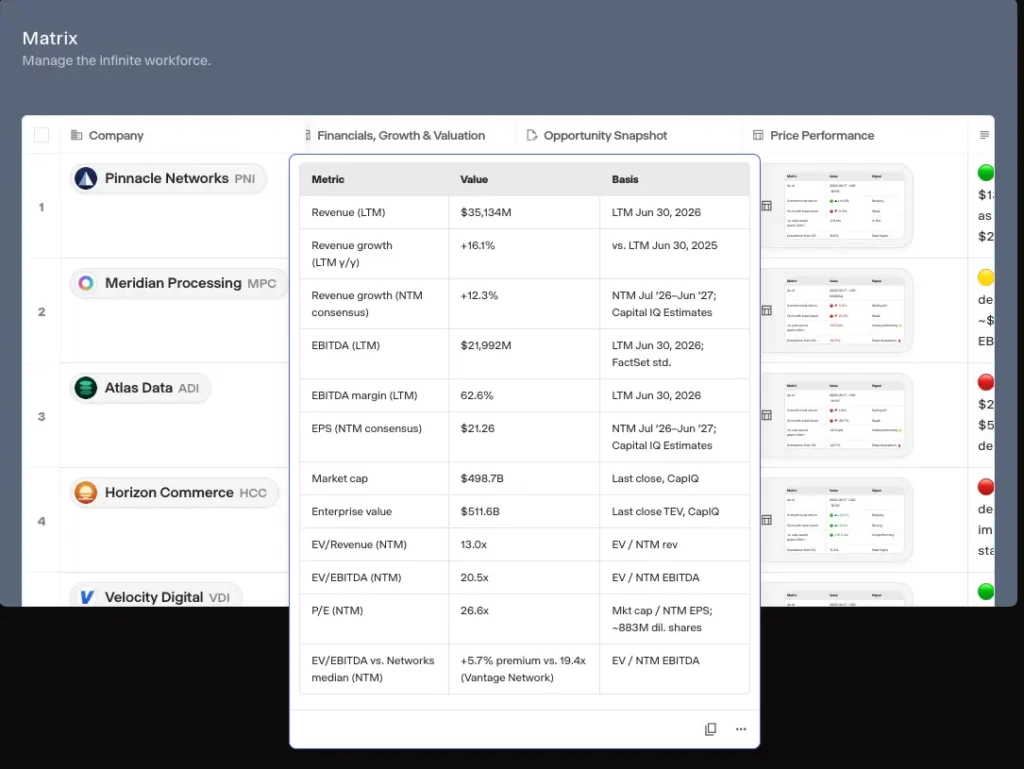
An example of Hebbia’s Matrix in action – Image source: Hebbia
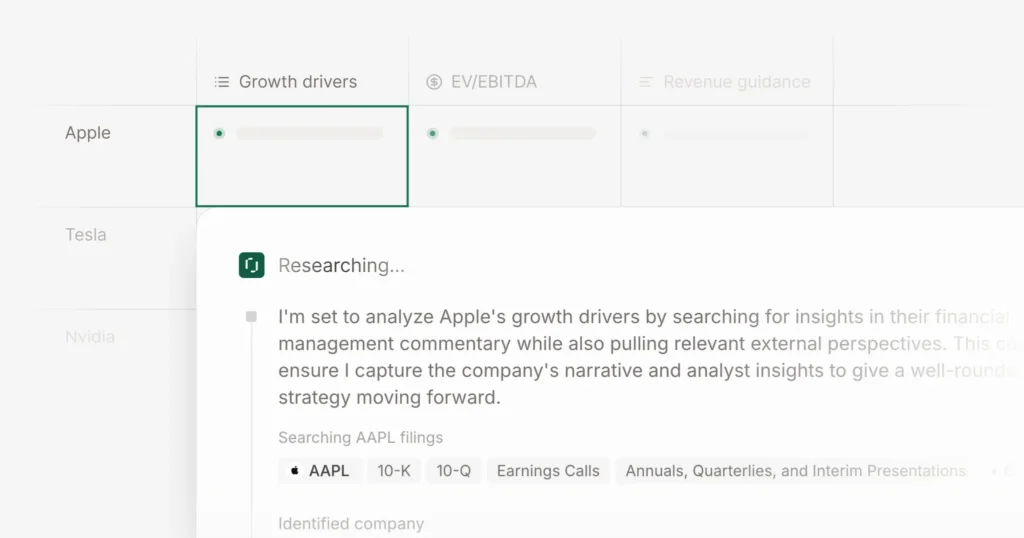
Users consistently note how effective Hebbia is at analyzing large volumes of documents and creating clear citation-backed answers. The spreadsheet-style interface also makes it very easy to structure findings, compare documents, and organize insights.
However, mid-market to enterprise-level users also note a steep learning curve for complex document analysis, especially when building advanced workflows and working across varying document formats6. In these cases, users suggest more careful prompting and human review because Hebbia may miss contextual information or misinterpret scope.6
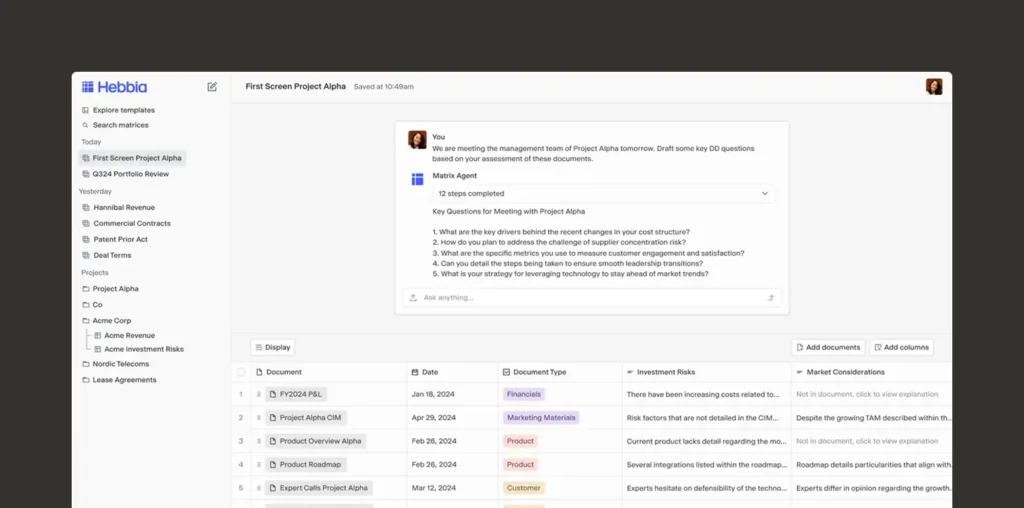
Screening with Hebbia – Image source: Hebbia
While it’s unclear at the time of writing if Hebbia offers custom development, it looks like it’s hiring forward-deployed engineers10 and strategists11 to help enterprise-level firms tailor Hebbia to their specific workflows.
Best for: PE/VC diligence, legal, hedge funds, asset managers, legal, and research teams needing deep, accurate document analysis at scale.
Rogo
Rogo is a secure, agentic AI platform built for investment banking and capital markets. Its flagship solution is Felix, a model-agnostic harness that orchestrates models across Google, OpenAI, and Anthropic7, allowing it to complete multi-step workflows like building decks, models, and memos from prompts or even a request via email as if it were a junior assistant.
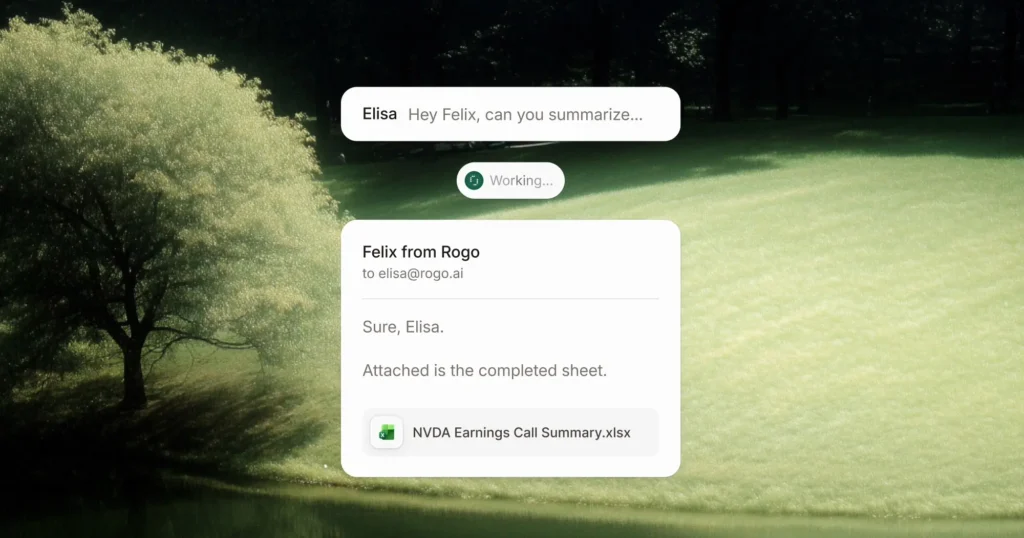
An example of how Felix works – Image source: Rogo
Over 50,000+ bankers and investors across 350+ institutions like Rothschild and Co, Jefferies, Lazard, Truist, and Baird,1 use Rogo to speed up repetitive, data-driven tasks.
Its core platform capabilities include:
- Pitchbook, memo, and deck creation
- Financial modeling
- Valuation & comps
- CIM & VDR screening
- Proprietary document integration
- Automated, form-specific workflows
- Interactive table database
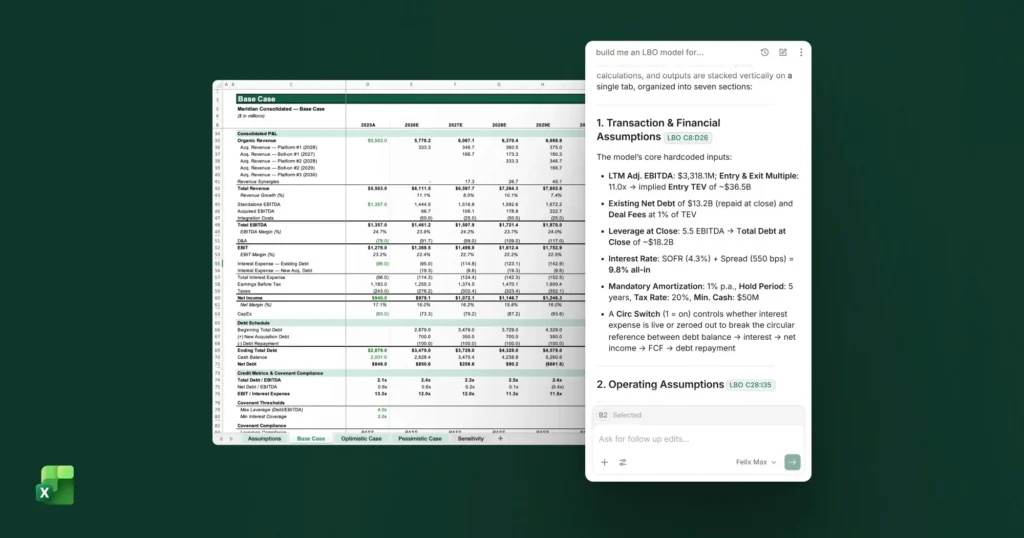
Financial modeling with Rogo – Image source: Rogo
Since Felix isn’t a bespoke build embedded in a client’s systems, teams typically use it as a workflow-native agent that sits on top of existing systems, such as your data, operating systems like Microsoft Office or Google Drive, as well as third-party data providers like FactSet, Capital IQ and PitchBook12.
Users note how efficient Felix is at pulling information from these integrated sources, while also expressing concern around inconsistent response quality across longer, more complex sessions like broad financial research that slows performance.8
Best for: Investment banking, PE, hedge funds, corporate finance, and capital markets teams needing faster, more accurate workflows across valuations, modeling, screening, and more.
What to Consider When Evaluating Rogo and Hebbia: 4 Questions to Ask
Rogo and Hebbia are both strong platforms, addressing different parts of financial workflows. While each can manage both sell and buy-side investments, Rogo is geared more toward the sell-side of investment banking and Hebbia leans toward buy-side investment teams, specializing in volume-heavy document analysis.
But most analyst teams need help with managing their investment and deal flows end to end, spanning multiple steps, each with specific challenges that these tools can’t solve on their own. These include fragmented data sources that lead to inaccurate outputs and manually reviewing high volumes of AI-driven outputs for accuracy.
As a result, one tool might not address fundamental challenges that affect more than one workflow or provide real time savings as bottlenecks move from one area to another. This applies whether you’re considering vertical-specific platforms like Rogo and Hebbia, or even horizontal options like Claude, OpenAI, or Copilot that offer connectors and plugins specific to financial services.
The four questions below help analyst teams evaluate these platforms against the real operational challenges they face, and determine which path is the right fit.
1. How Many Workflows Can Either Platform Cover?
Start by understanding how many workflows you need Hebbia or Rogo to cover, as many financial services firms will be looking to improve more than just one. You might want to optimize workflow-execution tasks like models, valuations, and CIM screening, as well as document-heavy analysis during diligence. This goes beyond asking which platform is better, to how many bottlenecks each one can actually close.
For example, Rogo is strongest at creating repeatable workflow-execution tasks like comps, valuations, pitch materials, modeling updates, and CIM/VDR screening. Hebbia on the other hand excels at document-heavy analysis, extracting information from internal and external documents with citation-level traceability.
While each can stretch a little into each other’s territory, neither is designed to cover the full lifecycle from end-to-end.
This gap is more evident for firms where decision logic, compliance requirements, or workflows aren’t standardized, like a multi-strategy fund that underwrites differently by desk, or cross-border deals with shifting compliance sign-off.
Even after choosing Hebbia or Rogo or combining them, these firms find that they can only configure off-the-shelf platforms to a certain extent, leaving their internal knowledge in the minds of a handful of senior people, with nothing in writing capturing that unique understanding, which is also their competitive advantage.
So, even the most specialized platforms can’t manage full lifecycles or systematize a decision process that was never codified.
2. How Much Verification and Ongoing Oversight Do Outputs Still Require?
Accuracy and auditability matter just as much as speed because they provide the foundation for reliable, compliant decision making, but neither platform removes the need to check outputs.
Hebbia’s sentence-level citations speed up traceability considerably, since it shows exactly where each answer comes from, but analysts still need to verify and validate results, especially for high-stakes workflows.
Rogo’s use of licensed financial data can help minimize inaccuracies, and its in-cell citations make sources easy to trace,9 but the same rule of human checks remains.
You also need that same accuracy and auditability to apply over time. AI systems don’t behave like traditional software as they’re made up of multiple interacting parts, and that behavior can change as the underlying models, datasets, and context evolve.
This means agentic systems need continuous evaluation to keep confirming correctness and performance. Neither Rogo nor Hebbia currently provide built-in evaluation frameworks, so you need your own process for defining what ‘good performance’ looks like. This includes re-checking platforms on a schedule. Our AI agent evaluation framework guide walks you through how to set this up.
However, it’s important to avoid treating partial automation like full automation. We see many firms automating most of a task then leaving the rest for a human to review, which doesn’t remove the bottleneck. It merely moves it from doing the task manually to checking that it’s done properly.
Features like citations and grounding can reduce the checking burden, but they don’t eliminate it completely, for either platform.
3. Does the Platform Fit Your Systems and How Your Team Works?
How useful either platform turns out to be depends on if it fits what your systems, ways of working, and your people.
Rogo focuses on operational systems including CRM platforms and SharePoint, alongside a wide range of finance-native external integrations (e.g., market intelligence, private markets, cloud data warehouses) pulled into a single digital system.
Hebbia focuses more on external market data and research providers, pulling from private repositories and regulatory filings.
Which is the better fit depends on your stack, and whether your data is already fragmented across it. Fragmented data tends to duplicate and create inaccurate outputs in even the best AI platform for financial services. This means you’ll need to clean and standardize your data before plugging it into any new AI platform, whichever you choose.
As for your ways of working and people, adoption depends on defining the problem before choosing the tool. If the goal is reducing due diligence review time or improving deal screening, that is what determines which tool to pick.
You’ll also want to think through how the platform fits into your team’s daily workflows, including if existing processes need to be redesigned around it and whether analysts need training before they can use it well.
This makes fit just as much of a readiness question as it is a platform question.
4. Who Owns Compliance, Security, and Governance?
An output can be both accurate and useless in an IC meeting or an LP report if the chain behind it isn’t transparent. The real stakes here is understanding the difference between an output your firm can use for an investment decision versus one it can’t.
Both Hebbia and Rogo have a wide range of security certifications, but these alone don’t answer whether either platform provides usage guardrails, human-in-the-loop reviews, or audit logs of how AI actions are handled.
Firms also need to decide permission levels for users. For example, will everyone use it in the same way, or will senior advisors have access to more automated workflows while junior staff have human review gates on sensitive actions?
But at the most fundamental level, a person needs to be accountable for all of it. Someone at your firm has to decide whose outputs get automated sign-off and whose needs a human checkpoint before they’re used. Who is the escalation point if an automated output turns out to be wrong?
Neither platform hands you this structure, so it’s something you need to decide internally, before putting any tool into production.
Beyond Rogo and Hebbia: How Neurons Lab Provides a Third Path
Many financial services teams are pleased with how Rogo and Hebbia perform. However, they’re still off-the-shelf tools that solve parts of specific workflows like investment banking deal-prep or document-heavy PE diligence valuation updates, without addressing the entire investment or deal lifecycle end-to-end.
For firms managing more than one of those workflows at the same time, this partial automation is the real bottleneck and one that a third path can help: working with an AI enablement partner like Neurons Lab. A specialized AI partner means you can:
- Evaluate platforms like Rogo, Hebbia, and horizontal harnesses like Claude Cowork
- Integrate them successfully into existing systems
- Extend them with custom AI agents when needed
And if these steps don’t fully close the gap, the same partner can build a custom, fully compliant system around your exact requirements instead. This is how Neurons Lab helps Financial Services firms move from AI experimentation to AI adoption at scale.
To be clear, Neurons Lab isn’t an AI platform like Rogo or Hebbia, and we’re not resellers or partners of either one. What we do is help you figure out which platform, or combination of platforms, fits your challenges, integrate and govern it once you’ve picked one, and, if none of the off-the-shelf options fit, build a custom solution instead.
As an AI enablement partner serving organizations across the US, Europe, and Asia, we combine executive training, AI adoption programs, and custom AI agent builds to support secure, practical deployment. Clients build operational AI capability aligned with core workflows, governance, and business priorities.
Trusted by 100+ clients, including HSBC, Visa, and AXA, we’ve accelerated AI integration in banking, wealth management, private equity, investment firms, fintechs, and other highly regulated industries.
Here’s how Neurons Lab helps you choose the AI platform that fits best or decide when a custom build makes sense.
Get Guidance on Which Platform Actually Fits Your Firm Today and as You Scale
Most firms need a tool to work across multiple workflows like sourcing, screening, diligence, and document analysis, but aren’t sure whether one platform can solve everything. And with lean teams and pressure to move faster, firms may worry that choosing one tool will fix one bottleneck and expose another.
Neurons Lab acts as a long-term enablement partner, helping finance firms choose between Rogo, Hebbia, or other options like Claude. The right choice depends on your business strategy and particular challenges, so we help you pin down what these are, which tool can help solve them, and what future expansion might look like at a later date as you scale and as AI solutions evolve.
We run this as a structured adoption diagnostic, mapping your bottlenecks (e.g., sourcing, screening, diligence, document analysis, or some mix of workflows) before recommending solutions.
From there, we evaluate Rogo, Hebbia or other options like Claude or OpenAI for financial services against those specific use cases, and support the rollout once you’ve chosen. This includes role-specific training, adjusting workflows, and ensuring tool adoption across your organization.
Deploy Rogo, Hebbia, or Any AI Tool With the Governance Your Firm Needs
Most FSIs have fragmented data across Excel models, CRM entries, email threads, and market data feeds, without a unified AI layer connecting them. Without clean, standardized data and proper governance, even the most powerful AI platform won’t perform as expected.
Neurons Lab helps prepare your data so it’s usable for AI, whether you choose an off-the-shelf platform or custom built agents. We build role-based governance and safe usage guardrails from day one (not bolted on afterwards), defining accountability, ensuring human review, and making sure that every AI-assisted decision is traceable and fully auditable.
Since this foundation isn’t tied to a single platform, it allows you to expand AI use into new use cases or departments later on, without rebuilding governance from scratch each time.
This approach to data aggregation and integration from Neurons Lab helped an established investment firm reduce its error rate by 90% and accelerate its monthly reporting process by over 75%.
Extend Rogo or Hebbia (or Replace Them Entirely) With a Custom AI System
Some firms discover that neither Rogo, Hebbia, or any other off-the-shelf platform fully fits their workflows. Neurons Lab builds custom AI agents that work alongside Hebbia, Rogo, and other AI platforms. Or, we can create a fully compliant system that replaces them entirely.
We integrate AI agents into CRM systems, Excel models, core banking systems, and proprietary data sources. Our forward-deployed engineers embed directly within your teams, extracting key information and formalizing decision logic that’s never been documented. Then, we create a custom system built around this, including knowledge layers and shared AI skills libraries. This approach creates an AI agent that works like your best analysts and highest performing teams.
Every Neurons Lab custom build goes through a systematic evaluation covering accuracy benchmarks, hallucination monitoring, and defined pass thresholds before it goes live. Firms also receive a framework to use once it’s in production, to help maintain performance over time.
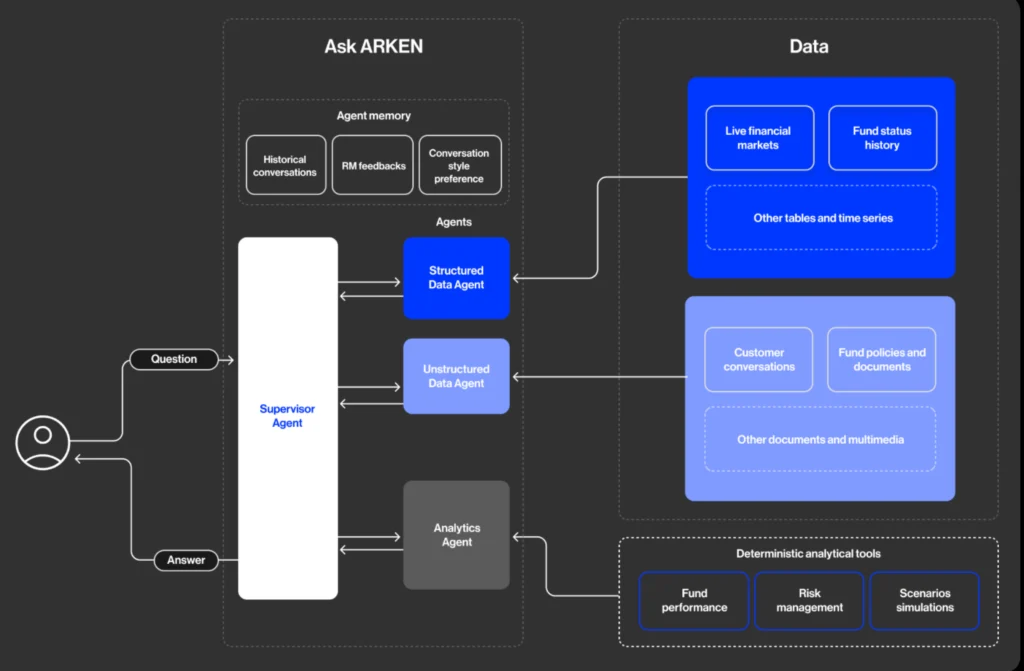
An example of a custom agent build with Neurons Lab
As an example of what a custom Neurons-Lab built system can achieve, we helped one global asset management firm achieve enhanced financial performance, faster strategy development, improved risk management, and scalable, secure deployment.
How a Capital Markets Fintech Achieved 99% Document Accuracy
The equity capital markets (ECM) team at an established capital markets fintech organization were operating under tight deadlines but still using manual processes and fragmented systems.
This approach meant the team missed market opportunities, and were relying on tools that didn’t have the domain intelligence required for ECM-specific operations like issuer identification and deal scoring. The organization’s current approach also made it a challenge to comply with regulatory and audit requirements.
By partnering with Neurons Lab to implement a production-grade agentic AI architecture based on Amazon Bedrock and AWS services, the organization transformed complex operations into a streamlined, production-ready AI system which met enterprise security and compliance obligations.
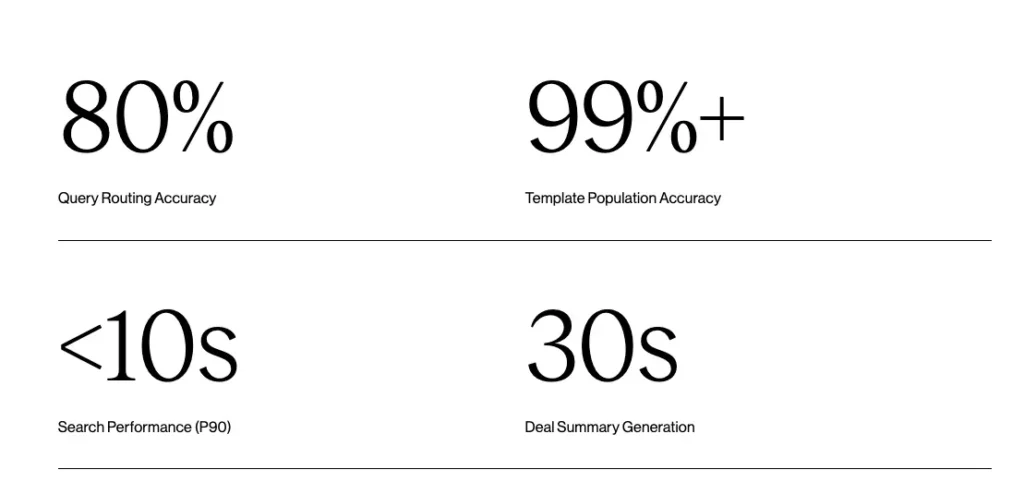
As a result, it achieved:
- Query routing accuracy of 80%
- Template population accuracy of 99%+
- Search performance (P90) of <10 seconds
- Deal summary generation in 30 seconds
Results like this show that by taking a tailored, scalable approach to transforming complex workflows and operations, organizations can unlock measurable improvements in efficiency, accuracy, and speed.
Choosing the Right AI Approach Starts Before Choosing Hebbia or Rogo
Most analyst teams are slowed down with multiple bottlenecks, from workflow execution and document heavy analysis to verification needs, fragmented data, and accountability requirements. AI can help with all of it, but only when you’re solving for the actual bottleneck.
Rogo and Hebbia are both strong answers to part of that picture, but neither closes every gap on its own, and for firms whose decision logic has never been written down, no off-the-shelf platform closes that gap at all.
The real challenge is figuring out which platform fits, what you need to govern and integrate once it’s in place, and whether anything left over needs a custom build.
Ready to find the right AI approach for your analyst team? Book a call with Neurons Lab.
FAQs
How do Rogo and Hebbia differ for due diligence?
Rogo speeds up repeatable, standardized investment‑banking tasks like valuations and creating pitch materials, while Hebbia is designed for multi-document retrieval and analysis at scale.
How do I choose between Hebbia and Rogo for my team?
It depends on your bottlenecks. If you’re looking for support with document-heavy research, Hebbia is a good choice. For streamlining structured workflows or processing market data, Rogo may be a better fit. Many firms use both, or pair one platform with custom AI agents designed to fill any gaps.
When should I consider a third option, like a custom AI solution?
A custom AI solution makes sense when your firm’s workflows don’t align with any off-the-shelf platform. For example, if your processes spam multiple, fragmented systems, or compliance requirements demand full traceability and auditability. Custom agents can work alongside AI platforms like Rogo and Hebbia, or replace them entirely.
Sources
1 https://rogo.com/
2 https://www.hebbia.com/
3 https://www.hebbia.com/blog/every-data-integration-one-view
4 https://rogo.com/product
5 https://www.hebbia.com/resources/financial-research-platforms
6 https://www.g2.com/products/hebbia-ai-2026-02-24/reviews
7 https://rogo.com/news/may-product-update
8 https://www.wallstreetoasis.com/forum/other/thoughts-on-rogo
9 https://rogo.com/news/whats-new-november-2025
10 https://jobs.ashbyhq.com/hebbia-ai/b35852eb-97ac-491a-b375-91fd13d0b7b3?utm_
11 https://www.hebbia.com/careers
12 https://rogo.com/product
13 https://sacra.com/c/rogo/
14 https://sacra.com/c/hebbia/