
As a private equity (PE) or venture capital (VC) firm researching the best AI tools, it’s likely that:
- Many of your core processes are still manual, even though you’re experimenting with AI tools for non-client-facing processes like deal sourcing, due diligence, and portfolio monitoring, but not in a structured way.
- You’re struggling to find AI solutions that can handle your firm’s specific workflows, fund size, and existing tech stack, while still ensuring accuracy and auditability.
- AI use is fragmented across investment, operations, and portfolio teams, making it hard to apply tools consistently, safely, and at scale.
Venture capital firms may prefer a tool to help teams manage high-volume deal sourcing and early-stage company research, while private equity firms will look for AI-powered solutions to reduce time spent on financial diligence, operational analysis, and portfolio value creation.
The right AI tools can help address these issues. But for very complex workflows or highly specialized systems, such as legacy technology and customized data warehouses, even the best AI tools may not be enough to deliver the security, compliance, and productivity gains you’re looking for.
This is when custom development comes in, connecting AI to your firm’s systems, data, workflows, and governance requirements. To help you understand where AI tools fit, where custom development is needed, and how to create measurable business value, this article will cover:
- Top AI Tools and Platforms for Private Equity and Venture Capital
- Why PE and VC Might Need More Than AI Tools
- How to Choose the Right Approach for AI Adoption
- How Neurons Lab Helps PE and VC Firms Adopt AI across the Full Investment Cycle.
- How a Financial Services Firm Increased Productivity Across Complex Investment Workflows
- FAQs
The best AI tools are a starting point, not the finish line. Neurons Lab helps PE and VC firms build the workflows, governance, and custom capabilities needed to scale AI adoption. Get in touch to discuss your firm’s AI roadmap.
Top AI Tools and Platforms for Private Equity and Venture Capital
The most widely used AI tools in private equity and venture capital today include generative AI (GenAI) tools and general-purpose assistants such as ChatGPT Enterprise, Claude, Microsoft Copilot, and Perplexity Finance. Firms use these platforms to draft investment memos, summarize diligence materials, research companies and markets, as well as support portfolio reporting.
These tools work well for individual productivity, and recent developments have expanded their capabilities. For example, Perplexity Computer can autonomously complete multi-step research and analysis tasks from a single prompt¹ ², while Claude for Financial Services provides finance-specific workflows, Microsoft 365 integrations, and templates for activities such as financial modeling and KYC screening³ ⁴.
However, as firms apply AI across multi-step workflows, they often encounter challenges around data access, integration, governance, and scalability. That’s why many PE and VC firms combine general-purpose AI assistants with specialized investment platforms designed for sourcing, research, CRM, and diligence.
The tools below include both widely adopted AI assistants and PE- and VC-specific platforms to help you evaluate the current landscape.
Widely Adopted AI Assistants for PE and VC
| Solution | Type | For PE or VC | Primary Purpose | Best For | Considerations |
|---|---|---|---|---|---|
| Claude Cowork | General-purpose | Both | Desktop AI workspace for business users | Research, document drafting, analysis, knowledge work | Strong for individual productivity; may require additional integration for firm-wide workflows |
| Claude for Financial Services | Finance-tuned | Both | Finance-specific extension of Claude Cowork with pre-built workflows and market-data connectors | Financial modeling, KYC screening, investment presentations, research workflows | Builds on Claude Cowork; full value depends on Microsoft 365 and data-provider connector adoption |
| Claude Code | General-purpose | Both | AI coding assistant and developer CLI | Building automations, scripts, integrations, and AI-powered workflows | Designed for developers and technical teams rather than investment professionals |
| Perplexity Computer | General-purpose (finance-tuned workflows available) | Both | AI-powered research and autonomous task execution | Market intelligence, competitor research, deal sourcing support; ships dedicated PE/wealth management/investment banking workflows via Computer for Professional Finance | Historically focused on information discovery rather than workflow execution, though this is expanding |
PE- and VC-Specific AI Platforms
| Solution | For PE or VC | Primary Purpose | Best For | Considerations |
|---|---|---|---|---|
| AlphaSense | Both | Market intelligence and research platform | Investment research, due diligence, deal origination, portfolio/competitor monitoring | Premium content and AI agent features are priced at enterprise tiers |
| Grata | Private Equity | AI-powered private-company deal sourcing platform | Market mapping, deal sourcing, buyer discovery, early diligence | Purpose-built for PE, investment banking, corporate development, private credit, and consulting; no dedicated venture capital offering |
| Affinity | Both | AI-powered CRM and relationship intelligence platform | Deal sourcing, deal execution, portfolio support, investor relations, fundraising | Value depends on how much deal and relationship activity flows through connected email/calendar data |
| Canoe Intelligence | Both (LP / fund-of-funds side) | Document collection and data extraction for alternative investments | PE and VC firms acting as LPs or in fund-of-funds structures; fund administrators and asset servicers | Built for the allocator/back-office side of PE and VC rather than GP deal teams; some analytics require a premium tier |
Note: Full citations for every claim in the tables above are provided in the platform-by-platform breakdown below and Sources list at the article’s end.
1. Claude Cowork
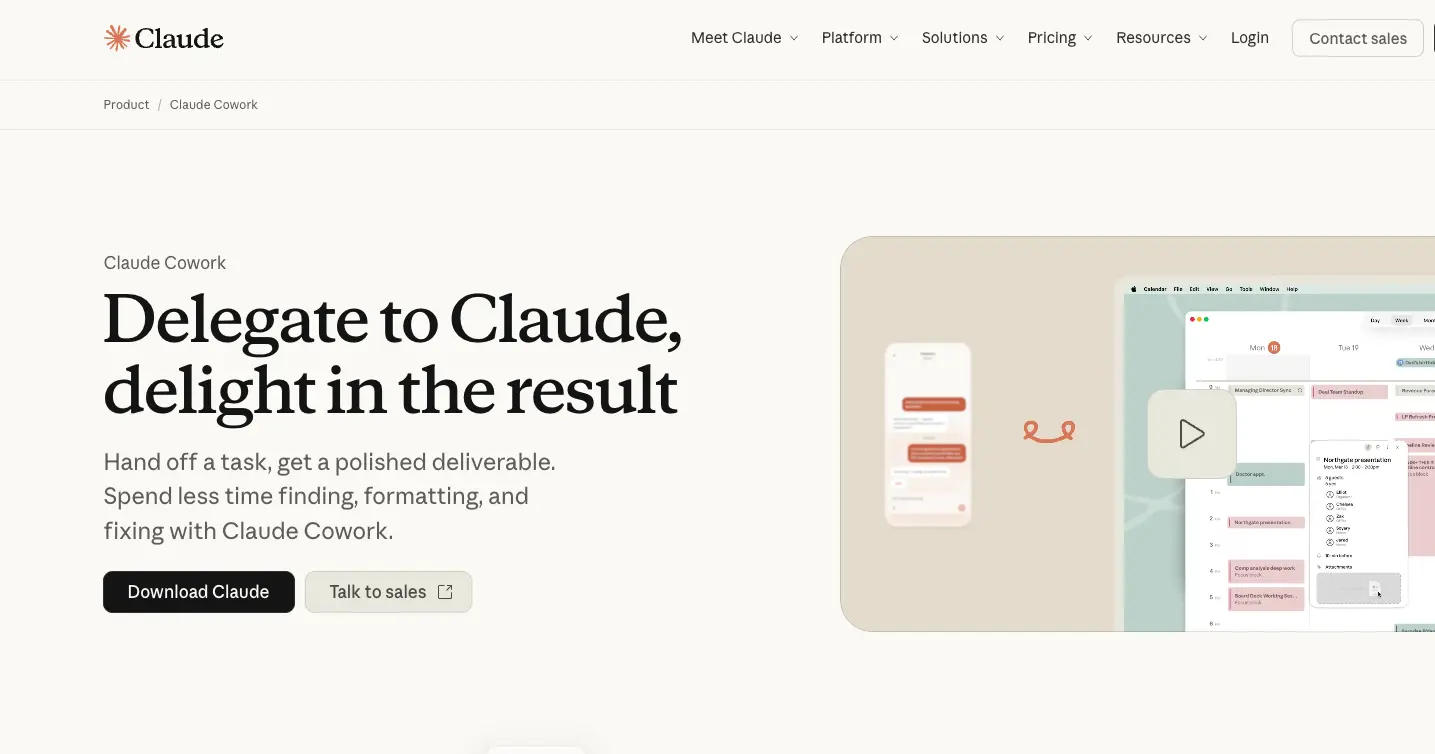
Anthropic’s Claude Cowork is a desktop AI application (also available on web and mobile) designed for business users who need help with complex, multi-step work⁵. It can connect to internal and external data sources, including documents and market data, allowing PEs and VCs to research companies, analyze information, and produce investment materials without switching between files, platforms, and prompts⁵.
Key use cases include:
- Investment memo drafting and synthesis
- Market and competitive research
- Portfolio company analysis
- Document analysis
- Reasoning across large document sets
Read more: What can you do with Claude Cowork in Financial Services?
2. Claude for Financial Services
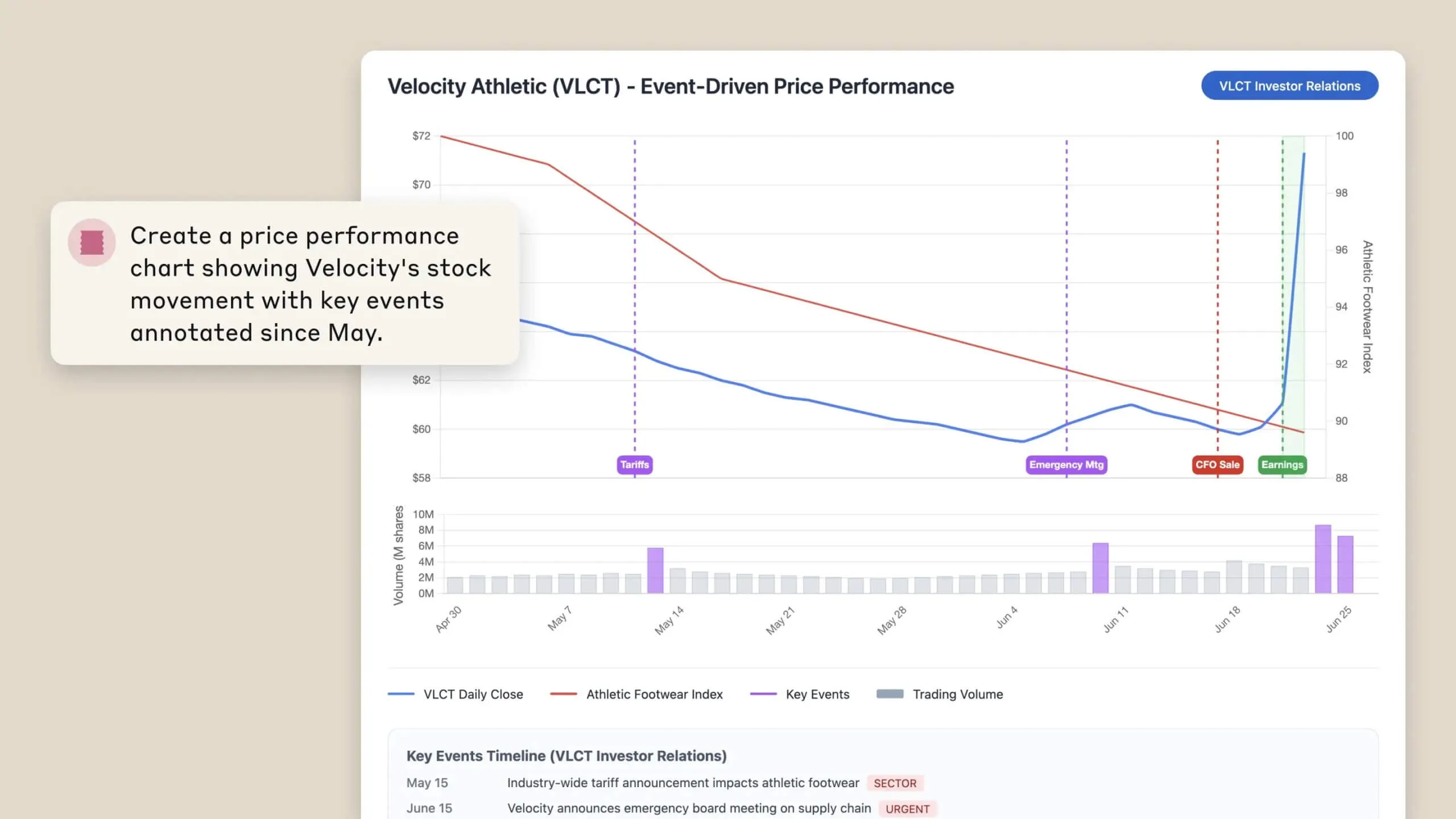
Anthropic also offers Claude for Financial Services, which extends Claude Cowork with pre-built financial workflows, Microsoft 365 integration, and connectors to market data and portfolio analytics providers such as FactSet, PitchBook, and Morningstar³ ⁴. It includes templates and agent workflows for tasks such as financial modeling, KYC screening, investment presentations, and research, making it particularly relevant for investment teams³ ⁴.
Discover more on our full guide: Claude for Financial services
3. Claude Code
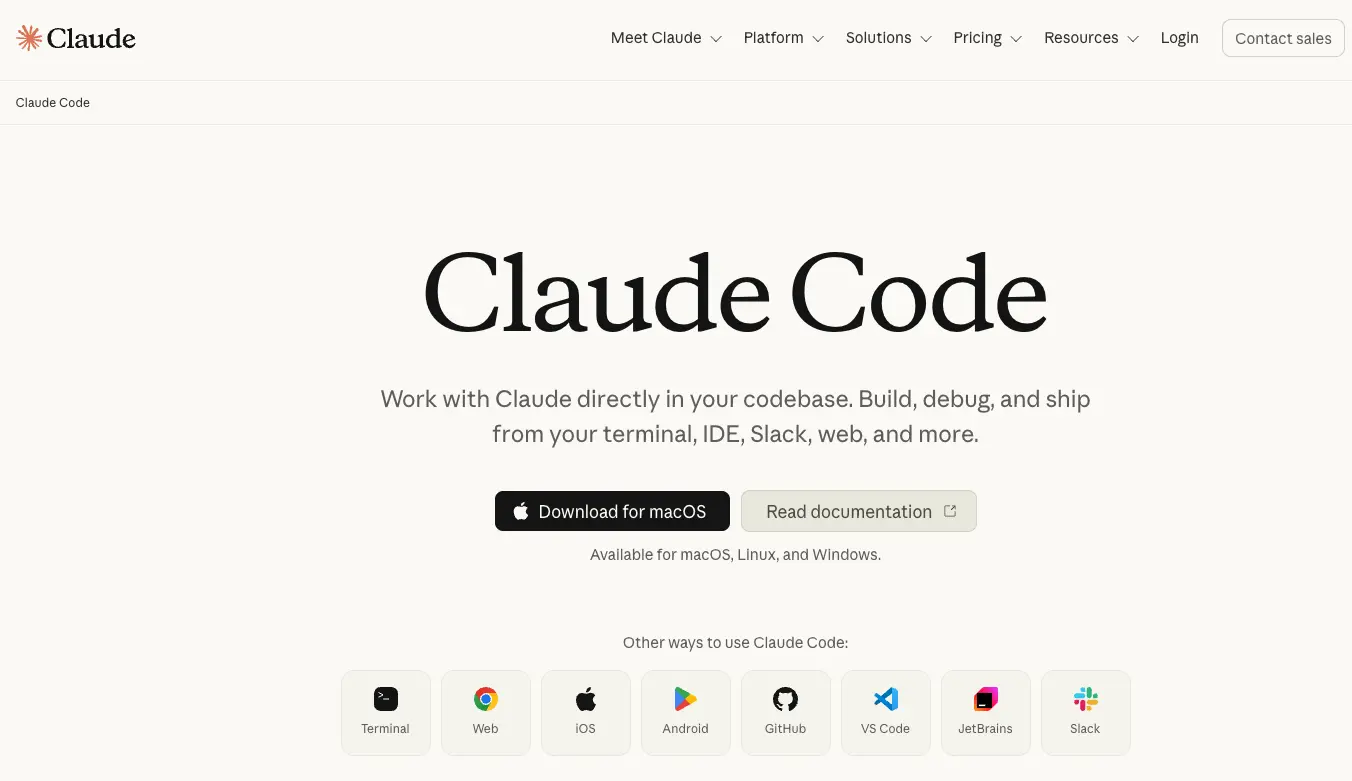
Claude Code is Anthropic’s AI coding assistant for developers, available in the terminal, IDEs, a desktop app, and the browser⁶ ⁷. It works directly within development environments, helping engineering teams understand codebases, edit files, run commands, and build AI-powered applications and automations⁶ ⁷.
Key use cases include:
- Automating internal investment workflows
- Connecting AI to internal knowledge bases
- Building custom internal tools
- Developing AI agents and integrations
It’s worth noting that most investment professionals will not use Claude Code directly. Instead, it is designed for engineering and AI teams building the internal tools, automations, and AI systems that support private equity and venture capital firms.
For a deeper look at how Anthropic’s Claude model family can complete multi-step financial services workflows, read our guide on Claude for Private Equity.
4. Perplexity Computer

Perplexity now combines AI-powered search with autonomous task execution. Alongside its research capabilities, Perplexity Computer allows users to provide the data and desired outcome, then autonomously completes multi-step tasks such as research, analysis, document creation, and reporting in an isolated cloud environment¹ ².
Rather than requiring constant prompting, it acts as a virtual assistant designed to execute complete business workflows with minimal user intervention¹ ². In May 2026, Perplexity extended this into Computer for Professional Finance, which ships with roughly 35 dedicated workflows across segments including private equity, wealth management, and investment banking, and can connect to firms’ existing data subscriptions such as PitchBook, Morningstar, and Daloopa⁸.
Key use cases include:
- Market and competitor research
- Deal sourcing support
- Industry landscape analysis
- Investment briefing preparation
5. AlphaSense
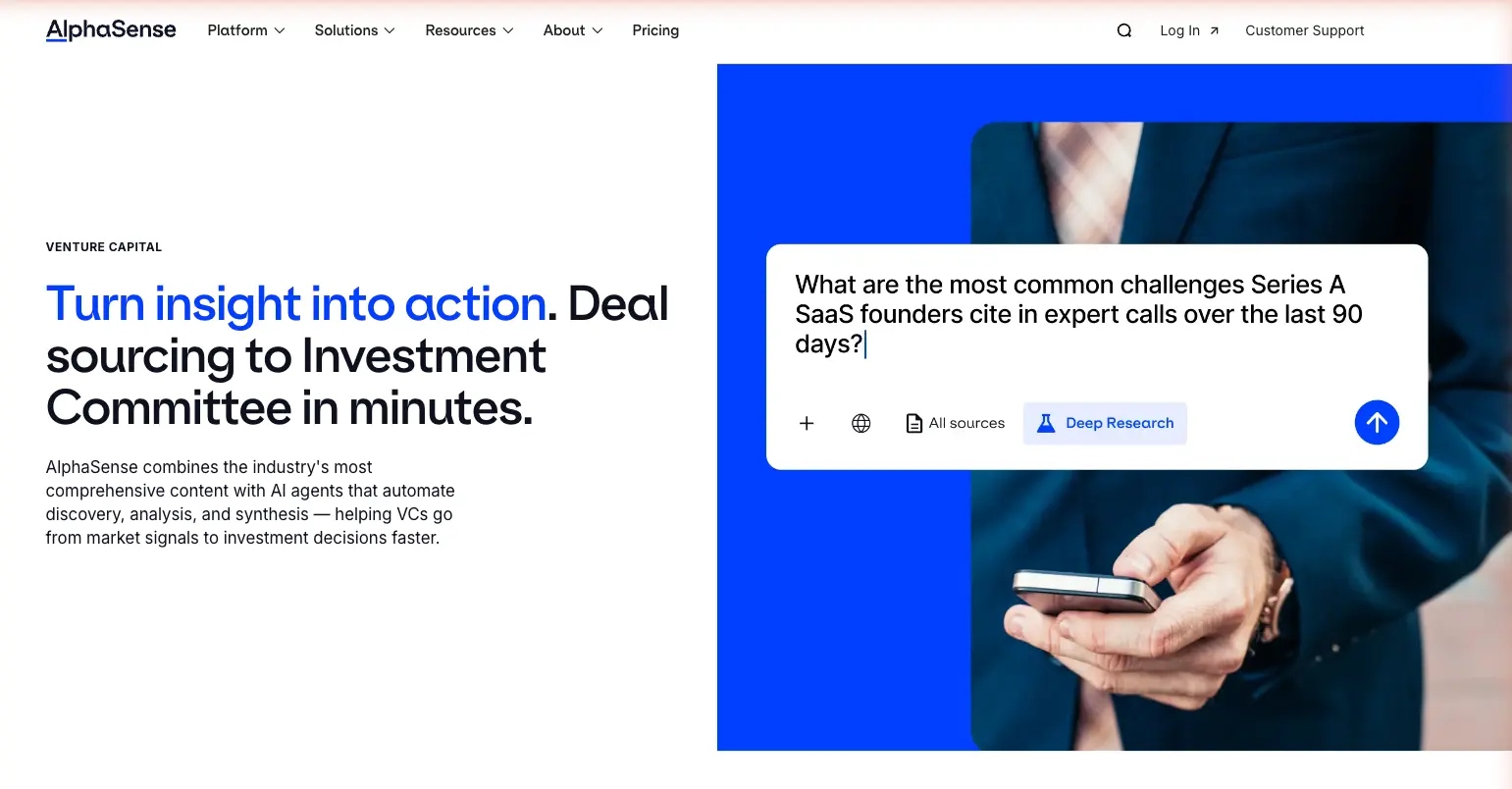
A market intelligence platform, AlphaSense offers specific solutions for both PE and VC firms, while also catering to a variety of industries, from financial services and healthcare to retail, technology, and energy⁹.
With access to over 500 million sources and documents, it uses GenAI to analyze your market search requests and helps automate multi-step workflows⁹ ¹².
VC-specific features include:
- Investment research across earnings calls, SEC filings, and more¹⁰
- Insights and citations for discovery, analysis, and synthesis processes via natural language processing (NLP)¹⁰
- Security, including traceability, SOC 2 Type II compliance, and enterprise Single Sign-On (SSO) integration¹⁰
- Always-on portfolio and competitor monitoring¹⁰
PE-specific features include:
- Market research and reporting¹¹
- Due diligence and deal origination¹¹
- Market and competitor alerts and insights¹¹
- Analysis of deal history, CIMs and more, with proprietary data uploads¹¹
6. Grata
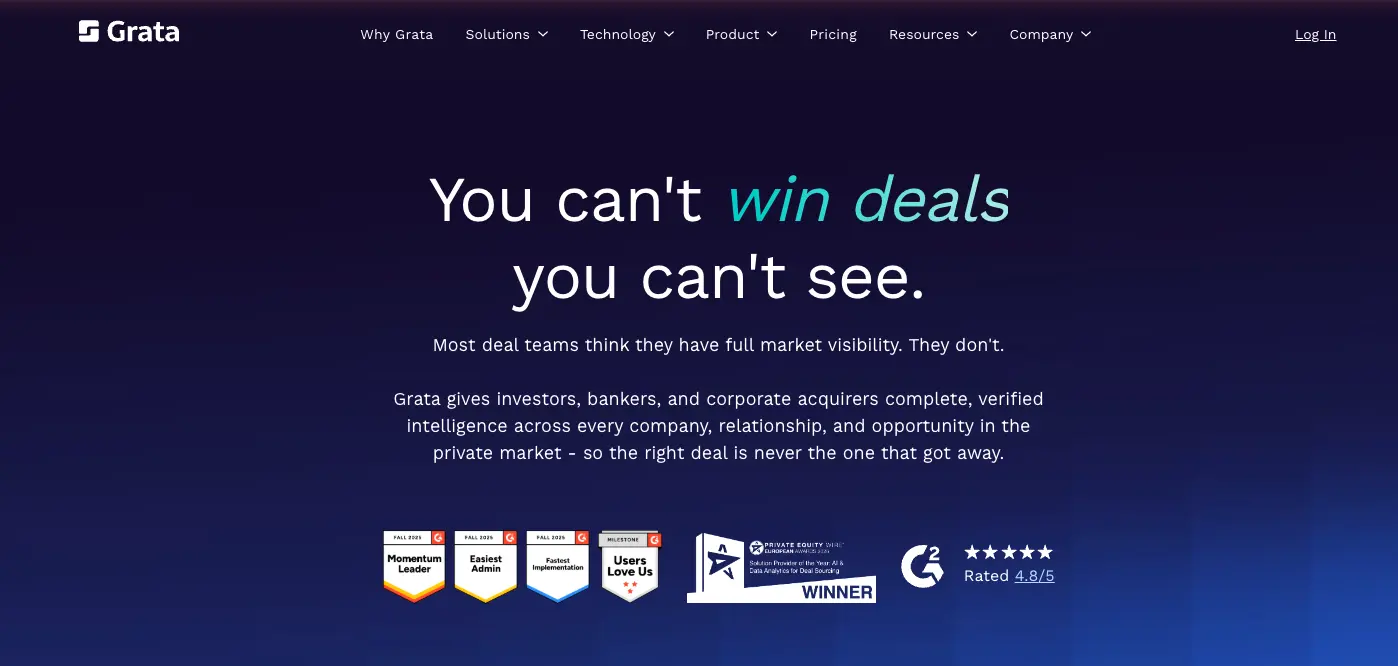
Grata is an AI-powered deal sourcing platform for private equity, investment banking, corporate development, private credit, and consulting¹³ ¹⁴. It does not currently offer a dedicated venture capital solution, which is why it’s listed as private equity rather than “both” in the comparison table above.
Through AI-driven search and AI context engineering, it behaves like an analyst and can define what a company does, discover similar targets, analyze data, and prioritize targets¹⁵. Grata offers enterprise-grade security, including SOC 2 compliance and end-to-end encryption¹⁴.
Use cases include:
- Market research and deal sourcing
- Due diligence
- Buyer discovery and M&A tracking
7. Affinity
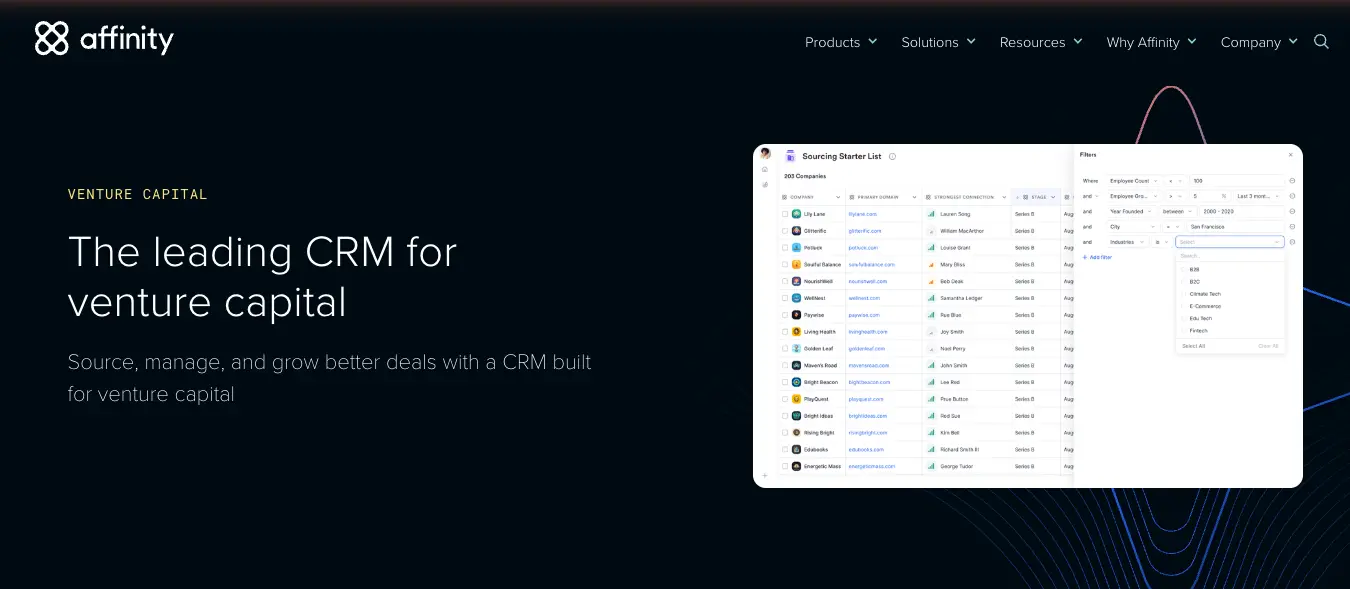
This AI-powered CRM and relationship intelligence platform captures data from relationship channels, including emails, calendars, and meeting activity¹⁶ ¹⁷. Affinity helps PEs and VCs identify opportunities and network connections, including deal pipeline analytics and reporting, deal and portfolio management, and fundraising and investor relationships¹⁶ ¹⁷.
PE-specific use cases:
- Deal origination and execution¹⁷
- Value creation support and reporting¹⁷
VC-specific use cases:
- Startup discovery, tracking, and connections¹⁶
- Strategic alignment evaluations¹⁶
- Deal information and evaluation sharing across teams¹⁶
- Investment performance support and reporting¹⁶
8. Canoe Intelligence
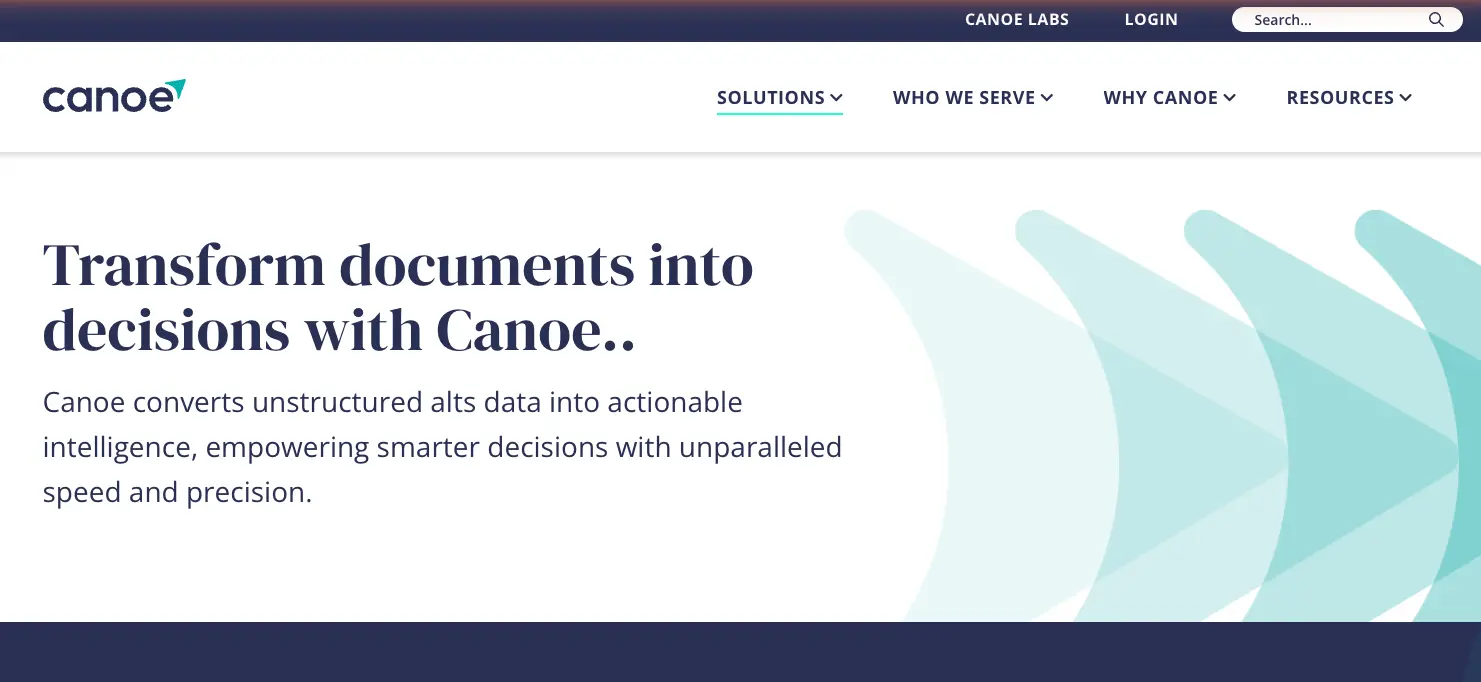
Canoe Intelligence is a document processing and data management tool specializing in document collection and extraction for alternative investments and assets¹⁸. Many of its features are suitable for private equity and venture capital, particularly those acting as Limited Partners (LPs) or fund-of-funds¹⁸ ¹⁹ ²¹. It provides traceable, auditable outputs and can integrate with enterprise accounting and reporting tools¹⁸ ¹⁹.
PE- and VC-specific use cases:
- Automated collection and digitization of General Partners’ (GPs’) documents¹⁸
- Machine-learning-driven extraction of financial data like valuations, cash flows, and fees from unstructured data (e.g., PDFs)¹⁸ ²²
- A premium subscription unlocks access to dashboards for private analytics and private exposures²⁰
While AI tools improve individual productivity, these challenges become more significant as firms begin applying AI across investment workflows. Let’s look at why you might need more than tools.
Why AI Tools Alone Aren’t Enough for PEs and VCs
For many investment teams, large language models (LLMs) and AI tools improve individual productivity, but their value doesn’t come from your teams simply having access to them.
We’ve seen this play out directly in private equity: before AI, a firm might evaluate around a thousand acquisition targets a year, already considered a lot, and still only buy the same handful of companies. With AI-assisted screening, that same team can realistically scan closer to ten thousand targets and still make the same number of deals, just off a much stronger shortlist.
Scaling AI across investment workflows introduces a different set of requirements, which we cover below:
Ensure Investment-Grade Accuracy and Auditability
General-purpose AI tools work well for drafting documents or summarizing information, but investment workflows place much higher demands on AI. The outputs used in due diligence, investment committee materials, portfolio monitoring, or LP reporting must be accurate, traceable, and supported by verifiable sources.
Even when an AI-generated answer appears correct, investment teams still need to understand how it reached that conclusion. Without traceability, analysts cannot validate assumptions, defend recommendations in investment committee meetings, or satisfy audit and regulatory requirements.
To support investment decisions, firms increasingly combine AI with retrieval systems, structured data sources, and evaluation frameworks that allow every output to be linked back to its original source.
For a PE firm, that might mean tracing an AI-flagged risk, such as declining revenue growth, back to specific financial statements, market data, or management reports before it goes into an investment memo.
For a VC firm, it more often means tracing a sourcing or diligence signal, such as a shift in a startup’s growth metrics or a claim made in a pitch deck, back to the underlying data room, cap table, or founder update before it shapes a term sheet decision.
Maintain Security and Data Residency
Private equity and venture capital firms both work with highly confidential information, though what’s most sensitive tends to differ.
PE firms are typically protecting detailed financials, debt structures, and management projections on mature businesses, while VC firms are protecting cap tables, founder communications, and early signals on companies that haven’t gone public. Either way, many off-the-shelf AI tools weren’t designed to operate within these security requirements.
Uploading sensitive information into consumer AI tools can create compliance, confidentiality, and governance concerns, particularly when firms need greater control over where data is stored and processed.
Many firms address this by deploying AI within their own cloud environments using platforms such as AWS Bedrock. This allows them to choose foundation models while maintaining control over security, access permissions, data residency, and governance.
For example, an investment team can analyze confidential diligence documents using AI without moving those files outside the firm’s approved cloud environment.
Integrate AI Into Existing Investment Workflows
Standalone AI assistants cannot access every internal system. But technology isn’t the only limitation.
Many investment processes exist as institutional knowledge, which are not documented workflows. Investment criteria, diligence standards, and decision frameworks often live in the experience of partners, principals, and analysts instead of formal documentation. AI cannot consistently automate processes that have never been clearly defined.
For example, a single diligence process can span company research, market analysis, and risk assessment, plus financial model checks for a PE deal, or founder and market-signal screening across a high volume of inbound opportunities for a VC fund.
If AI only summarizes one document, teams still spend time piecing together information, checking assumptions, and moving information between tools. The work gets slightly faster, but teams still spend time coordinating information across the rest of the workflow.
To create measurable value, firms first need to document and standardize how these workflows operate. They can then connect AI to CRMs, virtual data rooms, portfolio management platforms, and document repositories so information flows automatically across the investment process.
Instead of accelerating one task at a time, AI can support end-to-end workflows, helping teams surface risks earlier, compare data more consistently, and spend more time evaluating which deals to pursue.
Establish Governance and Ongoing Monitoring
When AI adoption starts informally, each team tends to use its own AI tools, prompts, data sources, and review standards. Outputs become inconsistent, best practices stay trapped inside teams, and leadership has limited visibility into how teams are using artificial intelligence.
Without a consistent way to control what enters AI tools or how outputs are checked, firms risk data leakage, compliance breaches, and governance failures.
This isn’t hypothetical. At one PE firm, a missing guardrail in a CRM automation let an agent mislabel a batch of dead targets as active, so it started reprocessing the firm’s entire history of roughly a thousand targets instead of the thirty it actually needed. The agent’s daily run cost went from around $100 to about $5,000 by lunchtime.
For US private equity and venture capital firms, this can also create challenges around SEC recordkeeping and marketing requirements. These obligations scale with a firm’s assets under management and registration status, so a large buyout fund and a small seed-stage VC firm won’t face the same compliance load.
Firms handling LP or portfolio company data internationally also need to account for GDPR, and to maintain audit trails that support investment decisions.
So, as soon as AI becomes part of investment processes, that’s when you need policies, evaluation frameworks, and ongoing monitoring to ensure outputs remain reliable, compliant, and aligned with business requirements.
The best way to address this is by creating a shared foundation for AI use that defines which AI tools teams can use, what data they can access, and how outputs should be reviewed before they feed into investment or reporting work.
How to Choose the Right Approach for AI Adoption
The AI tools and platforms covered in this guide can deliver significant value for individual and team productivity. They help investment professionals work faster across multiple workflows, from research and meeting preparation to deal sourcing and CRM workflows.
But as firms expand AI adoption, the question isn’t so much “which AI tool to buy”, but “can existing tools support our broader investment workflows”? Here’s how to choose the right approach.
Identify Where Individual Tools Fall Short
Many firms discover that automating 90% of a workflow still leaves analysts responsible for manual verification, reconciliation, approvals, or for moving information between systems. Individual tasks become faster, but the overall process changes very little because the bottleneck simply moves elsewhere.
For example, a single diligence process can span company research, market analysis, financial model checks, risk assessment, investment committee preparation, and portfolio reporting for a PE deal. Or for a VC fund, it can cover company and market research, founder screening, and investment memo drafting across dozens of opportunities. If AI only summarizes one document, teams still spend time piecing together information, checking assumptions, and transferring data between applications.
For many firms, this is where off-the-shelf AI tools reach their limits. They are often constrained by the systems and data they can access, requiring teams to manually transfer information between applications or work around existing processes.
Choose the Right Level of Investment
The next step is not always custom AI development. Many organizations first benefit from identifying the right AI tools, establishing governance, and redesigning workflows so teams use AI consistently across the investment lifecycle. As adoption matures, firms often identify higher-value opportunities that require deeper integration with proprietary data, internal models, legacy systems, and firm-specific approval processes.
Firms without prior experience typically need a year to two years to genuinely learn how to integrate agentic AI with the rest of their systems. This goes well beyond a single implementation sprint.
For example, a PE deal team might use Claude Cowork to analyze individual diligence documents while Microsoft Copilot helps prepare investment committee materials. A VC deal team might use the same tools to triage inbound pitch decks and track founder updates across a growing portfolio. As AI adoption expands, either firm may connect its CRM, virtual data room, portfolio reporting platform, and internal templates into a single AI-enabled workflow.
Rather than replacing off-the-shelf tools, custom AI extends them by connecting the firm’s systems, data, and workflows into one coordinated process.
The right approach depends on the outcome a firm is trying to achieve. Some organizations only need guidance on selecting and adopting the right AI tools. Others need help redesigning investment workflows or building custom AI capabilities around their existing technology stack.
Neurons Lab supports both paths through AI adoption programs, workflow enablement, and custom AI development for financial services organizations.
How Neurons Lab Helps PE and VC Firms Adopt AI Across the Full Investment Cycle
Neurons Lab helps Financial Services firms move from AI experimentation to adoption at scale. As an AI enablement partner serving organizations across the US, Europe, and Asia, Neurons Lab combines executive training, adoption programs, and production-grade agentic implementation to support secure, practical deployment. Clients build operational AI capability aligned with core workflows, governance, and business priorities.
Trusted by 100+ clients, including HSBC, Visa, and AXA, we’ve accelerated AI integration in banking, wealth management, private equity, venture capital, investment firms, fintechs, and other highly regulated industries.
Here’s how we help PE and VC firms adopt AI:
Adopt AI Safely with Training Tailored to PE and VC Firms
Once firms have identified the right AI tools, the next challenge is ensuring teams use them consistently and securely. Neurons Lab helps you tackle both by creating a shared foundation of AI workflows, usage standards, and governance practices.
Through executive training workshops, leadership can agree on where AI can create value across workflows, from deal sourcing to LP reporting. You’ll also have guidance on defining which use cases to prioritize and how AI governance should work in practice. This gives your firm a clear AI roadmap with agreed next steps, timelines, owners, and guidelines for firm-wide use.
At the team level, you’ll have help identifying where AI can be embedded into existing workflows and where processes should be redesigned to take advantage of AI capabilities.
You’ll also be able to capture the tacit knowledge that drives investment decisions. In many PE and VC firms, investment criteria, diligence standards, approval processes, and review workflows exist as institutional knowledge held by partners, principals, and analysts rather than formal documentation. Before AI can support these processes consistently, they need to be documented, standardized, and translated into repeatable workflows.
This ensures adoption translates into measurable productivity gains rather than isolated experiments.
Your analysts, operations teams, investment professionals, and operating partners then get role-specific training on how to apply approved AI tools in their daily tasks. They’ll learn how to connect data sources, follow common standards, check AI-generated outputs, and know when human review is required.
This moves AI from scattered individual use into shared, governed workflows across the firm. It also helps reduce shadow AI, lower the risk of data leaks, and make outputs more consistent. At the same time, your teams can review more opportunities, move faster on the right deals, and make better-informed investment decisions.
Turn AI Tools Into Scalable Business Capabilities
As AI adoption matures, many firms discover that improving individual productivity is only the first step. Greater value comes from connecting AI to proprietary data, investment workflows, and internal systems.
Our combined AI and financial services expertise gives you practical guidance on how different tools apply to real PE and VC work. Many tools perform well for general productivity tasks like drafting and summarizing, but fall short when faced with different data, context, and review demands of private equity and venture capital workflows.
With Neurons Lab, you get a partner that helps you evaluate each option against your actual use cases and choose what fits. This way, you avoid investing in solutions that work for simple tasks but break down when applied to deal sourcing, due diligence, portfolio monitoring, or investor reporting.
In some cases, documenting and standardizing workflows reveals opportunities that off-the-shelf tools cannot support on their own. When use cases require deeper integration, proprietary data access, or firm-specific investment processes, we build custom AI agents that embed those workflows directly into your existing technology stack.
You’ll have agentic systems built around your infrastructure, data sources, integrations, and analyst workflows, with governance and evaluation frameworks designed from the start. That way your teams can trust the outputs for high-stakes private market work.
You also get forward-deployed engineers (FDEs) embedded alongside your teams to help employees learn how to use the custom tool, integrate it into their daily workflows, and take pilots from testing into everyday use. This level of embedded support tends to fit firms with the scale to invest in a dedicated build, whether that’s a large buyout fund or a fast-growing VC firm scaling its own operations.
How a European Venture Capital Firm Standardized AI Across Investment Workflows with Neurons Lab
A European venture capital firm partnered with Neurons Lab to build structured AI adoption across analysts, partners, and fund operations. Analysts were spending hours on deal sourcing research, diligence preparation, and investment memo drafting, while investment knowledge, review standards, and sourcing criteria existed in isolation with individual team members.
Neurons Lab worked with the firm to document and standardize these investment processes before embedding AI into them. Through six Claude Cowork workshops built around real VC workflows (deal sourcing, due diligence, memo drafting, portfolio monitoring, and LP communications) we helped teams create common AI practices, a shared AI toolkit, and an adoption roadmap.
As a result, the firm moved beyond individual experimentation toward consistent, governed AI adoption, creating a foundation for scaling AI across future investment workflows.
Partner with Neurons Lab to Turn AI Tools Into Real Productivity Gains Across PE and VC Workflows
The best AI tools can improve individual tasks. Real productivity gains come from embedding AI into the workflows that drive investment decisions, portfolio performance, and firm operations.
Neurons Lab helps PE and VC firms adopt AI safely, redesign workflows around AI, and build custom capabilities where off-the-shelf tools reach their limits.
If you’re already exploring how AI can support sourcing, diligence, portfolio monitoring, or reporting, we’d be happy to talk through it. Book a call with us today.
FAQs
How does AI impact private equity and venture capital?
AI has the greatest impact in private equity and venture capital when it supports full workflows, not isolated tasks like drafting summaries or answering research questions. AI can help review documents, compare data, surface risks, prepare structured outputs, and route work for human review. This helps PE and VC firms speed up sourcing, diligence, portfolio monitoring, reporting, and memo preparation. It also reduces manual effort, improves consistency, and helps teams review more opportunities without adding headcount.
When do private equity and venture capital firms need custom AI agents instead of off-the-shelf AI tools?
PE and VC firms need custom agent development when AI has to orchestrate complex workflows end-to-end across legacy internal systems, proprietary data, financial models, approval steps, and governance requirements. In practice, this tends to make the most sense once a firm has the scale, whether that’s a large buyout fund or an early-stage VC firm, to justify a dedicated build.
How can PE and VC firms measure whether AI is creating value?
Firms can measure whether AI is creating value by first understanding baseline performance across key workflows before adoption. They can then use clear evaluation frameworks to track whether AI improves speed, consistency, accuracy, output quality, and team capacity over time.
How can venture capital firms use AI to handle high-volume, early-stage deal sourcing?
Venture capital firms can use AI to triage inbound pitch decks, flag startups that match investment criteria, and summarize market and founder signals across a much larger volume of early opportunities than a typical PE process, freeing partners to focus diligence time on the deals worth pursuing.
How can private equity firms use AI to drive value creation across portfolio companies?
Private equity firms can use AI to benchmark portfolio company performance, surface operational efficiencies, and integrate data from newly acquired add-ons, giving operating partners a consistent view across the portfolio instead of relying on each company’s own reporting formats and systems.
Sources
- Perplexity – Computer (product page): https://www.perplexity.ai/products/computer
- Perplexity – “Introducing Perplexity Computer”: https://www.perplexity.ai/hub/blog/introducing-perplexity-computer
- Anthropic – “Claude for Financial Services”: https://www.anthropic.com/news/claude-for-financial-services
- Anthropic – “Agents for financial services”: https://www.anthropic.com/news/finance-agents
- Claude Cowork (product page): https://claude.com/product/cowork
- Claude Code documentation overview: https://code.claude.com/docs/en/overview
- Claude Code (product page): https://claude.com/product/claude-code
- Perplexity – “Computer for Professional Finance”: https://www.perplexity.ai/hub/blog/computer-for-professional-finance
- AlphaSense (homepage): https://www.alpha-sense.com/
- AlphaSense – Venture Capital: https://www.alpha-sense.com/industries/venture-capital/
- AlphaSense – Private Equity: https://www.alpha-sense.com/solutions/financial-services/private-equity/
- AlphaSense – Financial Data: https://www.alpha-sense.com/platform/financial-data/
- Grata – Private Equity solutions: https://grata.com/solutions/private-equity
- Grata (homepage): https://grata.com/
- Grata – AI technology: https://grata.com/technology/ai
- Affinity – Venture Capital: https://www.affinity.co/industries/venture-capital
- Affinity – Private Equity: https://www.affinity.co/industries/private-equity
- Canoe Intelligence (homepage): https://canoeintelligence.com/
- ILPA – Canoe Intelligence Technology Vendor Factsheet: https://ilpa.org/wp-content/uploads/2021/05/ILPA-Technology-Vendor-Factsheet-Canoe-Intelligence.pdf
- Canoe x PrimePlus: https://exchange.canoeintelligence.com/prime-plus
- Canoe Intelligence & Altvia partnership announcement: https://canoeintelligence.com/canoe-intelligence-and-altvia-partner-to-enable-funds-of-funds-to-accelerate-lp-reporting-workflows/
- QPLIX & Canoe Intelligence partnership announcement: https://www.qplix.com/blog-posts-new/enhance-private-equity-efficiency-with-ai