
If you’re a private equity firm dealing with lean teams, pressure to reduce costs and manual processes across your flows, you may also be asking where Claude can increase margins without growing costs, or sourcing better deals without being limited by existing networks.
To help you understand how Claude can work in private equity, where to get started, and how to use it in a way that creates measurable value, this article covers:
- Why Claude Works for Private Equity
- How PE firms Can Use Claude
- What to Know About Claude for PE firms Before You Start
- How Neurons Lab Helps PE Firms Use Claude Safely and Effectively
- How a European Venture Capital Firm Enabled Claude Cowork Adoption Across Its Investment Team
- FAQs
Want to see where Claude can create real value in your private equity firm? Neurons Lab can help you identify where Claude fit your deal workflow. Get in touch with us today.
Why Claude Works for Private Equity
Anthropic stands out in private equity (PE) because its ecosystem caters specifically to business and enterprise use in financial services.
Unlike general-purpose AI assistants, Anthropic provides an enterprise ecosystem designed to support connected business workflows, integrations, and governance.
It offers a dedicated large language model (LLM) solution with Claude for Financial Services that helps automate research and financial analysis, while the agentic AI assistant Claude Cowork can work within everyday tools like Slack and the Microsoft 365 environment, including the add-on Claude for Excel.
Claude connects these tools through the Model Context Protocol (MCP), which lets it securely access approved internal systems alongside external financial platforms, such as Bloomberg and Morningstar. That means research, documents, spreadsheets, and firm knowledge can all be used within the same workflow.
Anthropic also offers Claude Code, an agentic coding environment that technical teams can use to build and connect custom workflows. It allows organizations to package internal processes as reusable instructions (i.e., AI skills), turning investment criteria, IC memo templates, review checklists, and reporting standards into repeatable workflows instead of prompting Claude from scratch each time. Analysts can then use those workflows without needing to write code or recreate complex prompts.
The latest edition to Anthropic’s financial offerings is a private equity plugin that helps teams specifically automate deal sourcing, running due diligence, building IC memos, and tracking portfolio performance.
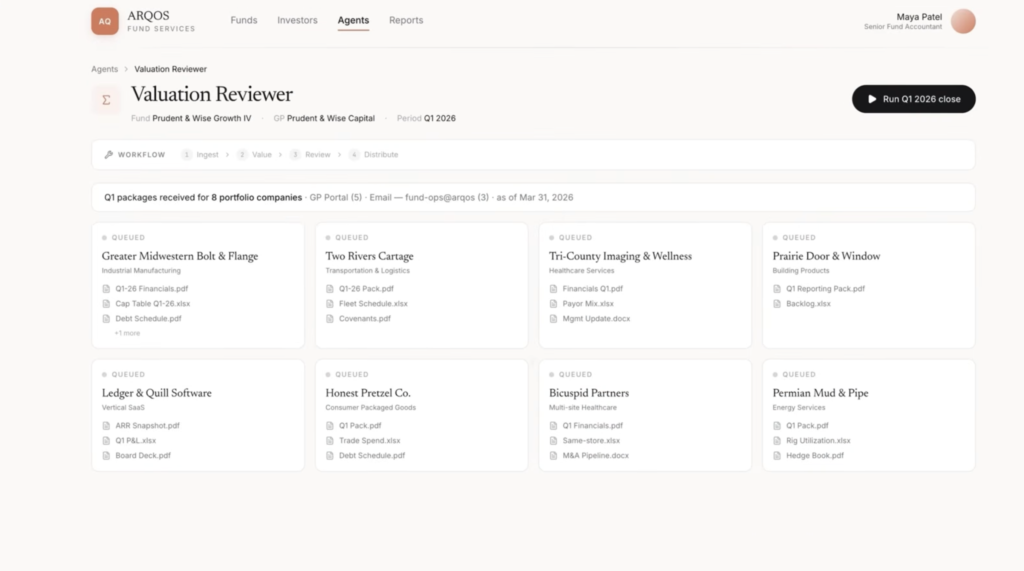
A library of Claude Cowork agents for finance, KYC, reconciliation, and reporting – Source: Anthropic
For private equity firms, this matters because Claude can become more than a chatbot for isolated tasks. Instead of using AI to draft emails or summarize documents individually, teams can use Claude to support real PE activity across multi-step workflows on repeat.
How PE Firms Can Use Claude
Most of what slows PE teams down is predictable, process-based work that still needs to get done but doesn’t always justify adding more analysts or interns. Claude can handle much of that across the deal lifecycle, from equity research and deal screening to portfolio monitoring.
For example, you can use Claude for the following:
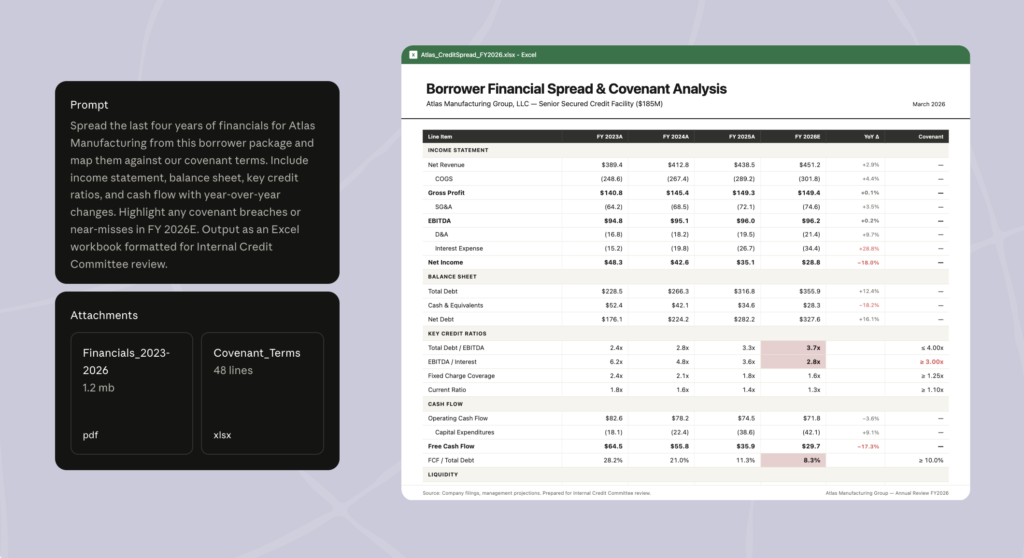
Claude Cowork generating a borrower financial spread and covenant analysis in Excel – Source: Anthropic
1. Deal Sourcing and Evaluation
Claude can review company financials, earnings calls, research reports, public information, and other available data against a firm’s investment criteria. Instead of your analysts manually screening hundreds of businesses, Claude can evaluate thousands of potential targets, score them against predefined requirements, and surface only the companies worth deeper review.
Imagine a firm intends to make 10 acquisitions. If analysts can realistically screen only 1,000 companies, they may never see many businesses that fit their investment criteria. If Claude helps evaluate 10,000 companies using the same criteria (and half the time), the firm is more likely to uncover stronger acquisition opportunities before narrowing them down to a final shortlist.
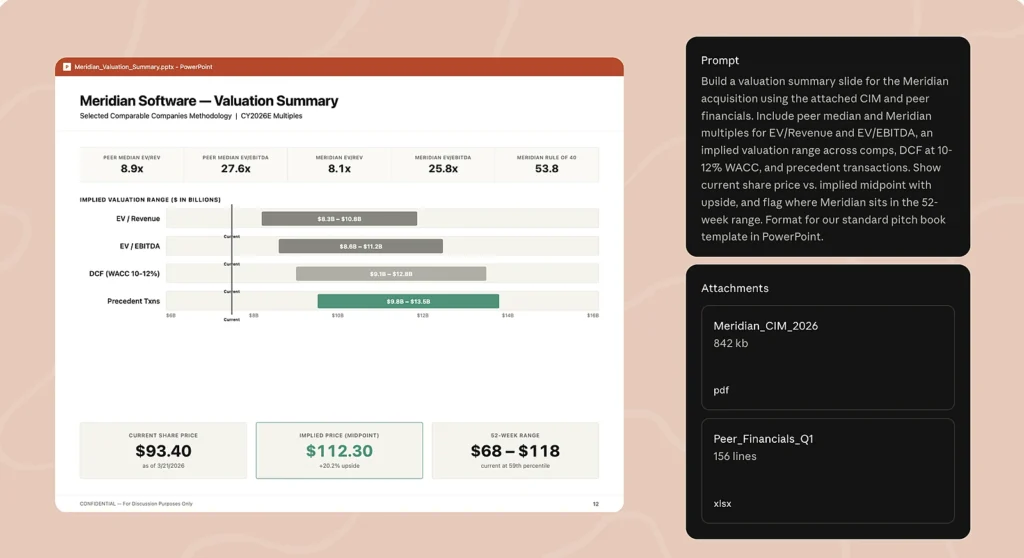
Claude Cowork pulling dashboard metrics into a weekly performance report – Source: Anthropic
2. Due Diligence
Today, firms stop investigating because additional diligence becomes too expensive or too slow.
With Claude, firms quickly gain a broader view of possible risks or red flags before making an investment decision. They can do this by looking across vast amounts of data, from teasers, CIMS, financial documents and company history to product information, hiring patterns, headcount changes, and even LinkedIn data.
This means they can investigate targets more thoroughly without slowing the deal process or having to stop digging because further analysis takes too much time or becomes too costly.
3. IC Memo Preparation
Claude can help teams turn diligence notes, comparable company analyses, market research, and risk findings into a first draft of an investment committee memo (IC memo). This doesn’t replace the investment team’s judgment, but it can reduce the time spent pulling information together from multiple sources and make sure the memo reflects the key points already reviewed.
This gives teams more time to review the analysis, challenge assumptions, and refine the final recommendation before it goes to the investment committee
4. Portfolio Monitoring
Claude helps firms monitor portfolios by reviewing and summarizing company updates, KPI reports, board materials, and management notes. This helps teams spot performance changes, risks, or follow-up items earlier.
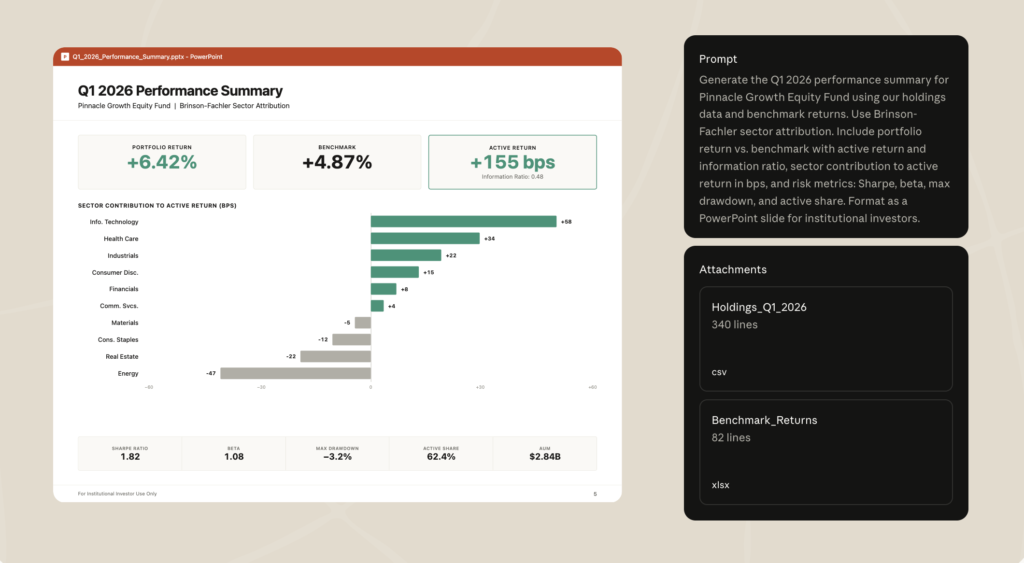
Claude Cowork creating an investor-ready performance summary from holdings and benchmark data – Source: Anthropic
5. Reporting
Claude helps firms prepare internal updates, LP reporting drafts, and recurring performance commentary faster. It does this by extracting data from quarterly results and meeting notes and creating a high quality first draft that teams can quickly review, apply their judgment to and finalize.
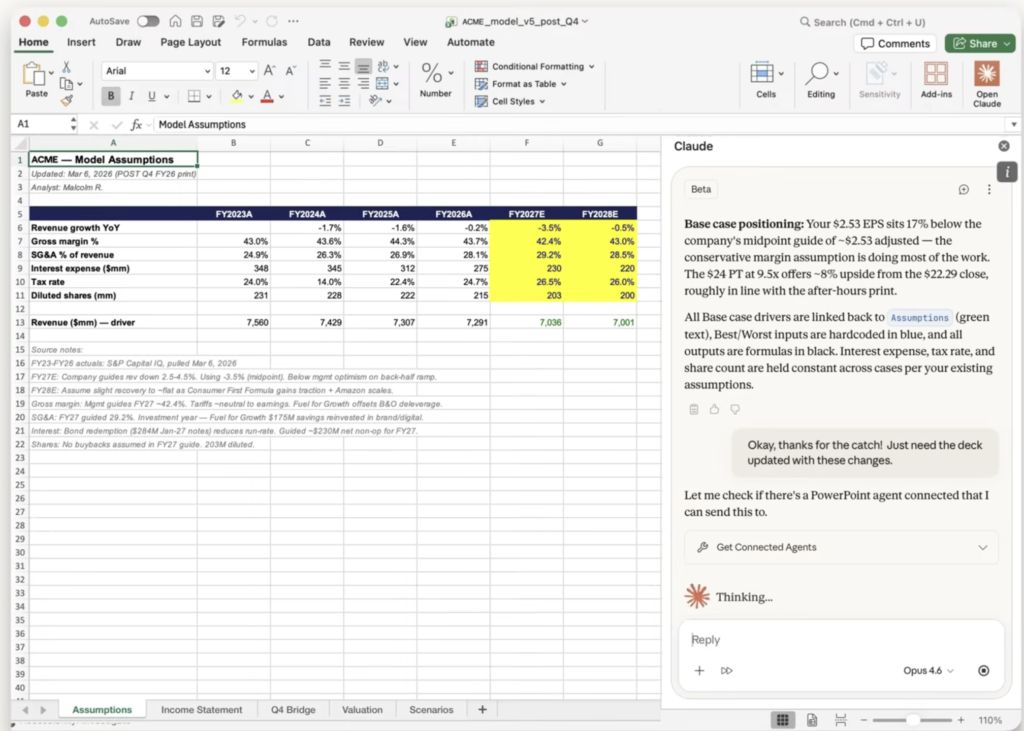
Claude Cowork updating a financial model, explaining each assumption, and sending the changes to a connected PowerPoint agent – Source: Anthropic
What to Know about Claude for PE firms Before Using It
Claude can help private equity firms move faster across sourcing, due diligence, portfolio monitoring, and reporting. But to get the most value from Claude, it helps to consider how it will access data, work across systems, and fit into your existing workflows.
Claude Is Only as Useful as The Data you Give it Access To
In private equity, information is often spread across different sources, from CRM records to deal notes, emails, and portfolio updates. If Claude only works from a prompt or a single uploaded document, its view remains limited. This means its outputs, based on incomplete data, can’t be safely used for real private equity work.
For example, a team may ask Claude to help assess a potential acquisition target. But without access to the firm’s investment criteria, past deal notes, CRM history, financial model, and diligence materials, it can’t produce a result the team can confidently use.
This still applies when teams use Claude’s PE-specific plugin. The plugin can help with tasks like market research and company screening, and access external data providers like PitchBook, S&P Capital IQ, S&P Global, and Moody’s. But, teams still need to connect it with the firm’s own systems and proprietary data with the right permissions, review steps, and usage controls in place.
So for PE firms, using Claude is not as simple as plug and play. It needs controlled access to the data your teams use every day. That way, it can support key workflows.
Agentic AI can Multiply Both Value and Mistakes
When Claude moves from individual prompts into automated workflows, every action happens faster and at a much larger scale. This helps firms process more deals, review more documents, and move work forward with less manual effort. But it also means any mistakes multiply just as quickly.
Without guardrails, an AI agent can accidentally process far more data than intended, dramatically increasing usage costs.
Imagine a PE firm uses Claude to review active acquisition opportunities each week. The workflow is designed to analyze 30 companies. However, because no guardrails restrict which CRM records the agent can access, it accidentally processes the firm’s entire database of 1,000 current and historical targets. The additional AI processing can increase costs from around $100 to several thousand dollars before anyone notices the mistake.
This is why guardrails are important from day one. The right standards and controls define what data Claude can access, how it can use that data, and when human approval or review is required.
Claude Can’t Read Your Spreadsheets the Way Your Analysts Do
Private equity teams spend much of their time working in spreadsheets, LBO models, and operating reports. However, these documents rely heavily on visual structure and formatting to convey meaning, which Claude cannot interpret in the same way as a human reviewer.
For example, a team may use Claude to review a portfolio company’s monthly KPI tracker. The spreadsheet may include revenue by business line, margin trends, customer churn, headcount changes, and management commentary across several tabs.
An analyst can quickly see which figures connect, which cells are assumptions, and which color-coded items require attention. Claude, on the other hand, may completely misread those relationships, leading to incomplete analysis or outputs that are difficult for teams to use reliably.
More accurate results are possible when firms convert spreadsheets, valuation models, and other visually structured documents into machine-readable formats that preserve the relationships between the underlying data. This often requires interfaces or data pipelines that restructure information before Claude processes it.
Claude Works Better When it Connects to Your Existing Systems
PE work spans multiple systems like data rooms and Excel models, and analysts often spend a lot of time manually transferring information between them. Connecting Claude to those systems removes those handoffs by letting the same output flow into the next step automatically.
For example, once Claude drafts a diligence summary, that same draft is automatically pushed into the CRM as an updated company note, added into a templated IC memo, and logged in the deal tracker with the latest status, valuation metrics including IRR and MOIC, and next steps. This speeds up the entire workflow, rather than just the diligence summary, helping teams move from diligence to decision faster. The same pattern applies across other workflows as well, helping teams do more with less manual effort.
Read more: Claude Cowork Alternatives for Mid-Market Financial Services Firms
Claude Creates More Value When Adoption Extends Across the Organization
PE work is connected by nature. A company identified during sourcing moves into diligence, where the team reviews its financials, risks, market position, and fit with the investment thesis.
Those findings shape the investment decision, and once the deal closes, portfolio updates inform investor reporting and any management or operational interventions.
When firms introduce AI into only one part of that process, the benefit can stall at the next team handoff.
This is why AI creates more value when adoption extends across departments and workflows. As more teams work with AI-enabled processes, each function can build on the work before it instead of slowing down at every department handoff.
Why Claude Adoption Takes More Than Installing its Tools or Plugins
Claude doesn’t automatically know your firm’s investment criteria, how your teams evaluate deals, how you review risk, or how you prepare investment memos. Instead this knowledge exists as unwritten expertise across analysts, and deal teams.
For Claude to reliably assist with investment workflows, someone has to capture that knowledge, turn it into a structure Claude can use, connect it to the right systems, and set up governance around how outputs are reviewed and used.
Firms can build this capability internally, but it often takes significant experimentation. An AI enablement partner with experience in both Claude and private equity workflows can help firms move faster, avoid common setup mistakes, and start using Claude in ways that support real deal work.
How Neurons Lab Helps PE Firms Use Claude Safely and Effectively
PE firms navigating AI adoption on their own can spend months or even years working out where it creates value, and how to use it safely and effectively across investment flows.
However, with AI enablement and support, firms can shorten that timeframe considerably.
And that’s where Neurons Lab operates. We help PE firms move from AI experimentation to AI adoption at scale.
As an AI enablement partner serving organizations across the US, Europe, and Asia, Neurons Lab combines executive training, AI adoption programs, and custom AI agent builds to support secure, practical deployment. Clients build operational AI capability aligned with core workflows, governance, and business priorities.
Trusted by 100+ clients, including HSBC, Visa, and AXA, we’ve accelerated AI integration in investment banking, wealth management, private equity, fintechs, and other highly regulated industries.
By partnering with us, you’ll:
Know Where to Start With Claude Through a Tailored AI Adoption Plan
You understand Claude’s potential, but it is not always clear how to adopt it in a way that supports real PE work. Claude can stay stuck in isolated experiments instead of improving how your firm sources deals, reviews opportunities, prepares diligence, and monitors portfolio performance. With Neurons Lab, you know exactly where to start with a tailored AI adoption program.
Through our executive AI briefing, you get aligned on where Claude fits within your firm’s operations. This gives leadership more confidence around AI adoption, including where to start, and what needs to be managed before rollout.
Our AI adoption diagnostic then looks at your workflows and where your teams spend the most time. This provides you with clarity on where Claude can create value, which use cases to prioritize, and where adoption is most likely to improve capacity, reduce manual work, or support better decision-making.
You then get a step-by-step plan built around your workflows, compliance requirements, and governance needs. That way, instead of figuring it out through costly trial and error, you have a practical path for moving Claude into key PE workflows like deal sourcing and portfolio monitoring.
Get More Done With The Same Team Through Claude-Specific Enablement
Like many mid-size private equity firms, you rely on manual work across deal sourcing, target screening, diligence, KPI monitoring, and reporting. But turning that work into Claude-supported processes is not always straightforward. As a result, capacity still depends on adding headcount.
Neurons Lab helps you move Claude into the workflows that slow down your lean teams through AI enablement built around Claude’s ecosystem.
Through AI-native workflow design, we help you integrate AI into the parts of your existing workflows where it can have the most impact, without disrupting how you already operate. That way, your team can focus on the work that actually requires their judgment, such as assessing risks, managing relationships, reviewing assumptions, and deciding which opportunities to pursue.
Role-specific training helps your teams learn how to use Claude in their day-to-day work. This includes identifying where to create reusable AI skills and how to apply Claude consistently to repeatable tasks.
To ensure safe usage, you set up guardrails with firm-wide standards for Claude use. This defines how your teams use AI, what data Claude can access, who reviews outputs, and which skills can be reused across functions. This keeps teams accountable for final decisions while Claude supports the repeatable parts of their work. That way, you can review more opportunities, reduce manual effort, and keep workflows running with the same team.
Set Up Claude Around the Way Your PE Firm Works with A Practical AI Adoption Partner
You may be ready to install Claude and its PE plugin so your teams can use AI across deal and portfolio workflows rather than isolated tasks. While the PE plugin is a strong starting point, it doesn’t automatically know your firm’s investment criteria, deal history, internal data, workflows, or review steps.
Without that context, Claude can produce generic outputs that don’t reflect how you assess targets, manage risk, review diligence, or track portfolio performance. With Neurons Lab acting as your practical AI adoption partner, you can set up Claude and its PE plugin around your investment expertise and operating model.
We help you capture the knowledge that lives in people’s heads, team habits, checklists, and internal processes. Then, we turn that expertise into structured context Claude can use to support how work actually gets done. This includes surfacing opportunities that match your sector focus and deal size, flagging risks based on past deal outcomes, aligning diligence summaries with your review standards, and generating portfolio insights using your preferred KPIs and reporting formats.
How a European Venture Capital Firm Enabled Claude Cowork Adoption Across Its Investment Team
A European venture capital (VC) firm partnered with Neurons Lab to build structured AI adoption across analysts, partners and fund operations.
Their analysts were losing hours per deal on sourcing research, diligence prep, and memo drafting. They didn’t have a shared playbook and their source material was spread across disconnected systems.
Together, we co-created the firm’s AI strategy, and tailored Claude Cowork workshops around six core investment workflows, covering deal sourcing, diligence, memo drafting, portfolio monitoring and LP comms. This enabled teams with hands-on practice and a shared approach to using Claude across investment activities that they could apply immediately.
Alongside the workshops, we helped the VC develop a shared AI toolkit and an AI strategy roadmap to standardize how they use Claude across the investment team.
The program accelerated adoption, reduced duplicated effort, and established repeatable AI workflows across the investment lifecycle.
Access to Claude Is Just the Starting Point
Getting value from Claude takes more than giving teams access to the plugin. Firms need to connect data in the right way, control what Claude can access, turn internal knowledge into a format AI can use, and set clear rules for how outputs are reviewed. Without this foundation, Claude may stay limited to basic tasks instead of supporting real PE workflows.
Neurons Lab helps firms put these pieces in place. As an AI enablement partner, we help you move from Claude access to practical adoption, with the structure needed to use it safely, consistently, and in ways that support real firm outcomes.
Ready to move Claude from interest to practical use across your PE workflows? Neurons Lab can help. Book a call with us today.
FAQs
Will private equity teams be replaced by AI?
No, private equity teams won’t be replaced by AI. Instead, it will help them work faster by reducing manual research, document review, reporting, and analysis work. Teams will still have to apply their judgment and make the final call on deal quality, risk, management strength, valuation, investment fit, and value creation potential.
Where should PE firms start with Claude?
PE firms can start with enablement led by a partner who understands Claude, AI, and private equity workflows. This helps them identify the right use cases, prioritize frequent and measurable tasks, and set clear standards for using Claude safely, consistently, and with the right data access.
Is Claude safe to use with sensitive deal data?
Yes, Claude can be safe to use with sensitive deal data when the right controls are in place. Private equity firms can apply enterprise guardrails, define which systems and documents Claude can access, and establish governance standards for how data is used, reviewed, and protected.