
If you’re looking for an AI strategy roadmap, you may currently feel under pressure from two directions:
- New AI capabilities and tools like Claude Cowork and Microsoft Copilot are emerging faster than you can evaluate them
- Competitors are already using AI to improve workflows like investment research, client servicing, and onboarding, and to drive operational efficiency across the firm
For investment banks, capital markets and other financial services firms, this makes planning difficult. Where can AI create the most value? Which initiatives deserve investment? And how do you expand adoption without increasing governance, security, or compliance risks?
Without a clear roadmap, AI efforts often become fragmented. Different departments pursue different priorities and use different tools, and leadership lacks a consistent approach for evaluating and scaling AI initiatives.
But it doesn’t have to be this way. In this article, we’ll show you how to build a roadmap that helps prioritize AI investments, govern adoption, and scale AI across your firm.
Read on to discover:
- How to Build an AI Strategy Roadmap for Financial Services
- Key Considerations for Your AI Roadmap
- Why Partner With Neurons Lab to Create Your Roadmap
- FAQs
Want to build a step-by-step AI strategy roadmap tailored to your firm’s goals and operating reality? Neurons Lab can help. Book a call with us today.
How to Build an AI Strategy Roadmap for Financial Services
An AI strategy roadmap—also known as an AI implementation plan—provides a structured approach for how your firm will adopt and scale artificial intelligence in a way that is practical, compliant, and tied to real business outcomes. It defines:
- Where AI can create the most value
- Which use cases to prioritize
- Who owns adoption
- How to measure success through clear KPIs
- What governance is required as implementation expands
It also gives leadership a clear view of what needs to happen now, what should happen next quarter, and which initiatives belong in longer-term planning. In this way, you can fund, govern and scale AI initiatives as part of a coordinated business strategy and coherent operating model, rather than a series of isolated projects.
Here are the steps to build an effective AI strategy roadmap:
1. Align Leadership On A Unified AI Vision For Your Business
When building an AI strategy roadmap, start by securing executive sponsorship and leadership buy-in from your C-suite, operational leaders, change management leaders, and other senior stakeholders on a shared view of what the firm wants to achieve with AI.
If leaders aren’t aligned, each function may push the firm in a different direction. Your investment team may want AI for portfolio research and market analysis, while compliance prioritizes AI-assisted review and audit trails, and operations focuses on automating fund administration workflows.
Strategic alignment means defining your AI ambition, understanding your current operating and competitive reality and agreeing on where AI can create value, which risks need to be managed, and how AI adoption should be prioritized across the firm.
This includes clarity on investment in AI tools, feasibility checks, and timelines for what should happen in the next 30 days, what should happen in Q1, and what should be phased into later quarters.
Executive alignment also means getting leaders on the same page about core AI concepts and terminology.
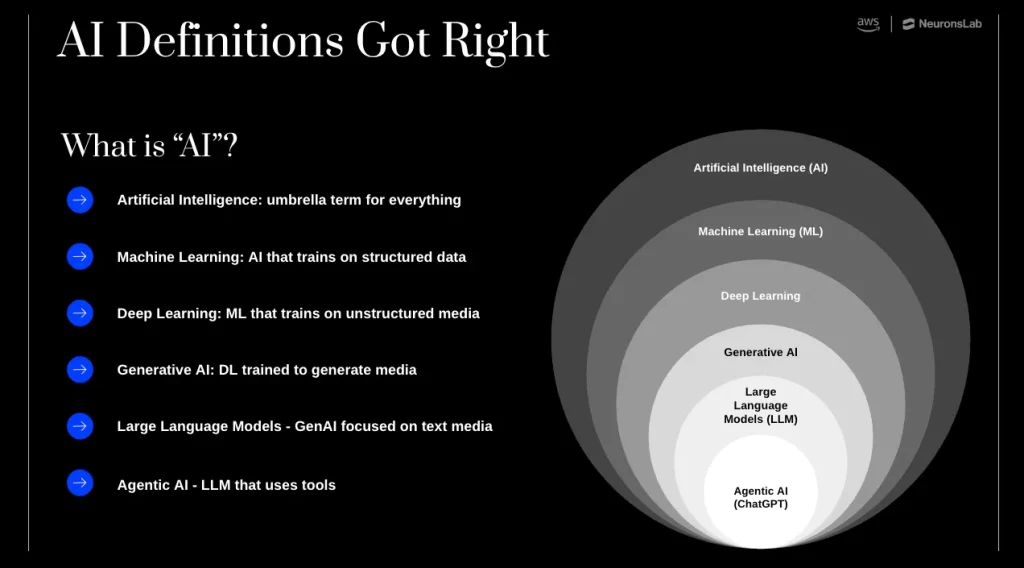
An example of executive AI training that covers core AI concepts and terminology – Source Neurons Lab
For example, a CEO may hear “AI” and think of generative AI tools like Claude or ChatGPT. A CTO may think of agentic AI systems that connect to internal data and execute tasks across workflows. An operations leader may think of automation for onboarding, reporting, claims, KYC, or payment operations.
Without executive alignment, teams may invest in disconnected tools, duplicate work, and create gaps in governance, quality, and oversight.
For a deeper look at leadership alignment, discover Why AI Training Often Falls Short for Financial Services Executives (And What Actually Works)
2. Launch Pilots Connected to Priority Use Cases
Once leaders are aligned and an initial strategy defined, launch a small number of pilot projects tied to your highest-priority AI use cases to understand what works in practice before expanding adoption across the firm.
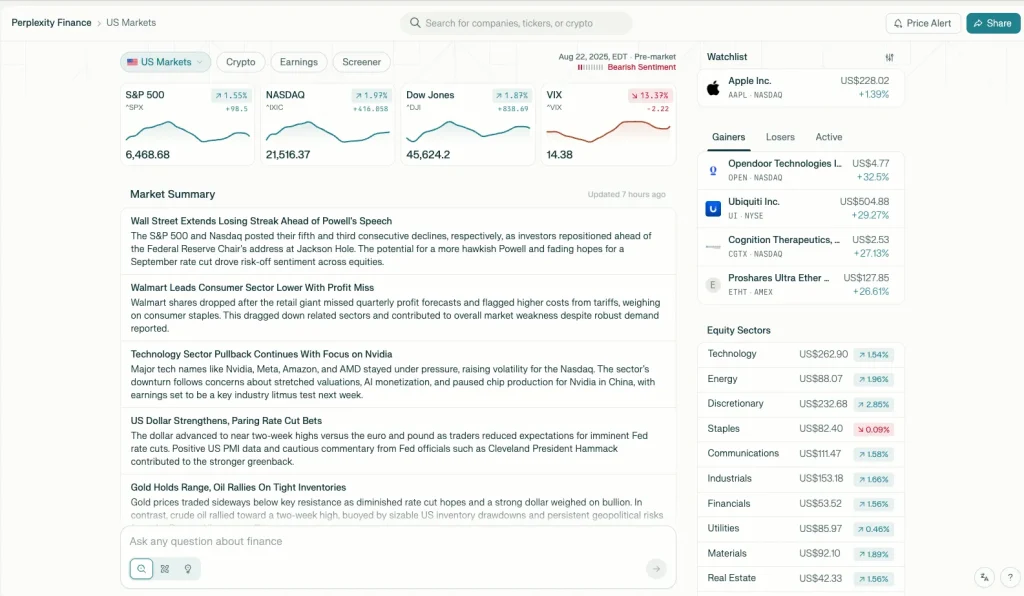
Perplexity finance interface
For example, if your strategy is to improve relationship manager productivity, you might pilot an approved AI workflow for client meeting prep. Or, if you’re an insurer focused on faster claims handling, you might test an AI workflow that helps claims teams check policy details and prepare first-pass case notes for human review.
With pilots, you assess your firm’s AI readiness, prove which use cases work, understand what support teams actually need, and reveal where governance, security, or workflow changes are required before wider rollout.
3. Define AI Champions
Next, define AI champions who can help embed AI from the ground up.These are employees who understand how AI applies to their function and can help colleagues integrate it into daily workflows. Depending on the size of your firm, champions might be functional leaders, motivated team members, or other influential individuals within the organization.
Champions turn your roadmap into proven results teams can observe and build on.
For example, a champion in your investment team might show other members how Claude Cowork can create a valuation summary faster, while a champion in compliance might share how AI speeds up regulatory review.
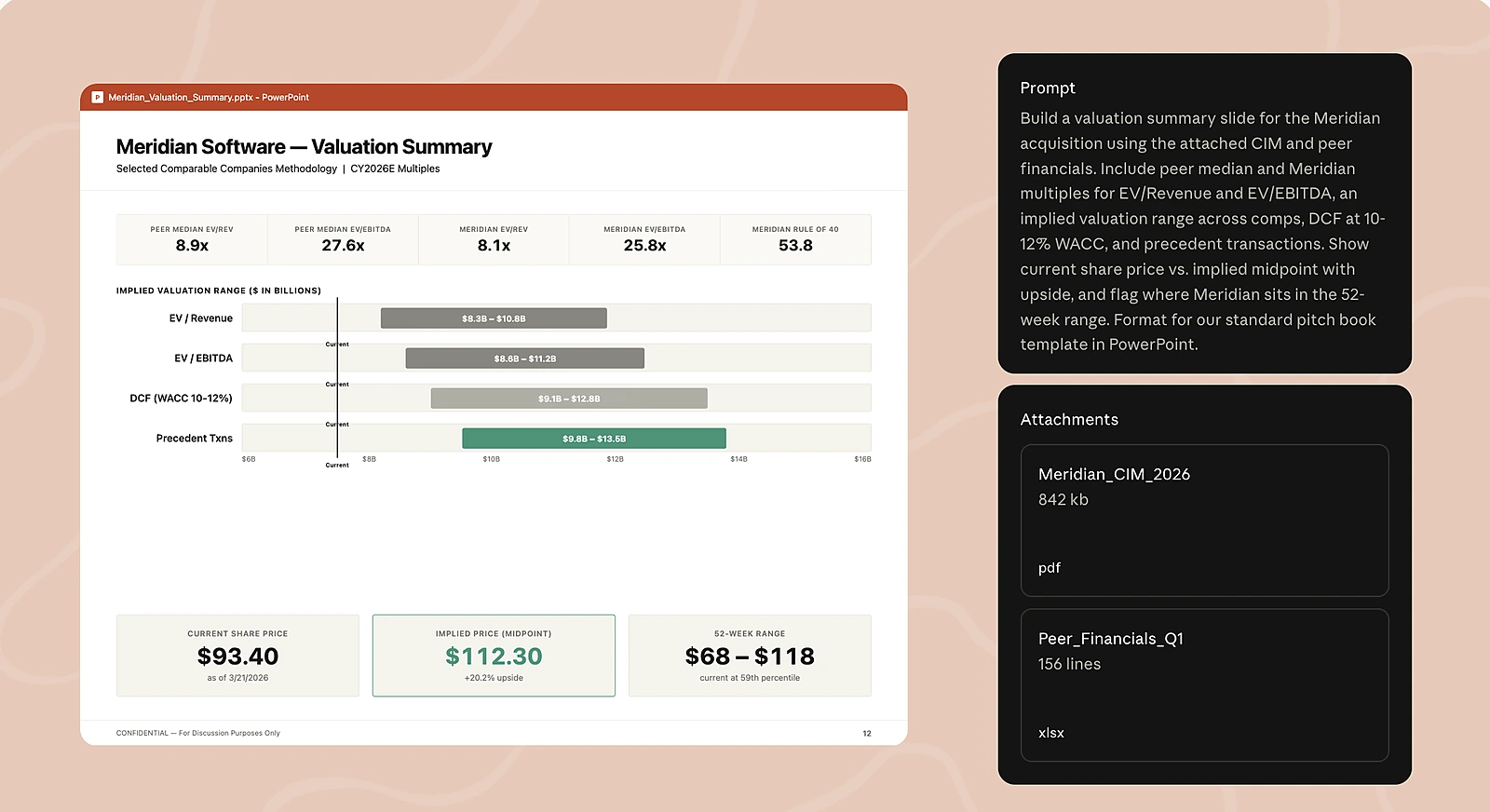
Claude Cowork valuation summary output
They also help you identify what works, where teams are struggling, and what needs to change before you roll AI out across the entire firm. During implementation, champions also motivate skeptical colleagues by showing them what successful AI use looks like in practice. This helps teams build confidence and adopt AI faster.
When teams start using AI in practice, leadership also needs a bottom-up view of what is changing across the organization.
4. Embed AI Into Daily Workflows from the Bottom Up
Once your strategy has traction through pilots and champions, the next step is embedding AI in day-to-day operations. This is where AI moves beyond experimentation and becomes part of repeatable processes, regulated workflows, governance processes, and performance expectations.
If you don’t keep building on that momentum, you risk teams slipping back into old ways of working and your progress falling through.
To ensure adoption expands, leaders need visibility into what is happening on the ground. Teams may require additional training, clearer review standards, or access to approved data sources. Capturing this feedback helps leadership refine the roadmap, strengthen governance, and identify which use cases are ready for broader rollout.
The goal is to create a continuous learning loop between leadership and frontline teams, where strategy guides adoption and operational experience improves the strategy over time.
Key Considerations for Your AI Strategy Roadmap
Building a roadmap is only the first step. To turn it into firm-wide adoption, address communication, governance, enablement, and change management. Here are some of the most important considerations.
Communicate What Success Looks Like Across the Firm
A strong roadmap doesn’t only align leadership. It also communicates that vision across the firm, so everyone understands what AI success looks like and their role in making it happen.
For example, after C-suite executives have determined the vision, senior leaders connect AI to business priorities, middle managers understand how AI changes their teams’ workflows, and teams learn how to use AI in their daily work.
This ensures the firm’s AI strategy is clear to everyone before implementation, so they can play their part in turning the strategy into compliant, lasting AI adoption.
Address Common Obstacles That Can Derail Your Roadmap
A strong roadmap anticipates the issues that commonly slow or derail AI adoption. Here are some of the most important areas to address:
- Reducing employee sabotage: Some employees may resist AI because they fear being replaced or have ethical considerations about how it is used in their work. An effective roadmap accounts for this with clear communication and role-specific training that shows teams how AI can support their roles rather than replace them.
- Eliminating Shadow AI: Employees may use unauthorized AI tools, creating risks around data privacy, client data security, and compliance. A clear roadmap defines approved tools, usage policies, and safe ways for teams to experiment within the firm’s governance framework.
- Providing education: Some leaders and middle managers may be too far removed from actual workflows to understand how AI applies to their function. Without that context, they can struggle to approve the right priorities, review AI-assisted outputs, or keep adoption aligned with business goals.The right roadmap closes this gap through targeted upskilling, hands-on workshops, and practical demos.
- Prioritizing AI governance: An effective roadmap defines who owns each AI system, who maintains it, and how outputs are reviewed. This ensures clear accountability, reduces compliance risk, and keeps AI use controlled as adoption expands.
- Choose your champions carefully: Not every high performer is capable of motivating others. The strongest champions are people who actively use AI in their work, can demonstrate practical results, and are willing to share what they’ve learned with others. Selecting the right individuals can significantly improve adoption across teams.
- Preserving human thinking and critical judgment: As teams use AI more often, there’s a risk that they’ll start accepting AI outputs without questioning them, even when the answer is incomplete, generic, or wrong. An effective roadmap prevents low-quality AI results by setting clear standards for review, feedback, and accountability. That way, AI supports rather than taking over human expertise.
Decide If You Can Implement a Roadmap In-House or If You Need A Partner
For your AI strategy roadmap to lead to real adoption, start by assessing your firm’s AI maturity, then decide whether you can handle implementation in house or need an external partner.
This is key because the route you choose determines what happens next. It also shapes the resources you need, the expertise you need to bring in, and how you’ll move from planning into real adoption.
If you’re going to handle adoption in-house, you’ll need the right mix of AI expertise, financial services knowledge, and change management know-how. It’s also important to consider how you’ll operationalize your roadmap. That means looking beyond strategy and asking what it will take to move into deployment and implementation.
For example:
- Do you have the technology infrastructure and data management capabilities to connect AI tools to your systems and data sources?
- Do you have a clear data strategy that supports the AI use cases you want to prioritize?
- Can you set up the right governance, review processes, and evaluation frameworks?
- Do your teams know how to use AI in their actual workflows, rather than only in isolated experiments?
On the other hand, if you choose to work with a partner, ensure they understand both AI and your specific sector. Also, check whether they can support you online or onsite, and if they can help beyond strategy with training, rollout, and ongoing adoption support. That way, you’re not navigating the complexity of moving AI into your operations alone.
Why Partner With Neurons Lab to Create Your AI Strategy Roadmap
Many Financial Services firms already know where they want artificial intelligence to create value. The challenge is turning that vision into adoption across teams, workflows, and regulated environments.
Neurons Lab helps financial services firms close that gap through executive alignment, role-specific enablement, and production-grade AI implementation.
Trusted by more than 100 clients across the US, Europe, and Asia, including HSBC, Visa, and AXA, Neurons Lab is an AI enablement partner that helps financial services organizations build AI capabilities that can be adopted, governed, and expanded over time. Our work spans executive education, workforce enablement, and custom AI systems designed around the realities of regulated environments.
By partnering with Neurons Lab, you gain the expertise, structure, and implementation support needed to turn your AI roadmap into measurable business outcomes. Here’s how:
Set a Clear Strategic Vision For Your AI Roadmap
With AI changing so quickly, it can be hard to know which approaches, use cases, and tools actually matter. Neurons Lab provides the strategic clarity you need to build a roadmap that works for your firm.
We do this through our executive alignment workshop, where your leadership teams build a shared AI vision and identify exactly where AI can create the most value. That way, instead of waiting for the market to settle or letting competitors pull ahead, you can move forward with confidence.
For example, when a major global bank wanted its senior leaders to better understand AI and help their teams adopt the bank’s internal AI tools, Neurons Lab delivered personalized Executive AI Training. The workshop brought together 50 participants, including heads of business units, procurement, compliance, customer experience, and other senior leaders.

Neurons Labs hands-on training covers how to use AI across specific roles
Unlike previous AI training the bank had received, which focused heavily on theory, we built the workshop around practical application and the bank’s operating reality as a regulated financial services institution with strict data and compliance requirements.
The workshop covered AI foundations, strategic AI outlook, executive AI literacy, and guided, hands-on exercises using tools. It also explored BFSI use cases, governance, competitive intelligence, and a clear AI implementation roadmap.
As a result, executives built AI literacy through practical experience. They came away more engaged and confident about AI, and better prepared to champion internal AI tool adoption with middle management and their wider teams.
Move AI Into Your Workflows with Role-specific Enablement and a Shared AI Layer
When you don’t have a clear playbook for implementing your roadmap, AI adoption often stalls or stays stuck in experiments and isolated tasks. AI use can also become scattered, exposing you to compliance risks from poor governance or data leaks from shadow AI. With Neurons Lab, you can move AI into your workflows in a controlled and compliant way.
Through tailored enablement training, your teams learn how to apply AI to their specific roles, how their workflows need to change, and how to use AI safely. The result is measurable business value through faster work, higher output, and better use of their time.
To ensure governance and AI use that’s unified rather than fragmented by team or department, we also help you establish a shared AI layer. This includes data infrastructure, reusable AI capabilities, and clear usage policies that address shadow AI, protect sensitive data, and keep AI adoption controlled as it scales. Where needed, we also help identify the high-quality data sources your AI systems need to produce reliable outputs.
The evaluation frameworks and human accountability standards we help set up monitor AI quality before issues such as model drift (i.e., where outputs become less reliable over time) affect your workflows. They also make clear where employees remain responsible for reviewing outputs, so AI supports human judgment instead of replacing it.
For example, one of our leading bank clients wanted its marketing team to create campaigns faster, analyze performance data more clearly, and personalize messages across multiple customer groups.
Neurons Lab designed and delivered a practical agentic AI enablement program built around the marketing team’s daily workflows.
The sessions focused on using AI tools for real tasks, including creating campaign assets, refining messaging for specific audiences, summarizing insights, and speeding up routine production work. Through guided exercises, the team also learned how to use agentic AI safely in their work and spot new ways to improve work across channels.
As a result, the bank reported a 20% improvement in speed and effectiveness across its core marketing workflows. The marketing team was also 98% satisfied with the course trainer’s presentation style and 92% satisfied with the course overall.
Keep Your AI Strategy Roadmap Adaptable as AI Changes
As a financial services firm, it’s important to have an AI strategy that can keep up as AI evolves, regulations shift, and more complex business needs emerge. With Neurons Lab, you can stay ahead of new developments and ensure your roadmap stays relevant.
Through our post-adoption approach, Forward-Deployed Engineers can embed with your teams to support rollout, refine workflows, and update AI capabilities. That way, your roadmap keeps delivering revenue growth and measurable business value.
And when your use cases become too complex for existing AI tools, Neurons Lab can help you build custom agents tailored to your strategy.
For example, relationship managers (RMs) at an Asian bank were spending significant time on manual tasks, compliance checks, and data gathering across multiple legacy systems. The bank needed a way to increase relationship manager capacity and client coverage without adding headcount.
Neurons Lab built a custom agentic solution that supports RMs with daily opportunity prioritization, market intelligence, meeting prep, and personalized product recommendations, all through a single conversational interface.
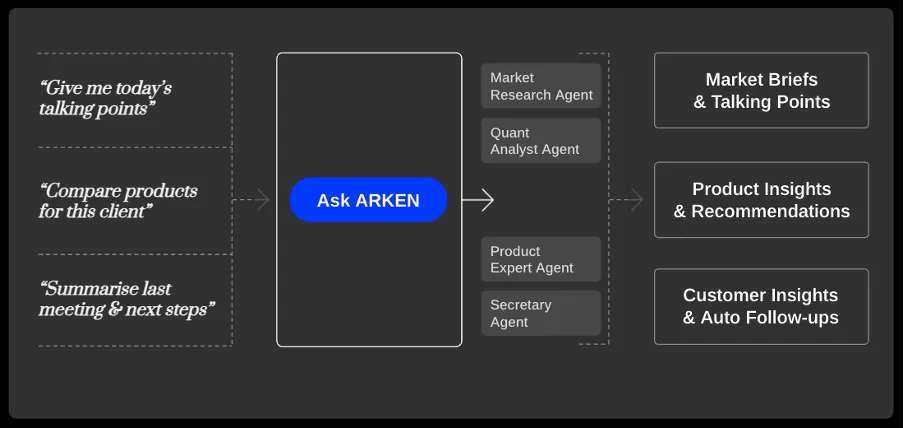
A custom copilot solution designed to support relationship managers through a conversational interface
As a result, the bank has achieved:
- 20+ additional RM capacity without new hires
- 2x increase in clients reached each month.
- A 15% uplift in net promoter score (NPS) through more consistent, personalized RM engagement
This means, instead of your roadmap being a one-time plan, you can adapt it as needed. You can start with practical adoption, keep improving what works after rollout, and build custom agents when AI tools like Claude Cowork are no longer enough.
Choose Neurons Lab for a Tailored, Strategic AI Roadmap
The right AI strategy roadmap helps you move from scattered AI use to a structured, organization-wide approach that delivers measurable business value. As a financial services firm, this starts with a clear strategy shaped by your operating reality and built around how your firm wants to win.
From there, it connects strategy to execution: aligning leadership, prioritizing the right use cases, giving teams role-specific training, embedding AI into real workflows, and putting the governance in place to scale adoption safely.
It also helps your firm create value now while staying flexible as AI tools, regulations, and business needs continue to evolve. Getting it right without expert guidance can be challenging.
So consider working with an AI enablement partner that combines AI expertise, FSI knowledge, implementation support, and post-adoption guidance. That way, you build an effective AI strategy roadmap your firm can act on, measure, and adapt over time.
Want a practical roadmap from AI strategy to implementation? Get in touch with Neurons Lab today to discover how.
FAQs
What is an AI strategy roadmap for financial services?
An AI strategy roadmap for financial services is a structured plan for turning AI into real business value. It helps firms move from scattered AI use and low-impact experiments to compliant, firm-wide adoption (tracked through clear success metrics) that delivers productivity gains. It sets the vision, key priorities, timelines, principles, use cases, governance steps, and implementation.
How can financial services firms keep up with a rapidly changing AI landscape?
Financial services firms can keep up by building a roadmap that covers current priorities, long-term AI vision, enablement, governance, and evaluation. Ideally, it’s flexible enough to change as AI tools, regulations, and business needs evolve. Working with the right AI partner also helps firms adapt their approach, including moving into custom AI development when standard tools are no longer enough.
How can financial services firms move AI from experiments into real workflows?
Financial services firms can move AI from experiments into real workflows with a clear strategy, practical roadmap, and role-specific enablement. This helps teams connect AI tools to daily tasks, apply governance, evaluate outputs, and use AI consistently across departments.