
If you’re researching AI for family offices it’s likely that:
- You’re already experimenting with AI, but it’s unclear which use cases to prioritize or what controls to put in place.
- AI is useful for surface-level tasks like drafting client emails, but it falls short when you try to use it to support workflows like target screening or reporting.
- You’re struggling to increase deal flow beyond brokers, bankers, and existing relationships, while expanding capacity for sourcing, diligence, and portfolio coverage still depends on adding more headcount.
While you’ve heard that artificial intelligence can benefit family offices, you’ve yet to see real productivity and cost efficiency for your office. To help you adopt AI in a way that creates value, we cover:
- Where AI Can Help Family Offices: Top Use Cases
- Why Many AI Projects Struggle to Create Measurable Value for Family Offices
- How Family Offices Can Become AI-Enabled
- How Neurons Lab Helps Family Offices Adopt AI
- Case Study: How a US Wealth Management Firm Enabled AI Adoption Across Its Advisory Team
- FAQs
Want to implement AI across your workflows in a way that reduces costs, saves time, and increases revenue? Neurons Lab can help. Get in touch with us today.
Where AI Can Help Family Offices: Top Use Cases
Whether you serve high-net-worth families through a single-family office or multi-family office, you face the same pressures: staying lean while protecting returns and handling growing workloads without inflating costs.
However, with a lean team, there are only so many deals you can source, screen, and monitor. Addressing this by hiring more people, brokers, and family office software only creates higher overhead that eats into your returns.
When implemented correctly, AI provides the right balance. It lets you scale your efforts across the entire investment lifecycle, bringing in more and higher-value deals without increasing costs and helping your office stay agile in the process. Here’s where AI can help:
Sourcing Deals
Your relationships with brokers, bankers and advisers are valuable, but they limit your pipeline to what your existing network brings in. This creates a deal flow problem. Your office may miss good companies that sit outside that network, and your team doesn’t have enough time to research or track a wider set of opportunities.
AI reduces that dependence by doing more of the research and tracking work for you. It enables your office to build a pipeline proactively. You can build watch lists of companies to follow, gather public information on targets, identify relevant contacts, and find counterparties such as lenders, sector specialists, or possible introducers.
This way, you source more of your own deals, uncover opportunities outside your network, and improve the quality of your pipeline.
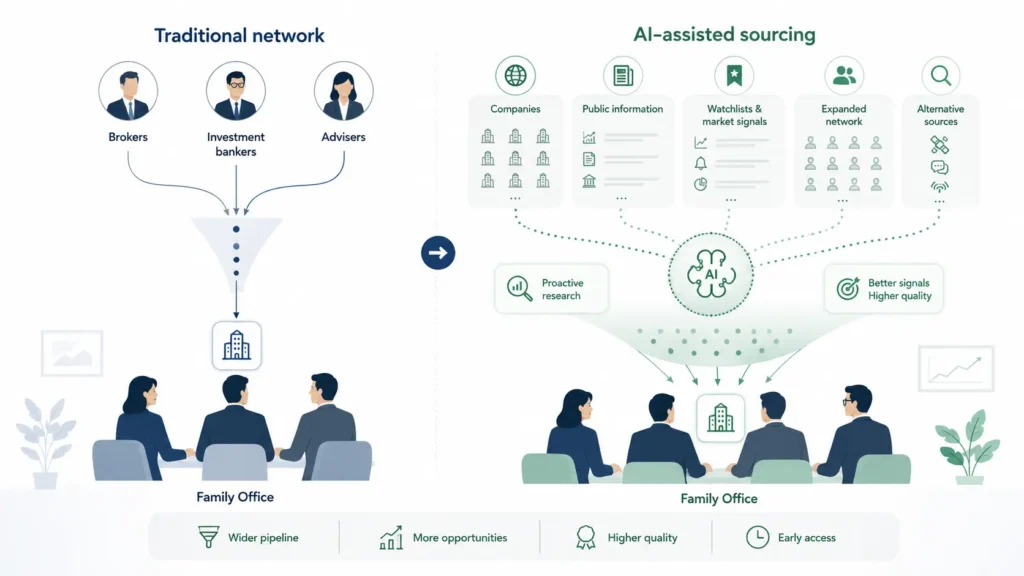
Deal sourcing without AI vs with AI – Image created with ChatGPT
Screening Deals
Family offices have to assess whether each target, from real estate assets to operating businesses, matches their investment criteria. In a lean team, this often means manually reviewing company materials, public information, financial details, and market fit.
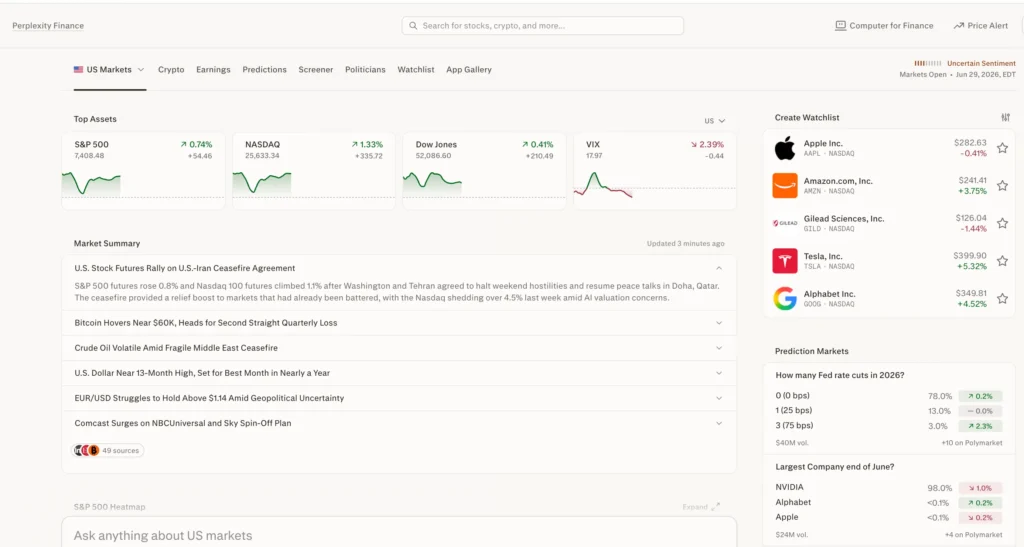
Market evaluation from Perplexity Finance
There’s only so much you can review by hand, so deals often get chosen from a small set rather than as the best opportunity from a wider market. That limits your office’s earning potential.
AI lets you evaluate far more targets against your criteria. You can choose the best 10 opportunities from 10,000 rather than from 1,000. As a result, the deals you select are far more likely to be of a higher quality, which raises the chances of a higher return.
Conducting Due Diligence
The work of reviewing company documents, checking assumptions, and looking for risks before investing spans a variety of unstructured data. This ranges from from reading financials and customer information to studying company history, ownership details, and market signals.
When a small team is stretched, deeper checks can get skipped simply because there isn’t enough time. This increases the chance of missing risks that could affect deal quality, valuation, or future returns.
AI helps by reviewing these key materials documents faster. It can trace company history, analyze past acquisitions or sales, review hiring and departure patterns, assess customer reviews, and check product demos or online materials for risk signals.
This way, you conduct deeper diligence faster and catch any issues before you invest. It also helps you reduce the risk of poor deals and protect your returns.
Monitoring Portfolio Companies
If your family office acts as an operator, you also monitor your investments long after a deal closes to keep your returns stable. This often includes collecting reports, checking KPIs, reviewing management updates, tracking performance, and actually supporting portfolio companies on an operational level.
For lean teams, this creates a constant trade-off. Deeper monitoring takes more time, but adding more people increases costs and lowers margins.
AI strengthens investment reporting by pulling portfolio data together across your companies and continuously checking performance against KPIs. It can also summarize updates and use anomaly detection to flag where a company is moving off plan, and where you need to look more closely at its operations.
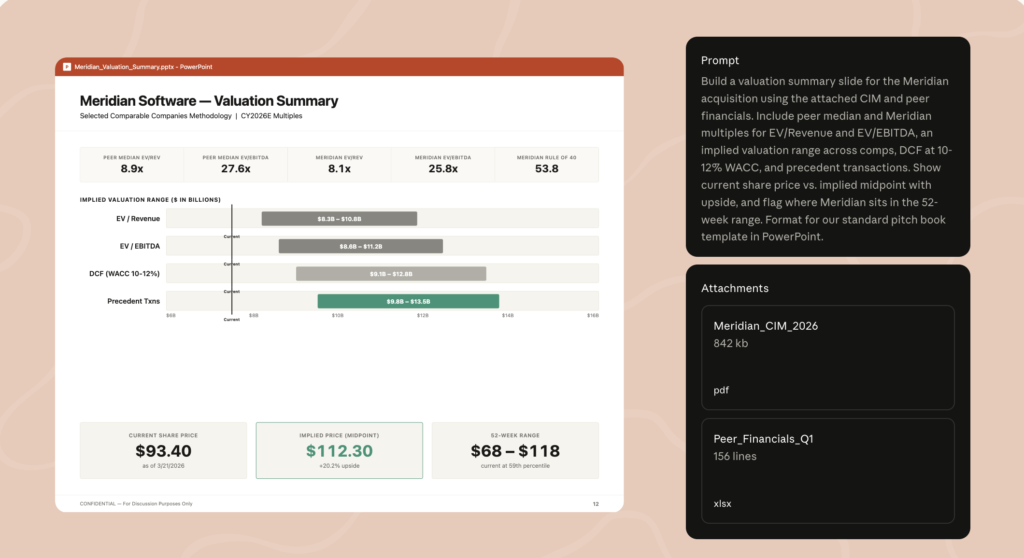
A sample valuation summary prepared with Claude Cowork – Image Source: Anthropic
As a result, you can manage companies more efficiently with the same team and spot warning signs earlier, minimizing the risk of losses.
AI can improve how family offices find, evaluate, and manage investments. But without the right setup, those gains can be limited by a lack of data, poor controls, or disconnected workflows.
Why Many AI Projects Struggle to Create Measurable Value for Family Offices
For family offices, the challenge is whether AI improves the workflows that drive deal flow, strengthen risk management, and expand portfolio coverage. AI projects typically fall short for two key reasons:
AI Isn’t Connected to Data or Workflows, So Value Gets Stuck
Many family offices start by experimenting with generative AI tools like ChatGPT. But these tools only use the context you provide while prompting them. They don’t automatically pull from your wealth data (e.g., your CRM, deal history, investment criteria, screening rules, decision logic, or portfolio records). This leads to incomplete outputs you can’t rely on for high-stakes investment work.
You’re also limited by the fact that these tools work one prompt at a time. You may ask AI to screen companies and create a shortlist, but because it isn’t connected to your CRM, you still have to move that shortlist into the CRM yourself. Then, you might ask AI to summarize diligence notes and paste that summary into a document because AI can’t access your files.
So even though AI speeds up some tasks, the overall workflow stays slow and value limited.
The same issue can show up across diligence, reporting, and portfolio monitoring. AI may help with individual tasks, but your team still has to move information between systems, repeat work, and check incomplete outputs. As a result, AI doesn’t improve the full investment lifecycle. Without the right integrations, family offices see limited gains in deal flow, risk management, decision speed, or portfolio coverage.
AI Is Set Up Without Enough Control, Increasing Risks
AI mistakes can quickly become expensive when you’re moving large amounts of capital, and when controls, review steps, and cost limits aren’t set up properly.
Consider a family office where a missing rule in its investment CRM causes archived deals to be marked as active. Instead of AI processing a small number of live opportunities, it works through the office’s full history of 1,000 records. In a matter of hours, the cost of running that agent jumps from around $100 a day to $5,000, costing the firm 50 times more than planned for one day.
This is just one example of what can go wrong when AI isn’t set up properly. Poor data governance can also expose confidential family, investment, or portfolio data, allow AI to act on the wrong information, or lead to decisions being made without proper oversight or accountability. Instead of seeing increased operational efficiency and asset value, family offices may face higher costs and risk and new compliance issues.
As we’ve covered, AI can only create measurable value when it becomes part of how a family office works. That means connecting it to the right data, embedding it across workflows, and setting guardrails around what AI can access, change, or act on.
How Family Offices Can Become AI-Enabled
While the two failure modes we just covered above can be challenging for family offices to navigate, you can work through them with the right approach, processes, and guidance. Here’s how to get started.
1. Document the Way You Work
Documenting your investment processes turns how your family office selects deals into structured knowledge AI can use. It also gives your team a shared reference for how decisions are made across your office.
As a starting point, record the sectors you focus on, the company sizes you consider, the financial metrics you look for, the risks that usually rule a deal out, and the exceptions that may change the decision.
2. Test and Refine Your Processes
Testing your documented processes with AI helps uncover gaps, inconsistencies, and missing criteria before they show up in live workflows. Over time, this makes AI more reliable across your investment cycle.
For example, let’s say you feed AI the process you defined for selecting deals. AI then gives you a company your team would reject, even though it matches the written criteria. This immediately reveals a gap in the process, and your team can identify where the mismatch came from. If the issue relates to weak management or sector exposure, that condition can be added to the criteria. Each run gives your team something concrete to review and refine.
3. Create a Knowledge Base AI Can Learn From
A knowledge base gives AI access to your firm’s financial data, deal views, exceptions, principal preferences, and decision logic. With that context, AI can move beyond experiments and become genuinely useful in day-to-day work.
You can build a knowledge base by digitally recording your internal and external meetings and providing AI with the meetings’ transcripts. Compared with manual note-taking or other ad hoc methods, this approach is low-friction and doesn’t require teams to change how they already work
By capturing and storing this information in one place (with data integrity maintained across sources), you give AI a structured source it can draw from to support the workflows that shape your investment decisions.
4. Start Using AI
Choose an AI tool like Claude Cowork and use it to run frequent, repeatable workflows like investment analysis, deal research, meeting notes, portfolio reporting, and investment memos. This helps your team learn by doing while also revealing where AI is most effective, where standard tools are enough, and where custom AI solutions are needed for more advanced workflows.
Once you’ve identified the use cases worth scaling, agentic AI tools like Claude Cowork can add even more value by working more directly with your files, systems, and workflows.
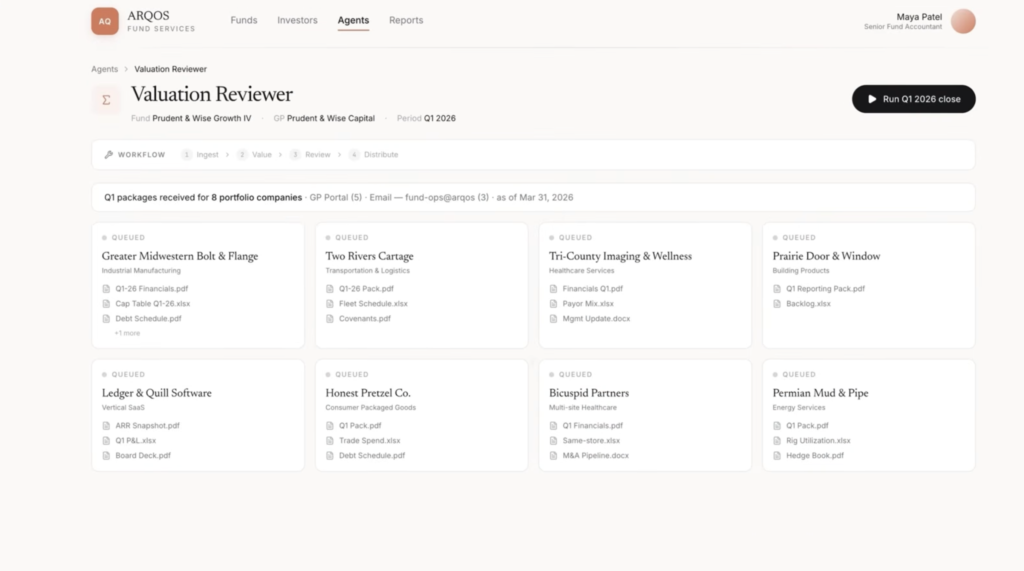
Claude Cowork can work directly with files and review steps, as shown in this valuation workflow. – Source: Anthropic
Read more: What can you do with Claude Cowork in Financial Services?
5. Consider How You’ll Adopt AI
If you want to keep adoption in-house, you’ll need to figure out data preparation, testing, AI controls, tech stack integration, workflow prioritization, and how to expand AI use across your office over time. For a small team, this can quickly pull attention away from day-to-day operations. It’s also where family offices often run into higher costs, longer timelines, and delays in seeing value from AI.
While the initial investment may be higher, working with an AI enablement partner can help you move faster without pulling your team away from the work that matters most. Your office can keep focused on sourcing opportunities, evaluating deals, managing risk, and supporting the family’s long-term goals. Meanwhile, the technical setup, controls, and rollout plan are handled with the right support.
Deciding whether you’ll adopt AI internally or work with an AI enablement partner is important because it helps you understand what resources you need and how to move forward.
How Neurons Lab Helps Family Offices Adopt AI
If you’re the principal or head of a family office, you may already see where AI can improve sourcing, diligence, and portfolio oversight. The harder part is turning that potential into a controlled system your team can use across real investment work.
Neurons Lab helps you move from AI experimentation to AI adoption.
As an AI enablement partner serving organizations across the US, Europe, and Asia, Neurons Lab combines executive training, AI adoption programs, and custom AI agent builds to support secure, practical deployment. Clients build operational AI capability aligned with core workflows, governance, and business priorities.
Trusted by 100+ clients, including HSBC, Visa, and AXA, we’ve accelerated AI integration in banking, wealth management, private equity, investment firms, fintechs, and other highly regulated industries.
By partnering with us, you can:
Get To AI Value Faster with an Expert-Led AI Adoption Plan
Without clarity on where to start and how to apply AI across your investment workflows, adoption stalls and tangible results stay out of reach. Neurons Lab helps you establish a clear path to business impact with an expert-led AI adoption plan tailored to your office.
This starts with an AI adoption diagnostic that enables you to map workflow opportunities. Instead of using AI across isolated tasks, you identify which processes to prioritize based on where exactly AI can reduce cost, increase capacity, or improve investment decisions.
Governance frameworks and controls help you define the guardrails needed before AI works safely across sensitive family, investment, and portfolio data. This includes rules for what AI can and can’t do, what data it can access, who reviews outputs, and who can authorize actions.
You end up with a step-by-step roadmap for adopting AI that’s aligned with your operations, workflows, and governance requirements. This ensures you avoid 18 to 24 months of costly trial and error and get to first AI value within three to six months, depending on your business case.
Turn Your Investment Expertise Into Repeatable Systems with Practical AI Enablement
Like many family offices, your investment knowledge may sit in people’s heads, spread across meetings, notes, and past deal decisions. This makes it harder for AI to support workflows reliably because it lacks a clear and consistent understanding of how your office operates. With Neurons Lab, you can turn that expertise into repeatable systems.
Through hands-on AI enablement, we help you document your investment criteria, decision logic, internal processes, and past deal judgment. You can then turn that knowledge into reusable instructions (i.e., AI skills) and workflows your office can use across deal review, diligence, and portfolio management.
Because AI stays grounded in how your office actually makes decisions, your team can trust its outputs.
And with role-specific training, your teams learn how to use these skills in day-to-day work. This includes how to review outputs, use AI safely, and apply reusable workflows consistently. That way, the human judgment behind your best deals becomes something your team can reuse, not rebuild deal by deal.
Expand Deal Flow and Investment Capacity with Custom AI Agents
Sourcing deals through existing brokers, bankers, and relationships limits how many high-quality opportunities you get. At the same time, manual target evaluation, diligence, and portfolio monitoring create bottlenecks that stretch your team and slow decisions across the investment lifecycle.
Neurons Lab helps you expand deal flow and increase investment capacity without adding headcount through custom AI agents. When standard tools like Claude Cowork alone aren’t enough, you can build custom agents around your specific workflows, proprietary data, and compliance requirements. These integrate with your existing systems, CRM, core banking, IVR, proprietary data feeds, and Excel spreadsheets.
This way, you can automate deal sourcing and first-pass evaluation at scale, run deeper due diligence across far more targets, surface risks from public and proprietary data, and monitor portfolio companies without expanding the team. You also move from evaluating hundreds of deals to thousands and surface the best out of a much larger pool.
And because AI agents can multiply mistakes as fast as they multiply efficiency, every custom agent is built with governance from day one. You always know what it’s doing, who can authorize what, and how it’s performing. This ensures there are no costly surprises from an agent running unchecked, and you have a clear audit trail for compliance.
How a US Wealth Management Firm Enabled AI Adoption Across Its Advisory Team
A US wealth management firm partnered with Neurons Lab to build structured AI adoption across their advisor team.
Their advisors were spending up to three hours preparing for each client meeting and more than 10 hours a week on market updates and business development. AI adoption was inconsistent across the team, with some advisors experimenting independently and others not using AI at all. There were no shared workflows, standardized prompts, or governance, leading to inconsistent outputs and duplicated efforts.
We’re currently co-creating the AI strategy with the firm and delivering six Claude Cowork workshops on AI foundations, email, writing, meeting prepreparation, next-best conversation, and back-office workflows.
The tailored program also includes a shared toolkit, standardized workflows, and an adoption roadmap designed to align with the firm’s SOC 2 security requirements. The goal is to help advisors adopt Claude confidently and create more consistent outputs, establishing repeatable ways of working across the team.
Work With a Technology Partner to Implement AI Faster
AI can help family offices reduce costs, grow revenue, and manage risk when applied to core workflows such as deal sourcing, deal evaluation, due diligence, and portfolio monitoring.
However, implementing AI effectively requires making office expertise usable by AI, putting the right controls and standards in place, and ensuring AI moves into core investment workflows rather than isolated tasks.
This is where Neurons Lab operates as your AI enablement partner. We help you identify where AI can create value first, choose the right implementation approach, define standards for safe use, and build workflows around how your office already operates.
The result is a faster transition from AI experimentation to real, measurable impact, without the delays, costs, and missteps that come with navigating AI adoption on your own.
If you want AI that captures your expertise, cuts costs, and grows revenue without adding headcount, book a call with us today
FAQs
What is the best AI for family offices?
The best AI for family offices is not one specific tool. Instead, it’s AI that fits your investment strategy, data, workflows, and risk controls. This helps you source better opportunities, review investments faster, manage asset allocation and risk, and support decisions that grow and preserve wealth.
How should family offices invest in AI?
Family offices should take a phased approach and learn by doing. They can start with standard AI tools for high-frequency workflows, such as research, meeting prep, reporting, and portfolio monitoring, then use those early projects to see where custom AI is needed to support more complex work.
When does a family office need custom AI development instead of standard AI tools?
A family office needs custom AI development when it has complex investment processes, legacy systems, private data, or strict governance needs that standard AI tools can’t handle.