
If you’re a mid-market financial services firm or fintech searching for the best AI agent platform, it’s likely that:
- You’ve hit a wall with large language model (LLM) tools and chatbot-based solutions like Microsoft Copilot and Claude for Financial Services and want to build your own agents, but in a cost-efficient, reusable way
- You’re concerned about whether AI agents will connect to your fragmented data and legacy systems.
- You’re looking to ensure AI agents behave predictably, accurately, and securely, complying with internal policies and external regulations.
- You want to be able to deploy and scale agentic workflow automation quickly across your entire firm.
AI agents built specifically for financial services address these challenges. However, finding the right fit can be difficult with so many options available. To help you understand what to look for in a solution, we cover the top four AI agent builder platforms. You’ll also discover what to understand about these solutions before choosing one and when a platform may not be enough.
In this article:
- Top 4 AI agents for FSIs: A quick overview
- Kore AI
- Glean
- Unique AI
- Rasa
- What to Look for in AI Agent Providers or Platforms as a BFSI
- Why choosing a platform is only one part of your AI decision
- How Neurons Lab helps financial services firms adopt AI agents
- FAQs
Looking to adopt AI agents for financial services?? Book a discovery call with us today to find the right approach for your business.
Top 4 AI Agents for FSIs: A Quick Overview
| Platform / Alternative | Type | Capabilities | Use Cases for Agentic Workflows | Best For |
|---|---|---|---|---|
| Kore.ai | Platform | Multi-agent orchestration, AI engineering tools, Search and data AI, AI security and governance, No-code and pro-code tools, Observability, AI safety / security / compliance / governance, Integrations | Financial summaries and analysis, Agentic customer service | Mid to large financial institutions that want enterprise-grade conversational and generative AI |
| Glean | Platform | Drag and drop agent builder, AI agent orchestration, Agent library, Agent engine, Agent governance | Customer support automation in retail banking, Research insights in investment banking, Claims handling in insurance | Mid to large organizations with scattered data and disconnected apps that want instant answers and task automation |
| Unique AI | Platform | Finance-grade security, Modular architecture, Model context protocol hub, Finance-ready connectors, Ready-made and custom finance agents, AI frontend for finance teams, API / SDK / developer toolkit, Quality and compliance controls | Wealth management, Client onboarding, Hedge fund insights, Retail banking client research, Insurance consultation workflows | FSIs that want secure and compliant AI agents using no-code or low-code platforms |
| Rasa | Platform | Production-grade automation, Built-in conversation repair, Centralized content management, Low-code Studio, Pre-built starter packs, Multi-LLM routing, Conversation Analytics Pipeline, Voice support | Customer account support and service, Secure transactions and payments, Authentication and fraud support, Knowledge search and answer resolution | Mid to large financial institutions that want greater control over the development process |
Below, we cover top-rated AI agents for financial services and fintechs.
While we didn’t rank them in order of quality or effectiveness, we chose them because they support AI agent development for financial services. Each one serves different business needs, technical teams, and implementation approaches. Which one is the right choice depends on your use cases, existing technology, and long-term AI strategy.
1. Kore AI
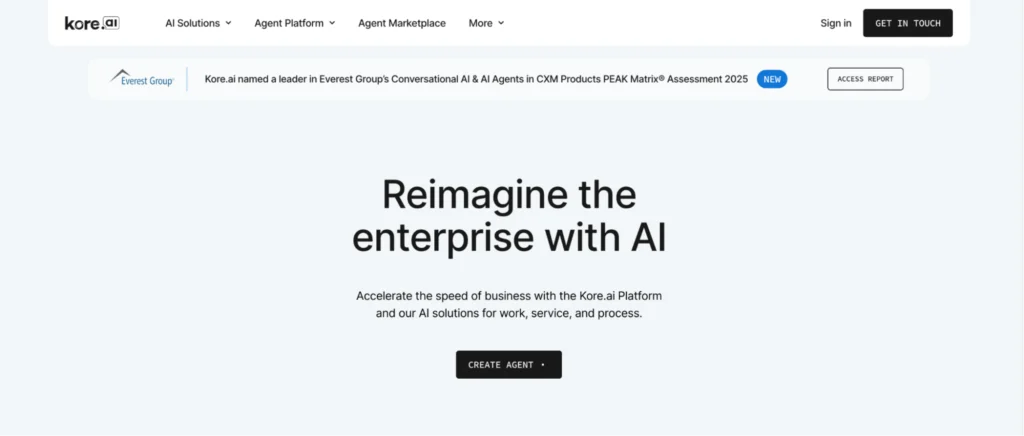
Kore.ai is an enterprise-grade platform for building and managing conversational AI agents at scale. While Kore works with multiple industries, the company also supports financial services with dedicated agents.
The platform offers a hybrid approach, combining both low-code and traditional coding (pro-code) tools. Institutions can build agents across use cases, such as financial insight retrieval, corporate research, financial summaries, and customer support. They also offer a ready-to-use agentic-powered application for banking customer service.
Platform capabilities include:
- Multi-agent orchestration
- AI engineering, low-code, and pro-code tools tools
- Pre-built, customizable templates
- Search and data AI
- AI security, governance, and observability
- Integrations
Best for: mid-to-large financial institutions that want enterprise-grade a conversational and generative AI platform to create chatbots, voice assistants, apps, and AI workflows.
2. Glean
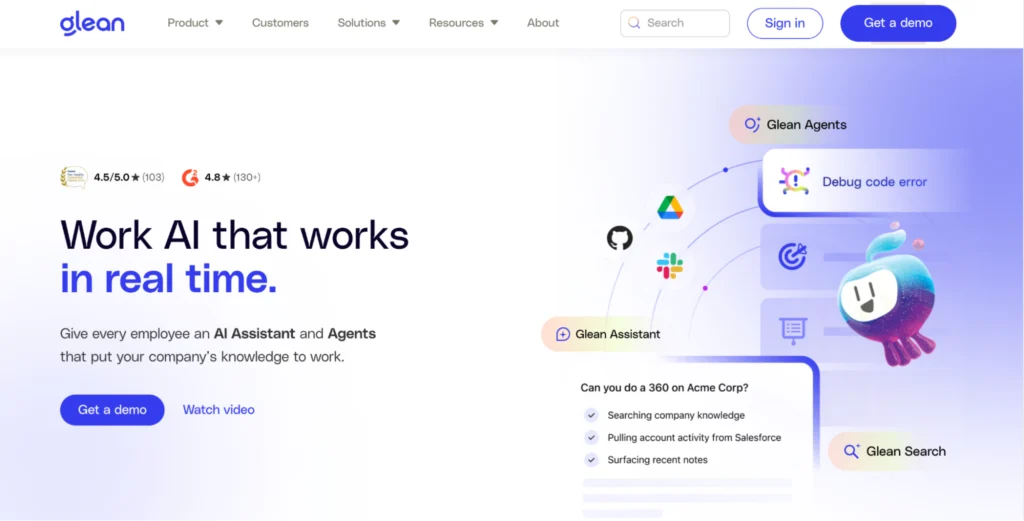
Glean is a centralized platform for creating and managing AI agents for regulated industries, including financial services. The platform supports non-technical business users through no-code tools and connects to enterprise data to automate work. Financial services firms can create agents across use cases, such as customer support automation in retail banking and research insights in investment banking.
Platform capabilities include:
- Drag-and-drop visual agent builder
- Agent orchestration, deployment, and observability
- Agent template library
- Built-in controls and guardrails for governance
Best for mid-to-large banks, insurers, asset management, private equity and venture capital firms dealing with large volumes of scattered data and disconnected apps that want to get instant answers and automate daily tasks.
3. Unique AI

Unique AI is a modular finance-specific agentic-AI platform designed for both developers and business department heads. With the platform, BFSIs can tap into customizable ready-to-use agents for common use cases across wealth management, client onboarding, hedge fund investment insights, retail banking client research, and insurance consultation workflows. It also offers an AI agent factory for banking, insurers, and private equity firms that want to build their own agents.
Platform capabilities include:
- Finance-grade security
- Model Context Protocol (MCP) hub with finance-ready connectors
- Ready-made and custom finance agents
- AI frontend for finance teams
- API, SDK, and developer toolkit
- Quality and compliance controls
Best for large financial institutions that want to build effective, secure, and compliant AI agents using either no-code or low-code platforms.
4. Rasa
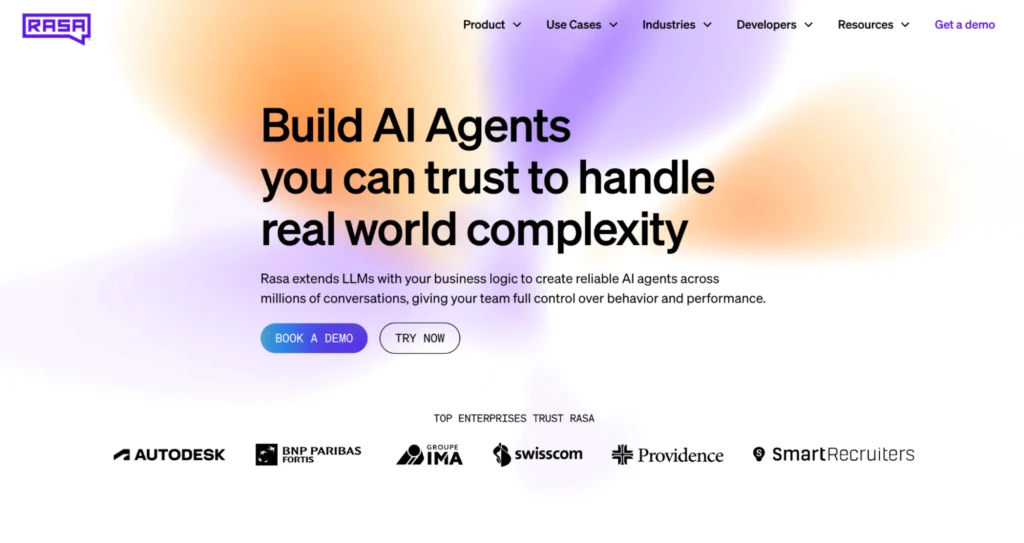
Rasa is an enterprise-grade, open-source AI platform for building, testing, deploying, and managing AI agents. It offers a flexible development experience that fits both technical and business teams using the CALM (Conversational AI with Language Models) framework.
Rasa supports a wide range of industries, including banking, finance and insurance. BFSIs can build agents across use cases like customer service and account support, secure transactions and payments, authentication and fraud support, knowledge search, and answer resolution.
Platform capabilities include:
- Production-grade automation tools
- Conversational IVR software
- Centralized content management
- Low-code tools and prebuilt starter packs
- Multi-LLM routing
- Voice support out of the box
Best for mid to large financial institutions that want greater control over the development process.
What to Look for in AI Agent Providers or Platforms as a Financial Services Firm
Every platform has different strengths. Some are designed for rapid prototyping, while others are better suited to complex enterprise environments. The right choice depends on your business goals, technical capabilities, and the types of workflows you want AI to support.
When evaluating the best AI-powered agent providers or platforms, here’s what to look for:
1. Financial Services Specialization
Look for providers with a proven understanding of financial services workflows, natural language processing (NLP) tuned to financial regulatory compliance requirements and terminology, and production AI deployments. This reduces the risk of investing in a platform that struggles to support your industry’s compliance workflows and operational needs.
2. Support for Multi-Step Workflows
Many financial workflows require AI to retrieve information, make decisions, interact with multiple systems, and complete tasks over time. Look for platforms that support these agentic workflows rather than only question-and-answer chat experiences or fixed-script robotic process automation (RPA).
3. Built for technical teams
While many platforms offer no-code or drag-and-drop agent creation, business experts rarely have the time to structure workflows, document business rules, and maintain production AI systems. Look for platforms that enable technical and operational teams to build, govern, and continuously improve AI agents so business users can focus on their area of expertise.
4. Integration with Complex Infrastructure and Systems
Confirm the platform can securely connect to fragmented data sources, legacy systems, internal applications, and third-party systems so agents can retrieve context, execute business processes, and return outputs within existing workflows.
5. Ability to Capture Your Business Expertise
Look for capabilities that help you capture and reuse your organization’s expertise. See if the platform makes it easy to define business rules, decision criteria, and best practices so AI agents can perform tasks consistently and avoid generic responses.
6. Flexibility and Customization
If AI is going to become part of your long-term business model, choose platforms that allow your technical teams to extend, customize, and integrate agents rather than limiting development to proprietary workflows or visual builders.
7. Efficiency and Reusability
Choose a provider that makes it easier to create and scale agents by providing a systematic framework for building once and reusing agent capabilities across agents and departments.
8. Governance and Observability
Look for built-in testing, monitoring, data privacy safeguards, and decision tracing that help teams evaluate agent performance and meet internal governance requirements. Certifications such as SOC 2 Type II, ISO 27001, and PCI DSS are useful signals of a provider’s security maturity.
9. Pricing that Matches Your Budget and Business Strategy
Evaluate the total cost of ownership rather than license fees alone. Consider implementation services, training, change management, and ongoing support, especially if your organization is adopting AI across multiple teams. Read our guide on the cost of AI as a financial services firm
10. Support for long-term AI adoption
Choose a platform that fits your organization’s current level of AI maturity while giving you room to expand into more advanced use cases. The right platform should support experimentation today without limiting future customization, governance, or enterprise deployment.
Why Choosing a Platform Is Only Part of Your AI Decisions
Choosing a platform is only one part of your strategy to adopt AI. As a fintech or financial services firm, you also need to determine if a platform is enough for your use case, how it fits your existing workflows, and how you will support adoption. We cover these considerations below.
Understand What You Want AI to Solve Before Choosing a Solution
Many firms begin by selecting a platform based on its features or with the promise of improving overall productivity or operational efficiency. While these capabilities can deliver value, they aren’t always where AI generates the greatest business impact.
For financial services, the stronger approach is to first define the business workflow where AI can provide high-value opportunities rather than saving a few minutes here and there in isolated tasks. These gains can range from revenue growth to risk mitigation.
For example, as a wealth management firm, you may want to increase client capacity, the number of engagements, and all around client satisfaction as measured by net promoter score (NPS). An AI agent built specifically around those goals will look very different from a customer service agent.
In this case, you’ll want an agent that can analyze client portfolios, provide proactive market alerts, and create personalized investment recommendations while keeping your relationship managers in the loop for final decisions.
Different use cases require different architectures, governance models, and levels of autonomy. Before selecting a platform, make sure it provides the capabilities needed to support your specific workflows, compliance requirements, and long-term AI strategy.
Standard Platforms Can Support Many FSI High-Value Use Cases
Once you decide what your agents will solve, know that many platforms can help you quickly build internal productivity and workflow automation use cases, often replacing manual, RPA-style scripts with more adaptive, reasoning-based agents.
Financial institutions can use platform-built agents as:
- Research assistants. Automate analyzing markets, company filings, earnings reports, financial modeling, and portfolio data to prepare research briefs, variance analysis, or investment insights for analysts and advisors.
- KYC/AML compliance support. Conduct identity verification, search customer documentation, identify missing information, surface potential compliance risks through anomaly detection and fraud detection signals, and prioritize cases for human review.
- Meeting assistance. Record meetings, generate summaries, identify action items, update Salesforce and other CRM systems, and draft follow-up emails
- Knowledge retrieval. Search internal policies, product documentation, regulatory guidance, and operating procedures to provide employees with accurate answers in seconds.
For example, an AI agent built for registered independent advisors can continuously identify portfolio optimization opportunities and cash-flow forecasting alongside market events, and alert advisors when allocations drift from client objectives or when sudden market movements require immediate outreach.
For these use cases, a standard AI agent platform is often the fastest and most cost-effective option.
Know Which High-Value Use Cases Require More Than A Platform
While agent platforms designed for financial services can cover many use cases and workflows, there are times when a more customized approach is needed.
Depending on your business, these can include:
- Fragmented enterprise systems and proprietary knowledge. An investment management firm may need an AI agent to combine information from Bloomberg, internal valuation models, CRM records, and document repositories before generating an investment memo. Much of the firm’s competitive advantage also lives in proprietary investment methodologies, risk frameworks, and institutional knowledge that cannot simply be uploaded into a generic platform. Bringing these systems and knowledge sources together requires secure integrations, domain-specific retrieval, and customized reasoning tailored to the firm’s workflows.
- Complex orchestration. Some workflows require multiple specialized agents coordinating with each other, external systems, and human reviewers. For example, an investment research process may involve separate agents gathering market data, analyzing portfolios, checking compliance policies, and routing outputs for approval before anything reaches a client.
- Cross-functional operations. High-value workflows rarely stay within one department. A credit underwriting or customer onboarding process, for example, may involve sales, financial operations, compliance, fraud, legal, and customer support, where each team uses different systems, policies, and success metrics. Coordinating these end-to-end processes typically requires more than a configurable platform.
A platform provides infrastructure on which to build your agents. But it’s still your responsibility to define how it operates, from redesigning workflows to ensuring teams adopt AI in their day-to-day work. And, as mentioned above, you can’t expect your business teams to do this on their own. It requires some technical expertise, operational thinking and implementation experience your investment advisors, relationship managers, operation specialists or compliance officers weren’t hired to provide.
AI Needs Structured Knowledge That Only Your Experts Hold
The success of an AI agent depends on how well your organization’s expertise is captured and translated into instructions the agent can follow. This is something a platform can’t provide since this knowledge is inside the minds of your subject matter experts.
For example, an experienced wealth advisor knows how to prioritize clients after a market event. A private equity investment team understands which qualitative signals matter during due diligence. And a compliance officer recognizes exceptions that aren’t documented in policy manuals. Much of this knowledge is never documented formally.
Extracting that expertise takes time and close collaboration with subject matter experts. You then need to translate it into workflows, business rules, evaluation criteria and knowledge structures that agents can reliably execute. But your technical teams may not know how to do it all on their own.
This is a key area where many organizations underestimate the effort involved, exposing inconsistencies in outputs and limiting the potential for a greater return on investment.
Governance Extends Beyond the Platform
Many enterprise AI platforms already include capabilities like permissions, observability, evaluations, and audit logging. Those are important, but technology is only one layer of AI governance.
Financial institutions still need to define how AI should operate within their business, including:
- Role-based autonomy. Decide which employees can delegate work to AI and which decisions always require human approval. For example, senior portfolio managers may be able to use AI-generated investment recommendations directly, while junior advisors require manager review before sharing recommendations with clients.
- Access and cybersecurity. Define which teams can access sensitive client data, proprietary research, or internal knowledge through role-based access controls (RBAC).
- Oversight and accountability. Keep human-in-the-loop approvals and establish how AI outputs are reviewed, monitored, and continuously improved, along with the audit trails and regulatory reporting required for regulators and internal risk teams.
- AI adoption. Create governance that supports how teams actually work. Clear policies, role-specific guidance, and practical training reduce the temptation to use unapproved AI tools while encouraging safe adoption across the organization.
These policies should reflect each firm’s regulatory obligations (including data privacy rules like GDPR), risk management requirements, and operating model. A platform can support governance, but it can’t define it for you.
How Neurons Lab Helps Financial Services Firms Adopt AI Agents
As an AI enablement partner serving organizations across the US, Europe, and Asia, we combine executive training, AI adoption programs, and production-grade agentic AI implementation to support secure, practical deployment. Clients can build operational AI capability aligned with core workflows, governance, and business priorities.
Trusted by 100+ clients, including HSBC, Visa, and AXA, we’ve accelerated AI integration in banking, wealth management, private equity, investment firms, fintechs, and other highly regulated industries.
Whether you adopt an existing AI platform, build custom AI agents, or combine both approaches, our role as an AI consultancy is to help you create AI capabilities your teams can own, operate, and expand over time.
Here’s how we do that:
Diagnose Where AI Will Create the Greatest Business Value
Successful AI adoption starts by identifying where it can create measurable business value.
Through our hands-on workshops with executives, business teams, and technical stakeholders, you can identify high-value use cases, map business workflows, and define success metrics, while determining whether an existing platform, custom AI agent, or combination of both is the right fit for your organization.
You’ll come away with:
- Prioritized AI use cases based on business impact, risk assessment, technical feasibility, and implementation effort.
- AI adoption roadmap that defines where to start, how to expand, and what capabilities to build over time.
- Success metrics and KPI dashboard to measure AI performance before implementation begins.
- Platform and architecture recommendations on whether an existing platform is sufficient or if custom development is required.
- Executive alignment to define and share priorities and success criteria across business and technical teams before development starts.
For example, a private equity firm may want to start with an AI assistant to summarize investment memos. Instead, during our discovery workshops, the PE firm may realize that the greater opportunity lies in speeding up due diligence by helping analysts compare portfolio companies, surface investment risks, and prepare investment committee materials.
Defining these workflows and success metrics upfront helps the firm invest in AI initiatives that deliver measurable commercial value rather than isolated productivity gains.
Starting with business outcomes lets you reduce the risk of investing in low-impact use cases and create a roadmap that supports long-term AI adoption across the organization.
Build Internal AI Capability
Once you’ve identified the right AI opportunities, the next step is enabling your teams to turn them into repeatable business processes.
Our Financial Domain Experts (FDEs) work alongside your SMEs and technical teams to translate your organization’s expertise into production-ready AI capabilities.
By working together with FDEs, you can:
- Capture knowledge from relationship managers, analysts, fraud prevention teams, and operations specialists.
- Translate your organization’s expertise into reusable AI instructions, workflows, and business rules.
- Train teams using their own tools, data, and business processes.
- Establish governance and adoption practices that support long-term AI use.
Depending on your business needs, deliverables could include:
- A reusable collection of AI instructions (i.e., AI skills library) that capture how your experts perform common tasks, helping agents deliver consistent outputs across teams.
- Predefined AI workflows for common financial services processes, from credit scoring and credit decisions to compliance reviews, that can be adapted and reused across departments.
- Governance playbooks with practical guidance covering AI usage policies, approval processes, compliance monitoring, role-based permissions, and audit requirements.
- Hands-on guidance tailored to executives, advisors, operations teams, compliance teams, and technical staff.
- Ongoing support to refine workflows, answer questions, and help teams build confidence using AI in daily operations.
For example, a wealth management can define what AI agents can do for relationship managers. This can range from monitoring portfolio performance against investment objectives and identifying market events that may affect a client’s holdings to preparing personalized portfolio reviews. You can have agents act as assistants, while your senior advisors and relationship managers remain responsible for reviewing recommendations and making final investment decisions.
With Neurons Lab, you can design AI that reflects how your business actually operates. Your agents apply your firm’s knowledge, workflows, and business rules to deliver more consistent, reliable outputs across complex financial services processes.
Build Production-Ready AI Agents
When existing agent platforms can’t support your requirements, we help you design, build, and deploy custom AI agents and machine learning models that integrate with your existing infrastructure, operate within your governance framework, and support complex financial services workflows from pilot to production.
With custom AI deployment, you’ll have:
- Production-ready AI systems with fully deployed agents designed to operate reliably within regulated financial services environments.
- Secure enterprise integrations with your existing data sources, business applications, and core banking systems (e.g., Fiserv, FIS, Jack Henry) so AI fits naturally into day-to-day operations.
- Reusable AI components that can be reused across future AI projects, reducing your development effort as adoption grows.
- Knowledge transfer, technical documentation, and implementation guidance that enables your teams to own, maintain, and expand AI over time.
For example, an asset management firm may first deploy an AI agent to assist investment analysts with portfolio research and market monitoring. Once the workflow is validated, the firm can extend those capabilities across risk, compliance, and portfolio management teams while applying role-based governance to ensure each team only accesses the data and AI capabilities appropriate to their responsibilities.
By building production-ready autonomous systems that integrate with your existing technology, governance, and operating model, you create reusable AI capabilities that your teams can own, expand, and scale across the organization as new opportunities emerge.
How Financial Services Firms Put This Into Practice with Neurons Lab
Neurons Lab has delivered more than 100 AI implementations for financial institutions, helping organizations move from AI strategy to production-ready systems.
For example, HSBC partnered with Neurons Lab to align more than 50 senior leaders on AI strategy, governance, and priority use cases before implementation began. Through executive workshops and structured discovery sessions, leadership established shared priorities, identified high-value opportunities, and created an AI roadmap with executive sponsorship across business functions.
Once organizations have identified the right opportunities and built internal AI capability, Neurons Lab helps them move into production with custom AI systems designed for regulated financial services environments.
For a capital markets fintech, Neurons Lab developed a suite of AI agents that automated investment research, earnings analysis, risk scoring, market monitoring, and client reporting. By integrating the agents with Bloomberg data feeds and the firm’s CRM, analysts received analysis-ready outputs instead of spending hours on manual data entry and gathering and organizing information. The result was a 3× increase in analyst productivity, research reports produced in hours instead of days, and governance with built-in audit trails for every AI-generated output.
Similarly, for a global asset management firm, Neurons Lab built an AI-powered ETF-like investing product that embedded the firm’s proprietary investment methodology into the platform, enabling it to generate personalized portfolio recommendations while preserving the organization’s investment logic and competitive advantage.
Choose The AI Agent Approach That’s Right for Your Fintech or Financial Services Firm
Choosing the right AI platform is only one part of a greater AI strategy. Understanding which use cases can provide the most gains, building AI agents around how your business operates, and giving teams the tools and confidence to adopt it is where you’ll see lasting value.
Deciding on using an existing platform, custom AI agents, or a combination of both depends on your goals, workflows, and regulatory requirements. Expect the right approach to fit your organization today while giving you the flexibility to scale AI over time.
Neurons Lab helps financial services firms identify those high-value AI opportunities, and enable teams to adopt AI, while also being able to deliver production-ready multi-agent systems that integrate with your existing operations.
If you’re exploring where AI can create the greatest impact for your fintech or FSI, we’d be happy to help you define the right approach. Book a call with us today.
FAQs
What are the best AI agents for fintechs and FSIs?
The best AI agents for fintechs and FSIs depend on the specific business problem you’re trying to solve. Many financial institutions automate internal workflows such as underwriting, research, and knowledge management using an existing platform, while others with more complex use cases may require custom AI agent builds. Evaluate platforms based on how well they support your workflows, existing systems, organization’s expertise, and governance requirements.
When is an AI platform enough for financial services?
An AI platform is a good fit for many common use cases, including creating a virtual assistant for research, meeting summaries, and internal knowledge management. As workflows become more complex or require proprietary data, enterprise integrations, and governance tailored to your operating model, additional implementation expertise or custom AI development may be needed.
Who should be responsible for building AI agents in a financial services firm?
Building production-ready AI agents in fintech or financial services firms requires collaboration between business experts, technical teams, and AI specialists. Subject matter experts contribute the business knowledge and technical teams build and integrate the solution, while implementation partners help translate organizational expertise into AI workflows, establish governance and compliance automation, and guide adoption.
This collaborative approach helps ensure AI reflects how your organization actually operates and can scale safely across the business.
Sources
- https://kore.ai
- https://www.kore.ai/ai-for-service
- https://www.kore.ai/ai-for-work/finance
- https://www.glean.com/product/ai-agents
- https://www.glean.com/industries/financial-services
- https://www.glean.com/agent-library
- https://www.unique.ai/
- https://rasa.com/
- https://rasa.com/platform
- https://rasa.com/industries/finance-and-banking
- https://rasa.com/industries/insurance
- https://rasa.com/industries/finance-and-banking