
The pressure to move faster in M&A is intensifying. Shifts in valuations and AI-driven productivity gains across deal teams means firms have less time to identify and evaluate the best opportunities before a competitor does. For deal teams across wealth management, private equity, and investment banking, speed and analytical depth have become competitive advantages in their own right.
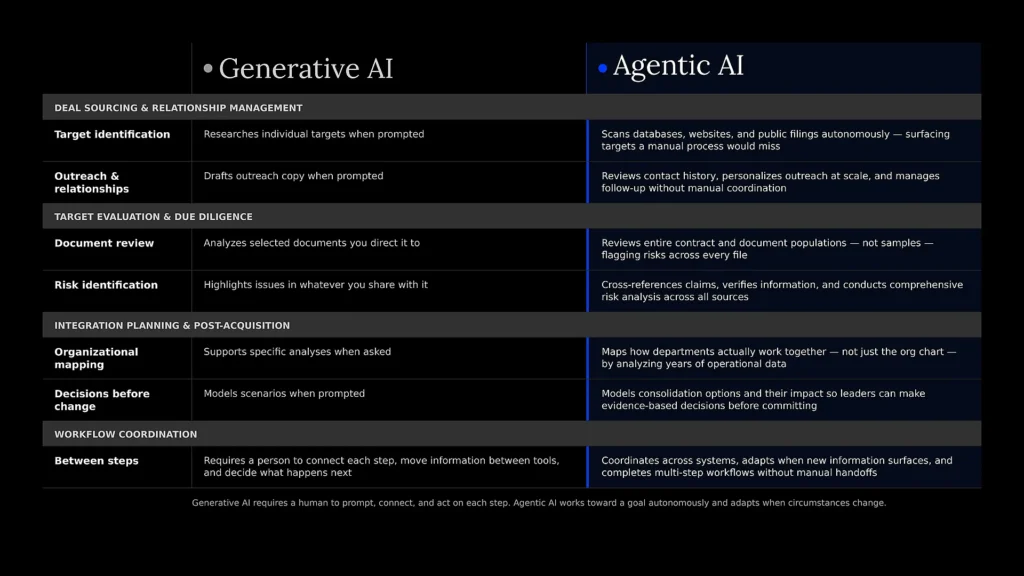
While generative AI (GenAI) tools like ChatGPT and Microsoft Copilot can help speed up individual tasks like researching targets or drafting outreach, each task still relies on a person to provide the next prompt, move information between tools, and decide what happens next. This leaves M&A teams manually managing the handoffs between tasks, especially when something changes mid-process.
Agentic AI takes a different approach. For example, an agent can redirect a due diligence review the moment a new risk surfaces, and have a human step in when appropriate. Used well, agentic AI can help deal teams increase capacity, improve decision-making, and drive more revenue.
But deal teams want those benefits without introducing risk that could compromise a deal or expose the firm to regulatory scrutiny. Knowing where agentic AI can actually help, and how to implement it safely, is what separates teams that capture the value from those that create a costly mistake.
In this guide to using AI agents for M&A, we’ll cover:
- Key takeaways
- How AI agents expand what M&A teams can do
- Where to apply AI agents in M&A workflows
- How to approach implementing agentic AI in the M&A lifecycle
- How Neurons Lab helps you embed agentic AI across M&A workflows
- FAQs
Want to use AI agents to find better deals, accelerate due diligence, and drive more revenue? Book a call with Neurons Lab.
Key Takeaways
- Agentic AI works toward a goal across multi-step workflows and adapts when circumstances change. This is a critical difference for M&A, where deals rarely follow a predictable path.
- Agentic AI adds value at every stage of the deal lifecycle: better sourcing, deeper due diligence, and faster integration decisions. Each improvement compounds, and together they can be the difference between winning a deal and losing it to a faster-moving competitor.
- Agentic AI can scale mistakes as fast as it scales productivity, so safe implementation means starting with high-value use cases, building in evaluation frameworks to catch errors before they compound, and enhancing human decision-making on high-stakes calls rather than treating it as a one-off deployment.
- Experienced enablement firms like Neurons Lab embed agentic AI into your existing workflows rather than handing over a standalone tool, building governance and auditability from day one, and transferring capability to your team instead of creating long-term dependency.
How AI Agents Expand What M&A Teams Can Do
Mergers and acquisitions (M&A) teams face three structural problems that individual GenAI tools can’t solve:
- Manual handoffs between departments during the multi-step deal lifecycle, from sourcing to restructuring, slow down processing and limit how many deals a team can close.
- Teams can’t analyze every document or target in the depth they’d like, which creates oversight risk.
- M&A performance is measured ruthlessly by IRR. Adding headcount to handle more deals increases operating expenses and eats directly into those returns. The goal is better deals and greater efficiency from the team you already have.
Agentic AI reinvents M&A by turning these separate tasks into autonomous workflows that coordinate across relationships, financial analysis, and decisions, without constant human input.
Take relationship management. Each potential target, investor, or deal partner typically requires a different approach, so boilerplate outreach is unlikely to be well received. An AI agent can research a contact’s history, previous interactions, and relevant company information, then use that context to personalize outreach, helping deal teams develop meaningful relationships at scale.
An agent can also work towards a specific goal, such as identifying a potential acquisition opportunity. It can even adapt as new information comes in (e.g., if a target discloses new financial information mid-negotiation) without someone needing to redirect it.
The same logic applies to diligence. Rather than sampling a handful of contracts or profiles, an AI agent can review every document tied to a target, flagging risks or inconsistencies a manual pass might miss, so teams can go deeper without adding time or headcount.
And because agentic AI can connect fragmented workflows, interact with existing systems, and respond to information from multiple people, it can coordinate multiple steps across departments without human input, helping deal teams move more efficiently through the entire process.
That potential spans the entire M&A lifecycle. The next question is where agentic AI delivers the most value.
Where to Apply AI Agents in M&A Workflows
The use cases below focus on the buy side — deal teams at PE firms, investment banks, and corporates that are sourcing, evaluating, and integrating acquisitions.
Agentic AI can support almost every stage of this lifecycle, from identifying acquisition opportunities to creating personalized outreach, evaluating targets, and managing post-merger integrations. These capabilities fall into three broad areas, which we cover below:
1. Deal Sourcing and Relationship Management
Deep manual acquisition research is too slow to apply to every opportunity, so deal teams often default to fast screening that results in low accuracy.
An AI agent gives you both speed and accuracy. It can source more opportunities by pulling and examining data from commercial databases, company websites, and public filings in just minutes, and because it automates multiple steps, it can go deep into the data to surface targets a traditional, manual process would likely miss. These are the ones that don’t meet obvious criteria on paper but are worth a closer look.
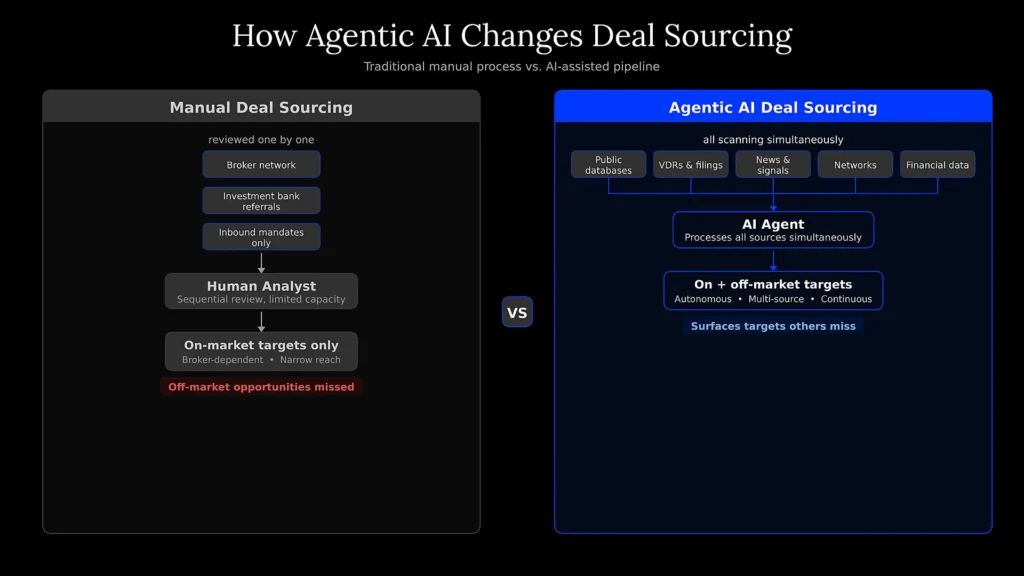
Agentic AI for deal sourcing vs manual deal sourcing
That same capacity extends to managing the relationships that come out of sourcing opportunities. AI agents can review the history of each contact and keep outreach specific and consistent in the team’s tone of voice, so deal teams can build a larger, more focused network of targets, investors, and partners without every interaction needing manual management.
Together, these capabilities can help M&A teams identify more potential targets and develop a higher number of quality relationships, without sacrificing the accuracy that helps determine which opportunities are worth evaluating in more depth.
2. Target Evaluation and Due Diligence
During this stage of the M&A process, AI agents help deal teams evaluate more targets more thoroughly than a manual process allows. For each target an agent can:
- Gather and cross-reference information from multiple sources, including virtual data rooms (VDRs)
- Evaluate management teams and analyze markets
- Identify patterns and flag risks or opportunities that need a closer look
That means teams can screen more companies and track changes over time.
AI agents powered by large language models (LLMs) also improve due diligence. Agents can review entire contracts rather than selected samples, analyze companies’ full workforce and organizational structure, verify claims made during the deal process (including those related to intangible assets), and conduct more comprehensive risk analysis.
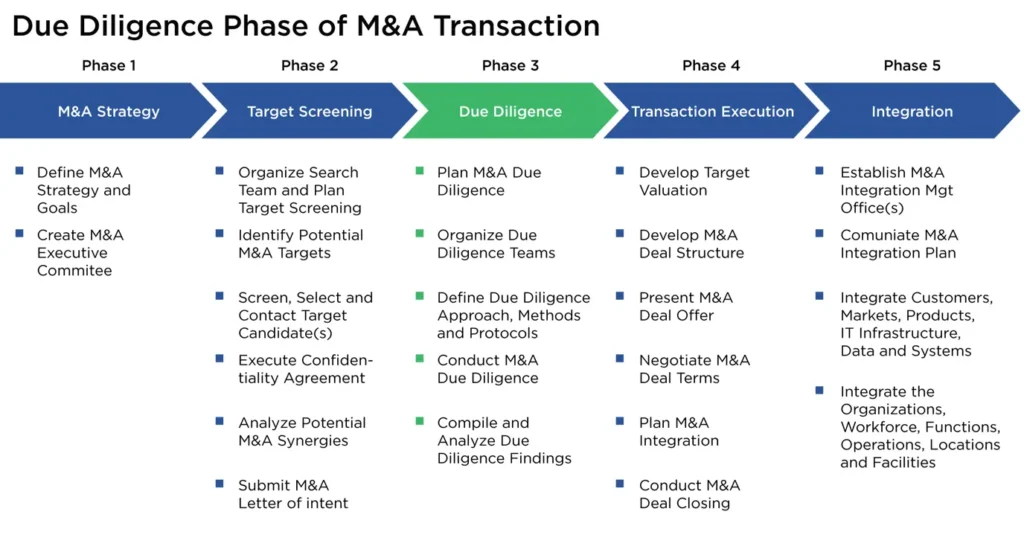
Agentic AI can cover the entire due diligence phase of M&A – Image source: Dealroom
Instead of spending the same amount of time evaluating companies superficially, agentic AI reduces the typical trade-off between speed and depth, allowing teams to move forward with more detailed information in less time.
3. Integration Planning and Post-Acquisition Integration
After an acquisition, leadership usually wants to move fast in a new strategic direction, but restructuring a company they don’t yet understand is high-risk and hard to reverse. If you wait to learn how the target actually operates, momentum stalls. If you move too fast without that understanding, mistakes can take months or years to unwind.
AI agents can close this gap. By analyzing years of the target company’s data and communications, an agent can map the enterprise architecture (i.e., how departments actually work together vs what their organizational chart says) and identify which past reorganizations or process changes worked and which didn’t.
This deeper understanding makes it possible to test decisions around integration planning and restructuring. For example, an AI agent can model how consolidating two departments might affect headcount, reporting lines, or client coverage, so teams can weigh the risk of each option before committing to it.
The same applies to workforce restructuring. Rather than spending months evaluating employee performance, an agent can analyze years of historical output data in days. For a technology team, that might mean assessing developer productivity based on volume and complexity of code changes over time, surfacing who the key contributors are before any decisions are made.
This gives you a much clearer understanding of how the business actually runs before any changes are made, making it easier to develop targeted integration playbooks. Instead of relying on assumptions or limited valuation models, leaders can make faster, more confident decisions based on evidence.
These benefits are significant, but getting the value from agentic AI depends on how you implement it.
How to Approach Implementing Agentic AI in the M&A Lifecycle
Because AI agents act independently and at scale, oversight has to be built in from the start, especially for high-risk financial, legal, and strategic decisions. Here’s what to know before you start.
Treat Agentic AI as a Strategic Initiative
The same autonomy and scale that make agentic AI powerful also make mistakes expensive.
When an agent gets something right, it does so fast and at scale. But when it gets something wrong, it repeats that mistake just as fast, and often before anyone notices. So, an agent built to manage outreach or update your deal pipeline will keep doing exactly what it’s set up to do, for every contact, immediately, even if that turns out to be the wrong thing.
This is why the most effective approach is to identify high-value use cases first, test how the agent performs, and then iterate before expanding its use across your M&A teams. For example, if an AI agent tasked with screening acquisition targets applies incorrect criteria, that error could affect hundreds or thousands of opportunities before anyone catches it.
This is why it’s essential to design it properly—either with an evaluation framework or a human in the loop—wherever a mistake would be too costly to catch late.
It’s also important to consider whether you have the internal expertise needed to implement agentic AI effectively. If not, you’ll need to decide whether to invest in building that internal capability, or to bring in external expertise as your team develops these skills. The goal is to move quickly enough to tap into the benefits of agentic AI, while still taking the time to understand how to implement it safely.
Be Prepared to Redesign Workflows
Some existing workflows might contain manual bottlenecks, unnecessary handoffs, or steps that only exist because of the limitations of manual systems or fragmented tool use. Adding an AI agent to these kinds of workflows may just automate inefficiencies instead of eliminating them.
That doesn’t require overhauling how your team already works. Agentic AI is built to achieve an outcome, not to repeat the same steps you already have in place, and it often finds a more direct way to get to its goal. Getting the most value from it usually means adjusting a workflow around that goal, rather than assuming the process has to stay fixed.
Therefore it’s important to choose an experienced implementation partner who can help identify which existing M&A workflows would benefit most from agentic AI, then redesign or adapt these as you embed agentic AI within your organization.
Choose a Partner That Builds Capability
You can identify use cases and redesign workflows on your own. But without hands-on experience building agentic AI, that usually means more trial and error, slower iteration, and a higher chance of expensive mistakes while your team is still learning what works.
An experienced partner shortens that learning curve, but only if they take a collaborative approach.
Most consulting engagements follow the same pattern: a subject matter expert explains what they want, a technical team builds it, then the expert reviews the result, often weeks later. That back-and-forth is too slow for agentic AI.
Once you know exactly what an agent needs to do, building it is fast. The real work is figuring out what that should be (e.g., which criteria it screens targets against, which tone it uses in outreach, which decisions it should still leave to a person) and testing whether it gets that right. That only moves quickly when the people who know your processes and the people who understand the AI work through those questions together.
Look for a partner who brings that hands-on expertise along with the guarantee they can transfer that knowledge to your team, rather than handing over a finished system no one inside your organization understands how to run. Over time, that reduces how dependent you are on any one partner and builds the internal capability to keep improving and scaling agentic AI as your needs change.
How Neurons Lab Helps You Embed Agentic AI Across M&A Workflows
M&A teams face the same three problems throughout the deal lifecycle: fragmented, manual workflows that slow deal processing, analysis that can’t go as deep as teams would like, and limited capacity to evaluate more deals or relationships without growing headcount.
Neurons Lab helps deal teams address each one by moving from isolated generative AI prompts to embedding agentic AI across all stages of M&A workflows.
We help firms identify where agentic AI can create the greatest impact, build the skills needed to use it effectively, and deploy AI agents that support workflows across sourcing, due diligence, and post-acquisition integration, instead of automating individual tasks in isolation.
Neurons Lab helps financial services firms move from AI experimentation to AI adoption at scale. As an AI enablement partner serving organizations across the US, Europe, and Asia, Neurons Lab combines executive training, AI adoption programs, and custom AI agent builds to support secure, practical deployment. Clients build operational AI capability aligned with core workflows, governance, and business priorities.
Trusted by 100+ clients, including HSBC, Visa, and AXA, our experts have accelerated AI integration in banking, wealth management, private equity, investment firms, fintechs, and other highly regulated industries. That experience helps firms avoid the implementation mistakes that create unnecessary risk or slow adoption.
By partnering with us, M&A teams can:
Balance Speed with Safety Across M&A Workflows via Tailored Adoption Programs
M&A teams often work across fragmented systems and workflows, with manual handoffs between each one slowing deal processing and limiting how much AI can actually help. While individual approaches and tools can help improve specific tasks, they don’t necessarily connect across the teams, processes, and information involved in a deal.
Through tailored adoption programs, Neurons Lab works with you to identify high-value use cases suited to agentic AI, test how agents perform on them, and build an AI strategy roadmap around specific outcomes and business metrics, such as time saved or output rate. This helps deal teams track which AI initiatives are delivering meaningful value, rather than investing time and resources in initiatives that aren’t.
With Neurons Lab, you can also build organization-wide AI capabilities through practical workshops. Executive and role-specific training helps leadership and individual teams understand where AI agents can add value, while workshops help teams understand the regulatory and compliance requirements that apply to their roles and connect fragmented processes across the organization.
This gives your entire organization a shared understanding of how agentic AI can help and where to start.
Develop Comprehensive Decision-Making and Analysis Processes with Expert Support and Custom Agents
M&A teams often make high-stakes decisions based on information from public sources, proprietary databases, internal systems, and large volumes of documents. Manually collecting and analyzing this information limits how deeply deal teams can analyze opportunities and how many deals they can assess.
Neurons Lab connects these fragmented sources by building custom AI agents around your specific workflows, processes, and compliance requirements. AI agents can quickly gather information from multiple sources, analyze documents, identify inconsistencies, apply quality controls, highlight risks, and summarize findings that need human oversight or review. This provides you with greater speed, depth of analysis, and financial accuracy, while keeping human expertise and judgment at the center of any major decisions.
You can also build governance, compliance, guardrails, and auditability into these systems from day one. AI actions, processes, and outputs can be traced, including which data sources were used, which policies were applied, and what the market context was. This makes it easier to review AI-assisted work, track issues through the relevant workflow, and maintain human oversight even as AI use increases.
Increase Capacity Without Increasing Headcount through Embedded Delivery
As deal volumes increase, M&A teams are under pressure to evaluate opportunities and analyze more information, without increasing headcount. Repetitive manual work and fragmented workflows can create frustration and leave less time for tasks that need strategic thinking, human judgment, and relationship management.
Neurons Lab works alongside your teams to embed AI into the workflows and processes where it’s likely to have the biggest impact, rather than handing over a standalone tool and stepping back. You’ll have help continuously looking for opportunities to improve and expand its use as your needs change. Your teams will also build the expertise to keep evolving agentic AI after we’ve handed over ownership.
As AI agents take on more repetitive tasks, deal teams have more time for higher-value work, such as evaluating opportunities, strategic analysis, and relationship management.
Embedded delivery also helps capture and retain operational knowledge. With Neurons Lab, you can document how your teams do their best work, so when people leave, that knowledge doesn’t go with them.
How a Leading Asian Bank Doubled Client Reach Without Adding Headcount
Deal and relationship capacity scale the same way, whether you’re covering clients or acquisition targets: consolidate the data, give an agent the context it needs, and free up the people you already have. Here’s how that played out for a leading Asian bank.
The bank needed its relationship managers to cover more clients without growing headcount, but RMs were spending significant time on manual tasks, compliance checks, and data gathering across disconnected systems, leaving less time for the client-facing work that actually grows a relationship.
Neurons Lab built and deployed a custom AI agent on AWS in 8 weeks, integrating data from 3 legacy systems into a single, RM-ready knowledge layer. The agent now supports RMs with daily opportunity prioritization, market intelligence, meeting prep, and personalized product recommendations, all through one conversational interface instead of switching between systems. As a result, the bank:
- Unlocked 20+ additional RM capacity without hiring
- Doubled the number of clients reached each month
- Improved NPS by 15% through more consistent, personalized RM engagement
From Isolated GenAI Tools to Scalable, Connected M&A Workflows
Agentic AI can help M&A teams move beyond isolated AI tools and manual workflows to scalable, connected systems that support the entire deal lifecycle. From identifying better opportunities and conducting deeper due diligence to accelerating effective integration, AI agents help firms do more without increasing headcount.
It’s important to identify high-value use cases, build appropriate oversight and governance, and ensure everyone knows how to use AI agents effectively. With an experienced implementation partner like Neurons Lab, agentic AI can help firms move faster and analyze more information, while still keeping human knowledge and expertise at the heart of dealmaking.
Ready to apply AI agents to your M&A workflows but not sure where to start? Book a call with Neurons Lab to find out more.
FAQs
How can agentic AI improve due diligence?
Agentic AI can improve due diligence by helping deal teams analyze more information in less time. Teams can use AI agents to research public and proprietary data, conduct comprehensive document reviews, and flag issues that require human oversight and expertise, instead of sampling a handful of priority documents.
What M&A tasks still require human oversight?
Human oversight remains an essential part of M&A workflows, particularly for high-stakes decisions around investments, valuations, negotiation strategies, and legal or regulatory approvals. While AI agents can support these processes, M&A teams should always review any AI-generated outputs, check results against their own expertise, and remain accountable for any final decisions.
How do you identify the best M&A workflows for agentic AI?
The best M&A workflows for AI agents are usually repetitive and time-consuming, with multiple stages or large amounts of data to process. Deal teams should audit workflows and processes to identify any that could benefit from improvements in speed, capacity, or decision quality.