
If you’re exploring AI for Registered Investment Advisors (RIAs), you’re likely trying to solve two problems.
First, your firm may need to grow without adding headcount. Hiring more advisors can be expensive, especially when you’re small by design and the current talent pipeline is limited.
Second, your client market is changing.Younger investors expect more personalized advice on demand. General recommendations and basic portfolio reviews that they can already get online won’t attract them.
But generative AI tools like ChatGPT, Perplexity or Claude that you’re already using for note-taking, drafting emails or querying details about a client’s portfolio only make a minimal impact on these growth challenges. Instead, you want to know how AI can take your firm to the next level, where it can support real business outcomes, such as greater advisor capacity, more consistent client service, and more personalized advisory work.
To help you understand what’s possible and how to get started, we’ll cover:
- Where most RIAs are with AI right now (And where they could be)
- What registered investment advisors can do with AI
- How RIAs can use AI accurately and securely
- How Neurons Lab can help RIAs adopt AI
- How a financial institution doubled client reach without doubling headcount
- FAQs
Want to use AI to serve more clients, deliver more personalized advice, and give advisors more time for high-value relationship work? Book a call with Neurons Lab.
Where Most RIAs Are With AI Right Now (And Where They Could Be)
Many RIAs are already experimenting with artificial intelligence. But for most financial advisors, AI use is still limited to isolated chatbot tasks, like asking a tool to help draft an investment recommendation.
Even though this kind of use can save time on individual tasks, it doesn’t create significant productivity or efficiency gains across your firm.
Small teams still have to prompt AI step by step while switching between CRM records, meeting notes and market data to review portfolios and assess market developments so they can prepare meeting briefs.
This limits:
- How many clients advisors can cover
- How quickly they can respond
- How much time they have for revenue-generating relationship work and personalization
Instead, the bigger opportunity lies in RIAs moving AI into entire workflows. For example, rather than asking AI to handle one task at a time, an advisor preparing for a client meeting could have AI manage multiple steps, from checking the client’s portfolio and reviewing recent market movements and personal exposure to pulling previous conversations and drafting a personalized meeting brief or proposal.
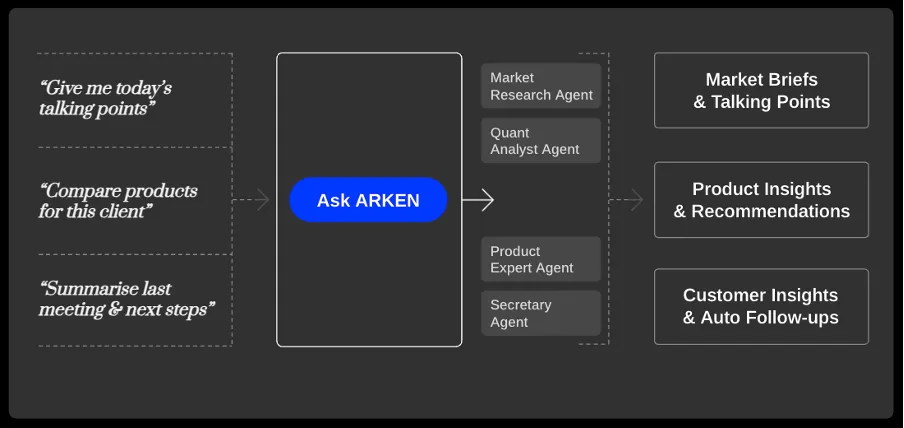
An example of a custom AI copilot helping investment advisors work faster and more efficiently
But this doesn’t mean AI bypasses advisors altogether. The advisor still reviews the output and applies their judgment and expertise to the final result. What they no longer need to do is the tedious prep work that takes up hours of their work week. They get intelligent augmentation that helps them enhance their skills, not replace them.
This is possible when AI understands your ways of working and how you handle core workflows. Once it has this knowledge, it can then increase advisor capacity and reduce the need for new hires where the talent pool is scarce. That’s how AI can help personalize outreach to match new client expectations and scale your advisory services without adding headcount.
Now that it’s clear where RIAs could be when AI is connected to real advisory work, the next step is understanding what those workflows could look like in practice.
What Registered Investment Advisors Can Do With AI
What RIAs Can Do With AI: A Quick Overview
| Top use cases | Example workflows | Benefits |
|---|---|---|
| Personalize Client Engagement | • Prepare for client meetings • Tailor client communication • Prepare portfolio conversations around client interests • Strengthen client discovery before meetings | • Hold more relevant client conversations • Improve client discovery across the team • Personalize advice beyond communication alone |
| Support Portfolio Analysis and Creation | • Review portfolio exposure • Create personalized portfolio recommendations • Analyze market events against client portfolios | • Monitor more accounts with the same team capacity • Focus review time on higher-risk portfolios • Prepare tailored recommendations faster |
| Automate Advisory and Operational Workflows | • Handle follow-up tasks after meetings • Support onboarding and account reviews • Create reusable workflows across the firm | • Reduce admin work after client meetings • Move account openings and annual reviews forward faster • Create more consistent workflows across the firm |
| Create Reports, Presentations, and Client Materials Faster | • Generate client review reports • Build consistent client presentations • Prepare personalized proposals • Draft internal and client-ready commentary | • Produce client-ready materials faster • Keep reports, proposals, and presentations consistent • Communicate more often without adding more manual writing work |
AI can help RIAs move beyond one-off chatbot use and into multi-step workflows that support client engagement, portfolio work, and reporting. As we show below, it supports work across your entire operations, from portfolio analysis to presentations.
1. Personalize Client Engagement
Rather than manually gathering client information from several systems, RIAs can use AI to automate the process.
For example, before a client meeting, AI scans CRM notes, past conversations,and market trends, giving the advisor a structured brief with key updates, portfolio information, and open questions to raise. As a result, the meeting caters to the client who feels seen.
An example of an AI copilot automating client presentations
When recommending similar investments across several portfolios, AI helps the advisor frame it differently for each client. A boomer nearing retirement will hear the advisor talk about stability and tax strategies, while the millennial client gets insights on growth and time horizons.
But what if a younger client shows interest in crypto or semiconductors when the RIA doesn’t yet specialize in that area? AI can help the advisor meet the client’s needs by researching the theme, summarizing risks, and helping them assess whether it fits their portfolio.
AI can also flag when there isn’t enough information on file for a client and suggest questions (e.g., retirement goals, family situation, risk appetite) for the next interaction to build a fuller profile. This helps the firm improve the quality of client discovery and personalization across the team.
2. Support Portfolio Analysis and Creation
AI can help RIAs make portfolio work faster, more consistent, and more tailored to each client.
For example:
- Portfolio Analysis: AI can analyze holdings, asset allocation, and sector exposure to support risk assessment, flagging potential issues such as concentration risk or misalignment with client goals. This helps advisors focus their review time where risk management is most needed.
- Portfolio creation: If a client has shown interest in clean energy or private credit, AI can combine that information with investment research, due diligence, model portfolios, and the firm’s investment policy. This helps the advisor prepare a more tailored recommendation faster.
- Portfolio alerts: When rates move sharply or a market event affects a specific sector, AI can flag which clients may be exposed, allowing advisors to respond proactively with relevant updates and talking points.
Across all of these use cases, the result is the same: advisors can manage more assets under management (AUM) without a proportional increase in team size.
3. Automate Advisory and Operational Workflows
Rather than relying on manual processes, AI can help RIAs automate repeatable workflow steps across client meetings and follow-ups and account reviews.
For instance, after a client meeting, AI can turn transcripts and notes into action items, CRM system updates, and summary emails. This reduces manual data entry, admin work, and the risk of missed follow-ups.
Operations teams can also use AI to collect client documents, check missing information, and prepare account files for review. For RIAs with lean teams, this can reduce back-and-forth between advisors, operations, and clients. It also helps move account openings and annual reviews forward faster.
4. Create Reports, Presentations, and Client Materials
Instead of building every report, proposal, or presentation from scratch, AI can help RIAs create client materials faster.
This includes:
- Client presentation preparation: AI can follow the firm’s brand guidelines, glossary, and preferred slide format. This brings the work into one clear, client-ready style, even when different analysts are contributing to the same presentation.
- Quarterly reviews: AI can draft a meeting pack using portfolio performance, benchmark data, and CRM notes. That way the advisor has a faster starting point for explaining what changed, why it matters, and next steps.
- Tailored investment proposals: AI can combine client goals, current holdings, risk profile, and relevant research into a first draft. This gives the advisor more time to check the recommendations, refine the message, and prepare the final version.
While RIAs can use AI across advisory work, firms also need to set up the right controls, AI compliance standards, and governance. These determine whether AI outputs are accurate, traceable, and safe enough to support client-facing decisions.
How RIAs Can Use AI Accurately and Securely
When moving AI into the multi-step workflows outlined above, it’s important to govern how it behaves to ensure outputs are consistently accurate and transparent. Here’s how to put the right safeguards in place:
1. Set Up Data Access and Controls
AI tools are only as good as the data and business information they can access.
Fragmented data across core banking systems and knowledge bases can lead to unreliable outputs. Similarly, outdated data can increase hallucinations, while weak controls over what data your systems can access can expose sensitive client information, create cybersecurity vulnerabilities, or lead to data leaks.
To avoid this, you need to:
- Standardize data across all source systems
- Define what AI can access, where data lives, and which systems it connects to
- Keep source data accurate and current
- Block AI from giving advice when key data (e.g., latest market report) is missing
Building constraints helps AI produce more reliable, consistent outputs while maintaining stronger privacy and security controls, like those required under Regulation S-P. This way, you can enable it to support regulated client work.
2. Maintain Traceability and Audit Trails
When AI supports activities that can influence client outcomes, such as client communications subject to the SEC Marketing Rule, portfolio reviews, or investment recommendations, firms need to be able to reconstruct how AI-assisted outputs were produced.
This helps advisors review recommendations, demonstrate their rationale, uphold their fiduciary duty, and meet FINRA and SEC oversight requirements as AI becomes part of the advisory process.
A practical way to do this is to set up automated audit trails that record the steps AI took, including the systems it accessed and the information used to generate each output.
For example, if a recommendation is questioned later by auditors, your firm should be able to show that it was generated using a specific client email, an approved investment policy, and the most recent market data available at the time.
3. Establish Evaluation Frameworks
Every change, from adding new data sources to updating business strategy or client segments, can affect your AI-powered workflows. Without a structured way to test AI’s performance, even small changes can introduce errors, inconsistencies, or unexpected behavior.
Setting up evaluation frameworks—structured systems that measure the quality of AI performance against your predefined standards—help you assess and course-correct AI-generated outputs before advisors use them in client recommendations.
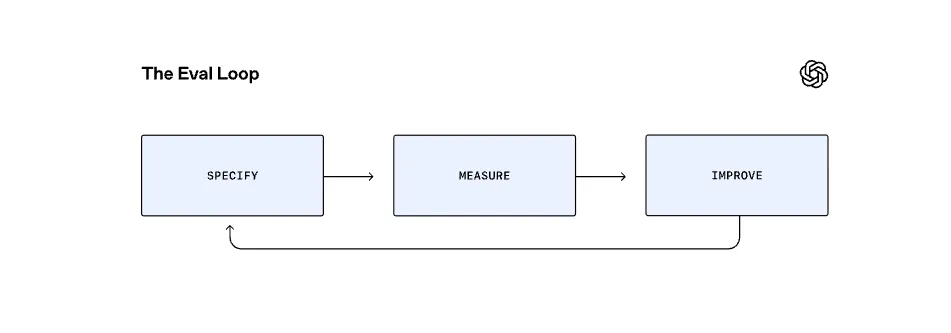
For example, you can create a test set of 100 representative client scenarios, each with an approved response based on your firm’s investment policies. Whenever you update an AI workflow, run it against the same test set and compare its outputs with the expected answers. If the AI continues to meet your quality benchmark, such as correctly handling 97% of the evaluation scenarios, it’s a strong indication that the workflow is still performing as expected.
Evaluations ensure your AI-generated recommendations remain accurate, consistent, and aligned with your firm’s investment policies.
4. Set Different Approval Rules for Different Roles
If you’re a mid-size RIA, you may have both senior and junior staff using the same AI workflows.
However, not every employee should have the same authority to send, approve, or act on AI-assisted outputs.
To ensure consistent, accurate results, AI use should match the person’s experience and the level of risk involved in the task. This way you can scale AI adoption across the firm without sacrificing oversight, accountability, or client trust.
For example, an RIA may allow senior advisors to use Claude Cowork to send routine AI-assisted client communications without additional review. While junior advisors can use the same tool, any AI-generated recommendation, portfolio proposal, or client presentation should be approved by a senior advisor before they are shared externally.
The safeguards we’ve covered above can be difficult to put in place unless you have the right AI and financial services expertise. Without the right governance foundations, AI can create as many risks as efficiencies. The RIA firms seeing the strongest results are those that not only select and use the right AI tools but approach adoption as an operational capability.
How Neurons Lab Can Help RIAs Adopt AI Safely and Effectively
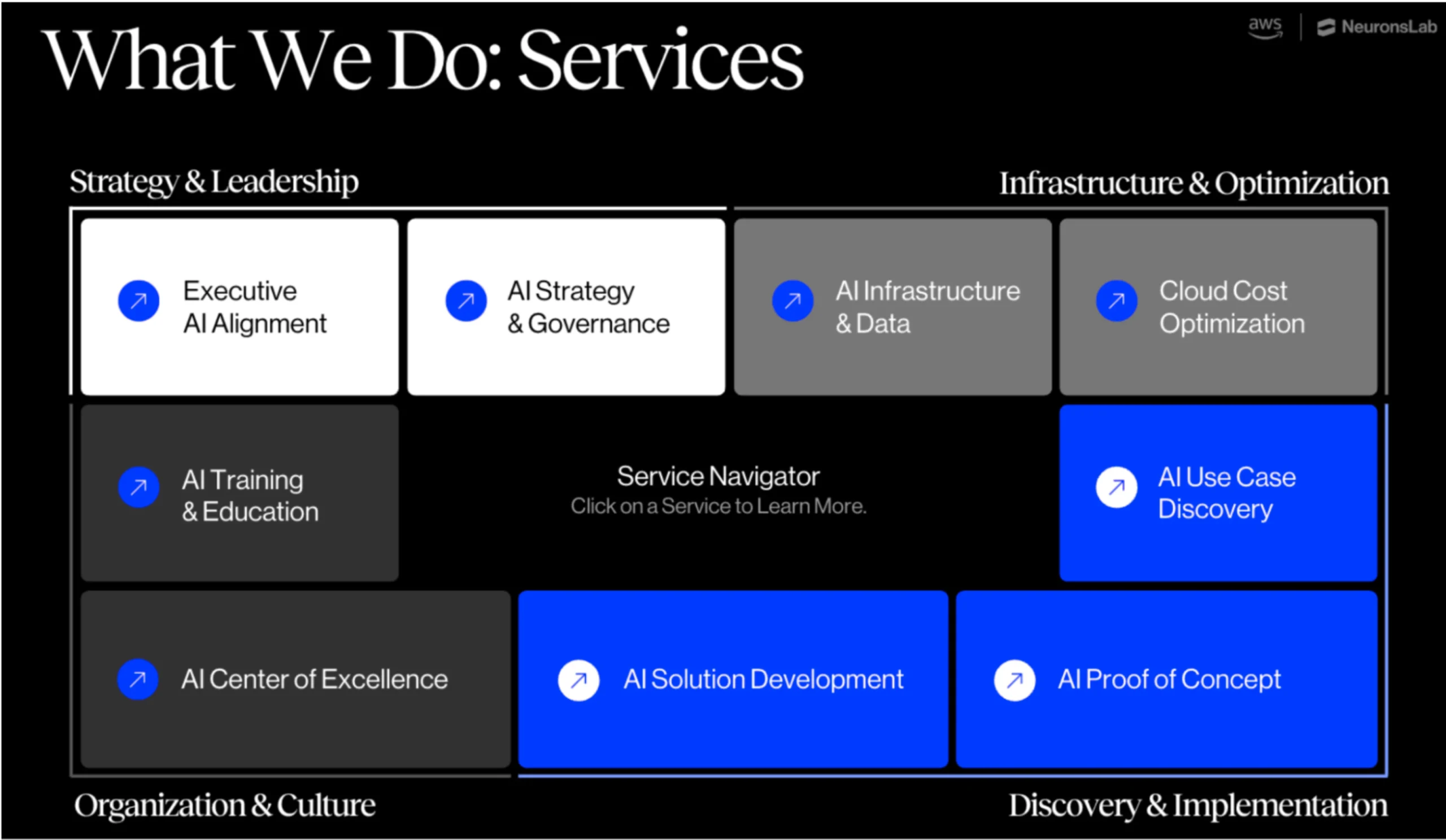
Neurons Lab helps RIAs move from AI experimentation to AI adoption at scale. We do this in a practical way, starting with the tools you already use and moving toward connected workflows, shared rules, and custom support where needed.
As an AI enablement partner serving organizations across the US, Europe, and Asia, Neurons Lab combines executive training, AI adoption programs, and custom AI agent builds to support secure, practical deployment. Clients build operational AI capability aligned with core workflows, governance, and business priorities.
Trusted by 100+ clients, including HSBC, Visa, and AXA, we’ve accelerated AI integration in banking, wealth management, private equity, investment firms, fintechs, and other highly regulated industries.
By partnering with us, RIAs can:
Build AI Capability to Scale Client Coverage Safely
Hiring more advisors is becoming increasingly challenging as talent is scarce and expensive, making it difficult for you to serve more clients. At the same time, you’re using AI for isolated chatbot tasks, which creates only small gains in efficiency.
With Neurons Lab you can build firm-wide AI capability through tailored enablement programs, governance frameworks, and practical workflows designed around existing advisor processes.
This means your advisors spend less time preparing for meetings, gathering information, and drafting communications, allowing them to support more clients without compromising consistency, oversight, or quality.
For example, during our enablement workshop, we might look at how your advisors run portfolio reviews. Currently, that might mean pulling each client’s holdings, checking them against the target allocation, noting what has drifted, and writing a detailed summary, all by hand.
Based on that, you’ll receive support in building an AI workflow that automates this manual process and drafts a review for the advisor to check and sign off on. A review that previously took several hours now takes a few minutes, and each advisor can cover more clients in the same week.
Connect AI to the Systems Your Advisors Already Use
AI can’t support advisors effectively if it’s cut off from the systems and information they use every day. Neurons Lab helps you integrate AI to your CRM records, market research, internal knowledge, and other business systems. This way, advisors can access the relevant client context they need without switching between tools.
Instead of manually collecting information from multiple sources, they can prepare for client meetings, review portfolios, and respond to inquiries with the right information already assembled.
For example, before a client meeting, AI can draft a briefing note that brings together the client’s recent activity, their holdings against current market research, and notes from past meetings, without the advisor having to spend hours across each system to find them. The advisor reads it and applies their judgment and expertise, ready to discuss the client’s goals and next steps.
Tailor AI to Your Investment Process and Client Needs
It can be hard to deliver personalized advice with off-the-shelf AI tools that don’t know the client context, your proprietary data or your investment process. Neurons Lab helps you get past that through custom development.
With Neurons Lab’s customized implementation support, you can tailor AI around the way you already work. Depending on your needs, this can include:
- Connecting AI tools like Cowork or Copilot to client communications, portfolio data, and CRM records such as Redtail or Wealthbox.
- Integrating proprietary market research, investment reports, and internal knowledge, aggregating data, and consolidating context.
- Building custom research workflows for specific asset classes, sectors, or investment themes.
- Connecting AI to financial models and analytical tools used by your advisors.
- Creating firm-specific workflows that reflect your investment philosophy, communication style, and review processes.
This allows AI to work from the same information, research, and processes your advisors already rely on. Instead of generating generic outputs, it can help prepare recommendations, research summaries, portfolio updates, and client communications that reflect the firm’s established approach and speak to each client’s unique portfolio. This enables AI to support the kind of advisory work that wins over Millennial and Gen Z clients.
An example of Neurons Lab custom agentic system that automates portfolio work
For example, instead of relying on generic index fund conversations, your advisors can prepare richer discussions around the topics younger prospects care about, such as crypto, semiconductors, biotech, commodities, thematic investing, or emerging sectors.
They can also better communicate how those themes relate to each client’s goals, risk profile, and portfolio strategy. This gives your firm a stronger way to show younger investors that your advice is relevant to the investment conversations they already want to have.
How A Financial Institution Doubled Client Reach Without Doubling Headcount
An Asian financial institution wanted to increase relationship manager (RM) capacity and client coverage without adding headcount. RMs were spending significant time on manual tasks, compliance checks, and data gathering across disconnected systems.
Many of the challenges it faced are familiar to RIAs, including limited capacity, fragmented data, and increasing demand for personalized client engagement.
Working closely with RMs, Neurons Lab analyzed their day-to-day workflows and identified where AI could create meaningful time savings.
Rather than replacing existing systems, we connected data across legacy platforms and built an AI assistant that supported relationship managers throughout their daily workflows. The solution helped prioritize client opportunities, gather market intelligence, prepare for meetings, and generate personalized recommendations.
To support adoption, Neurons Lab also delivered role-specific training so RMs could use the solution effectively across their workflows.
As a result, the institution achieved the following measurable results:
- 20+ additional RM capacity unlocked without new hires
- 2x increase in clients reached each month
- 15% uplift in client satisfaction through more consistent, personalized RM engagement
These results provide a key takeaway for RIAs: meaningful AI adoption depends on connecting the right data, embedding AI into daily workflows, and ensuring employees know how to use it effectively.
Work with an FSI and AI Expert to Implement AI Across Your Firm
AI can help RIAs and financial professionals adapt to talent shortages, changing client expectations, and stronger competitive pressure. But only when it moves beyond isolated chatbot tasks and are integrated into the workflows that shape your firm’s daily operations.
Getting there takes the right operating model, employee enablement, and implementation approach to ensure AI delivers consistent value over time.
Neurons Lab helps financial services firms build that foundation. Combining AI expertise with deep financial services experience, we support RIAs from use case discovery and team enablement through to workflow integration, governance, and custom AI development.
Want to use AI to serve more clients, deliver more personalized advice, and give advisors more time for high-value relationship work? Book a call with Neurons Lab.
FAQs
Is AI replacing investment advisors?
No, AI is not replacing investment advisors. Even when using AI, advisors still apply their judgment, review the output, and stay accountable for the final recommendation. AI simply supports them with manual work, such as summarizing client notes, preparing meeting briefs, drafting follow-ups, and reviewing portfolio information. That way they have more time to focus on client relationships and higher-value advice.
How do RIAs stay compliant when using AI?
RIAs stay compliant when using AI by keeping humans accountable for AI-assisted outputs. They can control what data the AI accesses, so it only uses approved client, portfolio, and policy information and produces relevant outputs.
They can also trace and audit every AI action, so any decision can be reviewed and explained, and continuously measure and improve AI performance, so AI stays accurate and consistent over time.
What’s the difference between AI tools and AI agents for registered investment advisors?
The difference is that AI tools need an advisor to prompt them through individual tasks, which takes time. AI agents execute multi-step workflows on their own, which frees the advisor to focus on higher-value work and only check the AI’s final output to stay accountable for what it’s done.