
If you’re looking for the best agentic AI firms for asset management, you’re probably seeing widespread adoption of artificial intelligence tools in your firm, such as Anthropic’s Claude Cowork or OpenAI’s ChatGPT Work, but not much increase in productivity or efficiency. This is likely due to the following:
- Work stays mostly manual because off-the-shelf tools and fragmented data aren’t connected, limiting adoption to one-off tasks like summaries of manually uploaded documents like fund fact sheets or IC memos to find the right answers for completing DDQs and RFPs.
- You can’t prove AI outputs like a research summary or client report are reliable or safe to send, and compliance teams won’t approve results that only ‘seem correct’ without any hard evidence to back them up.
- You don’t have the budget to hire or keep ML engineering talent versus the pay of hedge funds and big tech, leaving you without an expert you can build a secure, auditable and accurate agentic AI system
An experienced agentic AI development firm can help. As an FSI-focused AI enablement partner, we’ll walk you through why your adoption has plateaued, how agentic AI can help, and the top AI firms that can help you build agents that fit your workflows and maintain your custom systems.
In this article, we’ll cover:
- Why Asset Management Firms are Hitting a Wall with AI
- How to Make Agentic AI Work for Asset Management
- Top Firms Developing Agentic AI for Asset Management: A Quick Overview
- 0. Neurons Lab
- 1. Capco
- 2. Alpha FMC
- 3. Delta Capita
- 4. Vertical Relevance
- 5. RavenPack
- What to Look for in an Agentic AI Partner for Asset Management
- FAQs
Looking to build agents around your own systems. Neurons Lab can help. Contact us to learn more about building agentic AI for your asset management firm.
Why Asset Management Firms Aren’t Seeing Results from AI Agents
According to a Gartner study, over 40% of agentic AI projects1 are expected to be cancelled by the end of 2027, due to cost, unclear value and weak controls.
In asset management, those reasons show up in three ways.
1. Tools And Data That Don’t Connect Limit Productivity and Efficiency Gains
Fragmented data sources can easily break an automated workflow. We’ve seen many pilots stall here and it’s not due to model quality. It’s about the agent not being able to access every data source, from your CRM to your portfolio system, and when it does, it encounters duplicated data or conflicting numbers. That jeopardizes the accuracy of outputs, and forces an asset manager or quant analysts to question the output and start from scratch.
That also affects the hours saved. If an agent hits a data wall between the portfolio tool and the order system, the gain disappears back into manual work.
Some data like proprietary research can’t leave the firm’s environment. Asset management firms won’t send their strategies and data to an external model, so off-the-shelf tools end up walled off from the systems where the work happens. Running the model inside the firm’s own environment (private deployment) becomes a precondition, but that requires greater investment in technical builds and AI expertise in house or outsourced to an external partner.
2. Compliance Teams Don’t Have The Required Proof To Approve AI-Driven Outputs
At the time of writing, there are very few AI-specific rules. The EU has pushed its high-risk requirements to December 2027, but most asset management use cases weren’t covered there anyway. In the US, bank regulators’ new model-risk guidance excludes generative AI and agentic AI. The UK’s FCA has said it won’t write rules for AI and will supervise its use based on existing standards, including SMCR, which makes a senior person responsible.
With no checklist to follow, your firm has to show your compliance team (and a regulator if asked) that agents are accurate and controlled.
But that’s difficult to do when seemingly correct outputs are often inaccurate and hard to spot. A confident wrong number in a DDQ poses significant compliance risk.
The same question can also return slightly different answers. Large language models (LLMs) are non-deterministic (ask the same question twice and answers vary). This randomness is a problem for auditors and regulators who want a trail they can reproduce. For example, if a regulator asks you to reproduce how you got an answer in a DDQ, you won’t be able to.
For research teams, inaccuracy can also emerge in backtesting because the AI model may already know how the test period ended. AI models are trained on text up to a cutoff date, and that text includes news, filings and analyst commentary about those same past years.
So when a model “picks” stocks for 2019, it may be remembering how 2019 turned out, not predicting it. The backtest looks great, but then the strategy underperforms live. Even a point-in-time dataset (where every data point only uses what was public on that date) doesn’t prevent this, because the leak is in the model, not the data.
You also risk compliance infringements by letting an agent share information with users that have limited permissions. An AI agent connects with its login, which is often broader than any one user in the firm. So, if a junior analyst asks about a position, and the agent pulls from a restricted deal file or another client’s mandate that the analyst isn’t cleared to see, the analyst has information that they shouldn’t. The audit logs will record that disclosure.
This lack of governance results in several promising pilots that wind up failing.
3. No One Owns The Process
The costs of agentic AI can quickly exceed its value if there’s no one calling the shots. Since every question to a model or agent call costs money, a pilot with more than a few users across different departments can quickly become expensive. Without someone tracking cost per useful outcome, the economics stop working fast.
But asset management firms can’t compete against the levels that enterprise tech firms and hedge funds are paying for AI engineering talent.
That means asset managers don’t have anyone to standardize the data, build AI, or connect agents to their existing technology, such as ERP systems.
Even if they do manage to build agents by hiring a freelance engineer, firms would still need AI experts to test and approve a pilot to take it to production as well as engineers to maintain the system and catch any outdated answer libraries, AI drift as models change or update, or performance drops.
How to Make Agentic AI Work for Asset Management
AI agents can work best in asset management workflows with multiple steps. This is namely across operational and research and quant use cases.
Operational Use Cases
AI agents can automate several tasks quickly, reading across different systems, and produce outputs like a draft of a due diligence questionnaire (DDQ) or request for proposal (RFP) that requires a human in the loop to review and sign off on. It’s especially useful for the operational processes shown in the table below
How agents can work in asset management operations
| Task | What the agent does | Who signs |
|---|---|---|
| RFP and DDQ responses | Drafts answers from an approved answer library (previously signed-off answers) | Compliance or the relationship team |
| Investment committee memos | Drafts the case for an idea with each claim cited back to its source | The analyst, then the committee |
| Portfolio commentary per mandate | Reads attribution data (why a portfolio beat or lagged its benchmark) and drafts the explanation for each client account | The portfolio manager |
| Reconciliation breaks | Triages mismatches between the firm's records and the custodian's | Operations |
| Corporate actions | Processes messy notices on splits, mergers and dividends | Operations |
| Security master enrichment | Fills and corrects missing fields in the master list of instruments | Data team |
| Private markets documents | Reads capital call notices (investors' requests for committed money) and validates waterfall calculations (how profits are split: capital back, preferred return, then carried interest) | Fund accounting |
Research and Quant Use Cases
Agents are useful in research, especially in private markets where each fund sends documents in its own format, fragmenting the data.
For research and quant teams, agents can also help with the following:
- Turning text into point-in-time datasets. For example, an agent can read 20 years of earning call transcripts and build a table with one row per company and one column per quarter. Each cell has a consistent score, such as how cautious each CEO sounded every quarter. It creates data that couldn’t easily be built manually and creates new data rather than summarizing existing data, making it one of the highest-value use cases for research.
- Factor and hypothesis generation. Here, the agent proposes and backtests thousands of candidate factors, but within a capped search budget and rules for defining what counts as meaningful. That way, you avoid mistaking what look like winning ideas for real signals.
- Research code. Before a quant can test an idea, someone has to write the code that pulls and cleans the data, the framework that replays the strategy over past data (known as a backtest harnesses), and the checks that show the reliability of the result. Agents can handle most of this routine work, letting researchers save time that they can invest in the idea itself.
- Reviewing backtests before a strategy gets capital. An agent (i.e., a red-team agent) can do the first-pass review, re-running the test and checking for look-ahead bias and survivorship bias. Here, firms need to redesign the workflow with multi-agent orchestration, so that a separate agent builds the backtest and another agent is the reviewer, so it’s not checking its own answers. A human researcher still reviews whatever the red-team agent flags.
Where Agents Don’t Belong and How to Make Them Run Safely Where They Do
Where agents don’t belong is in fiduciary decisions, which remain with the asset manager as the person legally responsible for judgement calls. This means asset managers should avoid using agents for autonomous trading, unreviewed client comms, and automated suitability.
Leading asset management firms like BlackRock already know this, having built guardrails in its Aladdin Copilot to prevent it from giving managers investment advice.2
Here are four controls you can set up to make agents safe to run across your firm:
- Test the agent against known answers before it goes live. Build a golden dataset: a set of test questions with known correct answers, such as past DDQ questions paired with the signed-off response. Run the agent against it and measure how often it’s right. That is how you tell a correctly functioning agent from a convincing one.
- Set clear limits. Don’t give the agent its own permissions. Ensure the agent only sees what the person asking has permission to see.
- Keep a record of how every AI-produced figure or answer was made. To limit the randomness of AI model responses, keep using the same model version (e.g., if you use Anthropic’s Sonnet 5.5, don’t automatically switch to the latest version like Fable 5.1), set the randomness (i.e., the temperature) to its lowest setting, and save every output that was sent to a client along with the instructions you gave the agent.
- Don’t test on years the model already knows about. To avoid unreliable backtest results, test on a period after the model’s cutoff date (or use a model with a cutoff date that’s prior to the period you’re testing). This is most helpful when building point-in–time datasets, where each score should reflect only what was known on that date.
Now that you where to best apply agents across your processes and how to make them run reliably, here are the development firms getting agentic AI right.
Top Firms Developing Agentic AI for Asset Management: An Overview
| Company | Headquarters | Focus / Strengths | Asset Management Use Cases | Notable Clients / Outcomes* |
|---|---|---|---|---|
| Neurons Lab | London, UK & Singapore | AI enablement partner for financial services. Builds custom agentic AI on the client's own systems, client-owned and model-agnostic. Evals, permissions, sign-off and audit logging come built in. Engineers can stay embedded after launch. | Research and portfolio analytics agents, compliance and document agents, KYC/AML automation, approved-answer agents for client and RFP questions | HSBC, Visa, AXA; Japanese asset manager: roughly +1% annual return, drawdown 32% to 29%, Sharpe ratio 0.4 to 0.6. |
| Capco | London, UK | Global management and technology consultancy for financial services and energy; a Wipro company | AI-enhanced data platforms, investment operations modernization | NatWest Boxed (supports its agentic AI programme); Deutsche Bank Operations (metaverse campus built in under 10 weeks, not an AI project) |
| Alpha FMC | 25 offices worldwide, including London | Consultancy for asset management, wealth management and insurance. Offers Data, Analytics & AI, Managed Services and Transformation Advisory. | AI and analytics in front-office tools, client service, platform modernization | Has supported over 20 asset managers on client service initiatives (2021). Named clients not published. |
| Delta Capita | London, UK | Capital markets consulting, managed services and technology provider. Offers a mutualised managed service model. | Client onboarding and KYC (Client On-Boarding acquired from LSEG, 2024), AI agents within regulatory frameworks, compliance workflow digitization | Anonymised onboarding case study: 80% faster account opening. No named clients. |
| Vertical Relevance | New York, NY and Short Hills, NJ | AWS and ServiceNow specialist with AWS Financial Services Competency | Cloud data strategy, trade lifecycle and risk modernization, GenAI-based processing on AWS | Bank of Montreal (client data strategy); AI Squared (custom AWS deployment for an asset manager customer) |
| RavenPack | Marbella, Spain (global HQ); New York (North American HQ) | NLP, big data analytics and sentiment intelligence for financial markets | Real-time sentiment signals, Bigdata.com autonomous research agents (launched April 2025), market insight engines | Serves hedge funds, banks and asset managers. No named clients. |
0. Neurons Lab
As the authors of this guide, we’ll start by sharing information on our AI agent development services.
Neurons Lab helps Financial Services firms move from AI experimentation to AI adoption at scale.
As an AI enablement partner serving organizations across the US, Europe, and Asia, Neurons Lab combines executive training, AI adoption programs, and custom AI agent builds to support secure, practical deployment. Clients build operational AI capability aligned with core workflows, governance, and business priorities.
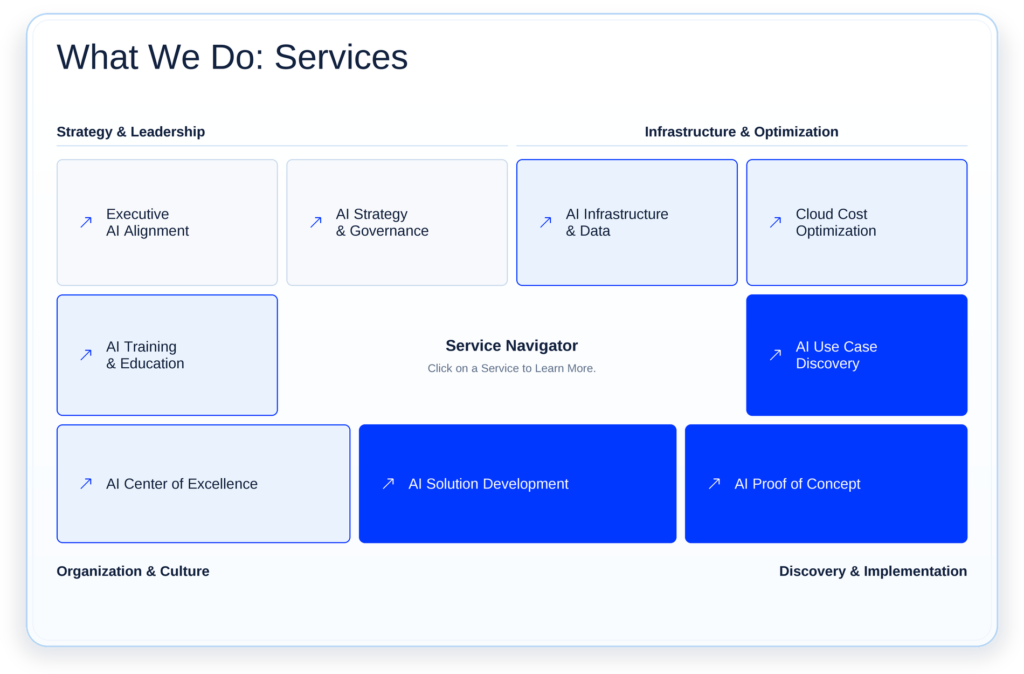
Neurons Lab’s end-to-end services
Trusted by 100+ clients, including HSBC, Visa, and AXA, we’ve accelerated AI integration in banking, wealth and asset management, private equity, investment firms, fintechs, and other highly regulated industries.
With Neurons Lab, your firm can use the agentic AI tools you already invested in, with redesigned workflows, tailored guardrails, compliant agent infrastructure, and measurable KPIs. Here are three reasons to develop AI agents for your asset management firm with Neurons Lab:
1. Build Custom Agentic AI Around Your Existing Systems
Disconnected off-the-shelf agents fall short because they can’t access the systems where your work happens day to day.
Neurons Lab builds custom agents on your own infrastructure, connected to your portfolio system, data warehouse and document store, with a new data layer that matches and standardizes the data between them. Since agents run in your own environment, your proprietary research stays safely in house.
You also own what we build, with a system that’s model agnostic so you’re not locked-in to one vendor. This also includes an approved answer library so your DDQ and RFP drafts are created from approved answers. Custom development can also come with a KPI dashboard so you can track and measure how outputs are helping you reach goals, like reduced drawdowns or increased returns on AI investment.
One example of our custom builds is a Japanese asset management company that wanted to roll-out an EFT-like product but was constrained by static allocation heuristics, which limited performance in volatile markets.
With Neurons Lab, the firm built a cloud-based research environment combining macroeconomic indicators and fundamental data in an agentic AI system. By having agents continuously update risk representations and inform portfolio decisions, this reduced reliance on static models.
As a result, the firm achieved an increased annual return by approximately 1 percent, drawdown reduced from 32 percent to 29 percent, and an improved Sharpe ratio from 0.4 to 0.6
2. Give Compliance The Evidence to Approve Your Agents
Without recorded, hard evidence, compliance teams can’t approve AI-generated outputs. And broad permissions can create regulatory risks.
With Neurons Lab, you can build the necessary governance and guardrails into your multi-agent systems from the start. This includes:
- A tailored evaluation framework (a structured test to measure and improve model performance) that shows how often an agent is right against golden data sets we help you set up. Read why Agentic AI evaluation frameworks matter for FSIs
- Permissions that limit the agent to the authority and access levels of the person using it, and you can also control the autonomy level at each seniority tier (i.e., senior roles have more automated workflows, junior roles less).
- Human sign off-steps
- Automated audit logging for a full trail for regulators and risk officers. This includes which data sources were used, which policy was applied, what the market context was at the time
This allows compliance to have the proof to review before allowing any output to go live or be shared. It also enables you to reproduce answers when asked by regulators.
We design our AI solutions to meet standards like GDPR and ISO/IEC 27001, and the requirements set by regulators like the OCC, FCA, and MAS. Data doesn’t leave these secure environments.
3. Embed Engineers to Run Your AI Agents After Launch
Many asset management firms don’t have the technical expertise in house to build, approve or maintain agentic AI systems.
Neurons Lab’s forward-deployed engineers work inside your infrastructure alongside your team after the build.
They maintain the agents, keep them accurate as models change and your answer library ages, and update the systems around them. Knowledge transfers as the system is built, so your team can run and extend it without us.
We also transfer knowledge continuously as we build. So if you choose, your team can operate and extend the solution without us, to avoid locking you into one vendor.
Who Neurons Lab is Best For
Neurons Lab is best for mid-market asset management firms and financial institutions that are making AI a strategic business priority. They want to turn experiments that have started with tools like Claude Cowork or ChatGPT Work into fully deployed agentic systems across the entire organization.
Through our embedded delivery approach, you’ll be able to have fully functioning AI systems in 2 to 4 months, along with the knowledge needed to expand them across your organization as you scale.
We know Neurons Lab may not be the best fit for every asset management firm, so here are five more options to consider.
1. Capco

Capco is a global consultancy in data modernization and enterprise AI integration for tier-1 banks and investment firms. Based in London, it specializes in financial services and energy industries consulting3, digital modernization, and AI/ML strategy.
While not purely AI-focused, they bring a mature perspective on embedding machine learning, LLMs, and AI automation into core investment operations. In asset management they can help with use cases like data platform modernization and AI in post-trade operations.
Main services include:
- Data and governance
- Technology consulting and transformation
- Supporting risk and regulatory compliance
Notable clients include Deutsche Bank4 and NatWest Boxed5, and Capco is best for large banks, capital markets firms and asset managers wanting one consultancy covering strategy through delivery. Its focus ranges from financial services to energy and isn’t concentrated on asset management alone, so it could suit firms that prefer broad experience over a specialist.
Discover the top Capco competitors and alternatives for AI in mid-market FSIs
2. Alpha FMC

With over 20 offices worldwide6, this global technology consultancy specializes in asset and wealth management consulting with advanced data and AI strategy.
Alpha FMC works with wealth and asset managers and insurance7 and has deep domain expertise. They help firms build cloud-native AI solutions for front-office analytics, portfolio insight generation, and platform modernization.
Main services include:
- Technology transformation strategy and integration
- AI and data analytics
- Managed services
Alpha FMC Alpha FMC says it has supported over 20 asset managers on client service initiatives8. They work best for asset and wealth managers that want a sector-focused consultancy with data, analytics, and AI along with managed services.
3. Delta Capita
With headquarters in London9, Delta Capita is a global capital markets consulting, specializing in technology consulting and automation-driven managed services10.
Delta Capita focuses on digitizing onboarding, KYC/AML, and compliance workflows through intelligent automation and production-grade AI agents. The AI use cases they cover range from regulatory onboarding and KYC/AML to risk management workflow automation11.
Main services include:
- Strategic consulting and transformation programs
- Regulatory compliance support
- Mutualized managed services
With various global banks, financial institutions and fintechs like Equilend12 as clients, Delta Capita is best for capital markets firms and banks seeking cost-efficient operational improvement in areas like onboarding and KYC.
4. Vertical Relevance
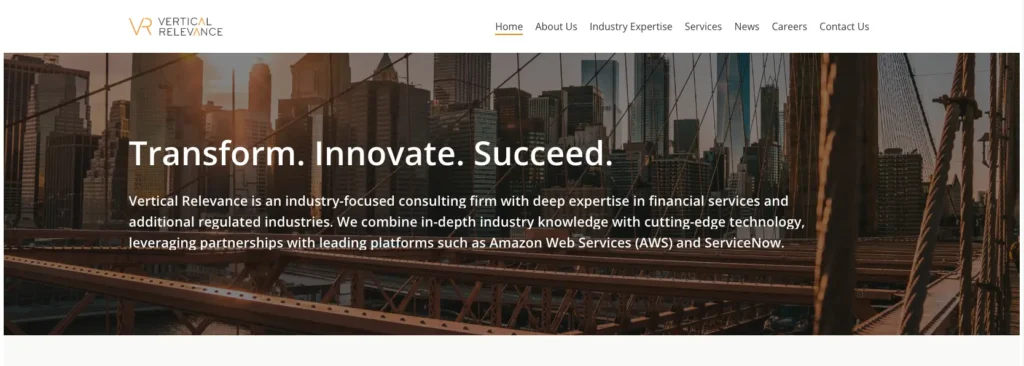
Based in New York, Vertical Relevance is a technology consulting firm helping regulated industries with digital modernization and AI deployment.
If you’re building within the AWS ecosystem, Vertical Relevance offers deep expertise in cloud-based financial modernization13. They help institutions modernize risk engines, trade lifecycles, and real-time analytics.
They can help asset management firms with use cases like risk engine modernization and AI-powered trade lifecycle automation.
Main services include:
- AWS cloud transformation services
- Business consulting
- Customer experience
Notable clients include the Bank of Montreal14 and AI Squared15. Vertical Relevance is best for financial firms that already run on AWS or ServiceNow, and want cloud data and modernization for that stack.
5. RavenPack
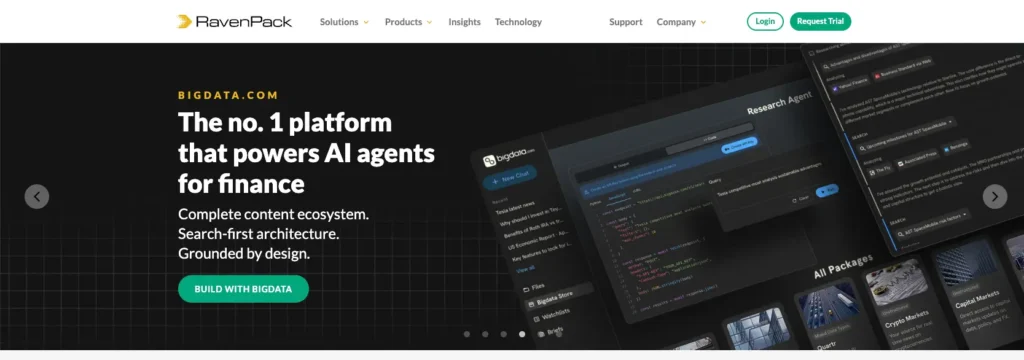
RavenPack is a big-data analytics and artificial intelligence company operating out of Spain16. It’s focus is in Natural Language Processing (NLP), data processing, and sentiment analytics for financial institutions
RavenPack builds autonomous research agents17 and market intelligence platforms using large-scale NLP models and data-driven AI systems. Their tools are used by quant funds, hedge funds, and institutional investors to uncover sentiment signals and market trends in real time.
Main services include:
- Alpha generation
- Risk and compliance
- Self-service data and APIs
RavenPack supports hedge funds and asset managers18 and is best suited to research and investment teams looking for ready-made market data and sentiment products. Unlike the other firms listed above, RavenPack is more of a product vendor, not a services firm.
What to Look For in an Agentic AI Partner for Asset Management
When evaluating AI agent development companies, consider those that offer:
- Asset management experience. Ask if they work with typical processes like mandate reporting, reconciliation, and private markets documents. If they already know the vocabulary and regulatory requirements, they won’t take up weeks of your team’s time to get up to speed.
- A proven approach to testing agent accuracy before launch. Look for golden datasets that can show you how often your agent is right before going live.
- Built-in permissions and audit trails. Ask how the agent inherits permissions of the person asking, and what gets logged automatically. You want to be sure you have observability into what the agent did and with which model version, and can reproduce any output for an auditor.
- Custom builds inside your infrastructure and systems. Look for firms that build agents that can run in your own environment and connect to your systems (portfolio, data warehouse) with a clean data layer between them. Make sure you won the AI system, and that it can work with more than one model to avoid vendor lock-in.
- Managed services. See if a partner can stay on after launch if you need it, as agents need upkeep, as well as knowledge transfer if you decide to build your own agentic AI team. Also see if they’ve already taken clients from pilot to production.
Choose an Agentic AI Partner That Builds Inside Your Asset Management Firm
Many asset managers have already started using AI, but the firms with the most success are the ones that invest in automating multi-step workflows, and keep strict guardrails around agents, like human sign-offs before sending outputs to clients. They also run their systems with the controls and traceability that compliance teams need.
But only a few firms have the human resources to build agents on their own, so the AI partner you choose matters. Look for ones that build on your own systems, prove accuracy before production, and stay with you to ensure agents keep creating accurate outputs.
Want to see what that looks like for your firm? Neurons Lab can show you. Contact us today to learn more.
FAQs
1. What is agentic AI in asset management?
Agentic AI refers to systems made up of multiple intelligent agents that carry out multi-step workflows across your tools and data, often through multi-agent collaboration. In asset management, this includes pulling data to draft DDQ response, monitoring compliance, and running research analysis, with people signing off before anything goes out.
2. How does agentic AI improve investment performance?
It does this mostly indirectly. Agents save analysts time on research and operations as well as feed better inputs into portfolio decisions. It does this by using interconnected AI agents to monitor markets, assess risk, and draft documents in real time.
3. Which agentic AI company is best for AWS-based solutions?
Vertical Relevance and Neurons Lab stand out for AWS-native financial modernization, offering solutions like AI-driven risk engines, relationship manager co-pilots and enterprise automation within Amazon’s cloud ecosystem.
4. How do I choose the right agentic AI development firm for my fund?
Look for firms with experience in creating agentic systems for asset management and proof that they test for accuracy before production. They should also be able to deploy in your own environment with built-in permissions and audit trails, along with the possibility to stay on after launch to maintain agents.
5. Are there any proven results from agentic AI in asset management?
Yes, but public examples are limited due to confidentiality. For instance, Neurons Lab has delivered measurable gains for Japanese asset managers, including a 1 percent increase in annual return and a Sharpe ratio improvement from 0.4 to 0.6.
Sources
- https://www.gartner.com/en/newsroom/press-releases/2025-06-25-gartner-predicts-over-40-percent-of-agentic-ai-projects-will-be-canceled-by-end-of-2027
- https://www.zenml.io/llmops-database/agentic-ai-architecture-for-investment-management-platform
- https://www.capco.com/about-us
- https://www.capco.com/about-us-old/success-stories/deutsche-bank-wandel
- https://www.capco.com/about-us/newsroom-and-media/how-capco-supports-NatWest-Boxed-in-embedded-finance
- https://alphafmc.com/office-locations/
- https://alphafmc.com/about-alpha/
- https://alphafmc.com/insights/uncovering-the-practices-of-high-performing-client-service-functions/
- https://www.crunchbase.com/organization/delta-capita
- https://www.deltacapita.com/about-us/our-story
- https://www.consultancy.uk/news/37143/delta-capita-buys-kyc-and-clm-solution-client-on-boarding
- https://www.deltacapita.com/insights/equilend-names-delta-capita-as-an-implementation-partner-for-equilend-spire
- https://www.verticalrelevance.com/ and https://www.businesswire.com/news/home/20220329005845/en/Vertical-Relevance-Achieves-AWS-Financial-Services-Competency-Status
- https://www.verticalrelevance.com/wp-content/uploads/2022/09/Vertical-Relevance-Co-Branded-Case-Study-Bank-of-Montreal-Client-Data-Strategy-Program-V2.pdf
- https://www.verticalrelevance.com/wp-content/uploads/2024/03/AI-Squared-Public-Case-Study-AWS-VR-Branded-Two-Pager-FINAL.pdf
- https://www.ravenpack.com/company/offices
- https://www.ravenpack.com/blog/bigdata-launches-agentic-ai-platform
- https://www.ravenpack.com/solutions/alpha-generation