

As a mid-market financial services firm exploring AI for AML, it’s likely that your core workflows still rely on a lot of manual effort. Teams pull documents from separate systems, chase the same evidence by hand, or work through false positives one by one. And every case they investigate still has to stand up to regulatory scrutiny.
The result is slow investigations and AML decisions that vary from one reviewer to the next.
Those delays and inconsistencies each carry a cost, whether that’s a compliance gap, a frustrated client, or reputational risk.
So it makes sense that you’d want to standardize how AML gets done and use AI to make your operations more efficient, without adding new risk. But the hard part is knowing where to start.
With new tools and competing approaches, it’s not always clear which use cases or types of AI actually fit your institution and your workflows. As an AI consultancy specializing in financial services, Neurons Lab supports companies to adopt agentic AI through training and enablement or custom builds.
In this article:
- Where AI Can Support Anti-Money Laundering Compliance: 4 Key Investigation Stages
- 4 Key Challenges Mid-Market FSIs Face When Applying AI to AML
- How FSIs Can Get Started with AI for AML
- How Neurons Lab Can Help FSIs Implement AI for AML
- How a European Bank Scaled AML Reviews and Cut Compliance Scaling Costs by 80%
- FAQs
Want to use AI to make your AML processes faster and more reliable at scale? Neurons Lab can help. Book a call with us today.
Where AI Can Support Anti-Money Laundering Compliance: 4 Key Investigation Stages
For mid-market financial services firms, such as private equity, family offices, RIAs, independent wealth advisors, and capital markets, combating fraud and financial crime like anti-money laundering (AML) is difficult because teams are lean and the work is spread across many systems, documents, and review steps.
A family office verifying the source of wealth behind a complex trust may pull from investor files, banking records, and prior case notes held in separate places, taking days just to clear one beneficial owner.
When AML checks drag like this, it can slow onboarding times and create backlogs, frustrating clients. It also raises compliance costs and increases regulatory risk.
Applied to the right workflows, artificial intelligence can support the full AML investigation cycle, reducing much of this manual effort while improving consistency and helping teams scale their AML operations.
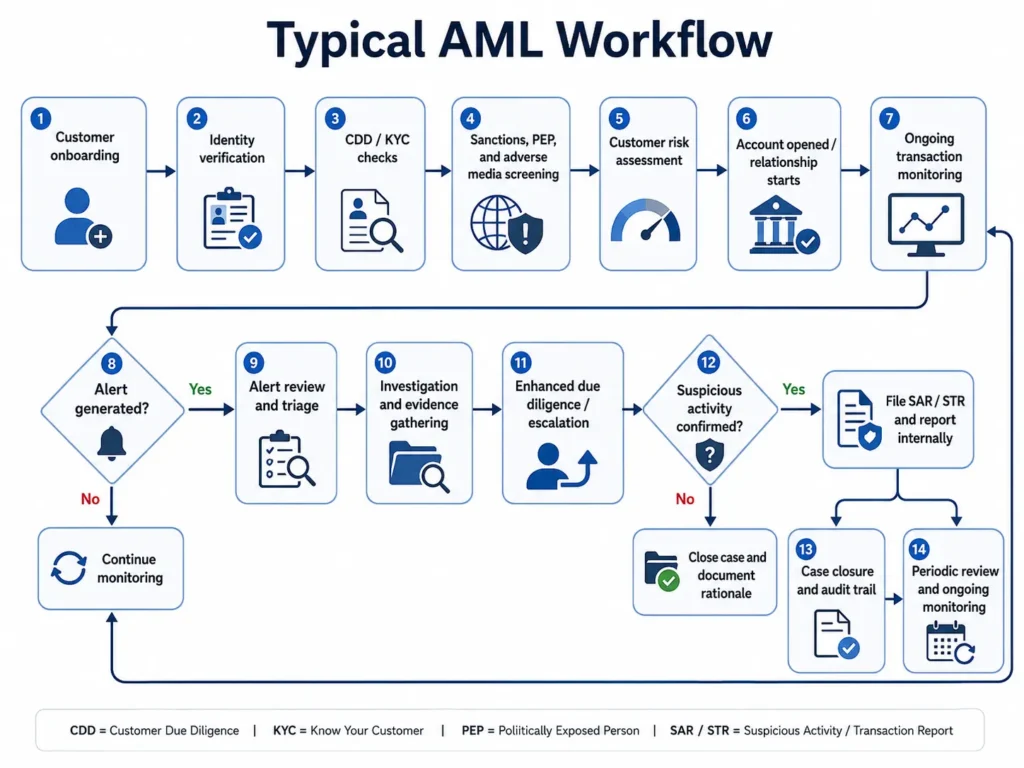
Image source: Neurons Lab
Key use cases and workflows include:
1. Supporting Customer Due Diligence (CDD) and Enhanced Due Diligence (EDD)
Compliance teams spend hours manually collecting client or investor information. This includes verifying identity, checking sanctions and politically exposed person status, reviewing source of funds or wealth, and documenting a final risk rating.
AI uses natural language processing (NLP) to read documents, extract key details,compare information across files, and flag missing or inconsistent evidence. Generative AI (GenAI) can also summarize adverse media and prepare a first draft of the review file for a compliance officer.
For example, a registered investment advisor (RIA) onboarding new clients can use AI to read identity documents, draft risk ratings, and flag files with mismatched evidence. The team clears more onboarding without extra headcount, and the RIA onboards happy clients in hours rather than days.
2. Investigating Complex Ownership Structures
Investigators trace complex ownership by hand across LLCs, trusts, holding companies, offshore entities, and layered beneficial ownership. This means details sit scattered across filings, trust records, and investor files, and a controlling owner is easy to miss.
AI tackles this by using pattern recognition to pull ownership details from these sources and organize them into a clear ownership view that highlights gaps, conflicts, or entities that need deeper review.
A family office reviewing trust and holding structures, for example, can use AI to draw trustees, beneficiaries, and controlling parties from deeds and entity charts into one view. The team works from a complete picture rather than a partial one, and the firm avoids the risk of an undisclosed owner surfacing in a later audit or investigation.
3. Prioritizing Alerts and Higher-Risk Cases
Compliance teams face high volumes of alerts which makes it hard to identify which cases to prioritize, so real financial crime risk can slip through undetected. AI combats this by using machine learning to apply risk scoring to alerts, filtering only those teams need to focus on based on the level of risk involved.
Take a fintech running transaction monitoring. AI can score each alert by risk level using the customer’s prior case outcomes and similar transaction patterns. The team focuses on the genuine cases first, helping the firm catch more of what is likely to be real financial crime.
4. Preparing Investigation Files and Audit Documentation
Every compliance decision a firm makes has to be defensible. However, when investigation or case files have to be compiled by hand from notes and evidence spread across different systems, they can end up incomplete or inconsistent, and hard to trace back to the source when a regulator or auditor reviews them.
AI helps by logging every action, from gathering evidence across sanctions screenings, suspicious activity reports (SARs) and know your customer (KYC) checks to summarizing case notes and linking each finding back to its source document. It can then prepare a structured draft case file for human review.
Let’s say a private equity firm is onboarding a new investor committing $20 million to a fund.
An AI agent can log the anti-money laundering checks and actions made by the agent and the humans in the loop:
| Step | Audit Record |
|---|---|
| 10:01 | Investor onboarding initiated |
| 10:01 | Retrieved KYC documents and beneficial ownership information |
| 10:02 | Screened investor and beneficial owners against sanctions and PEP lists |
| 10:03 | Identified beneficial owner linked to a politically exposed person |
| 10:04 | Applied enhanced due diligence policy |
| 10:05 | Recommended compliance review |
| 10:12 | Compliance officer approved onboarding with additional monitoring requirements |
If regulators later ask why enhanced due diligence was performed, the firm can show exactly:
- Which ownership records were reviewed
- Which screening results triggered concern
- Which AML policy was applied
- Who made the final decision
- When each action occurred
This creates a clear, defensible audit trail for investor onboarding.
Before introducing AI into these workflows, it’s important to understand the operational, governance, and data challenges that can affect implementation.
4 Key Challenges Mid-Market FSIs Face When Applying AI to AML
Many firms run into specific challenges when applying artificial intelligence to these multi-step workflows that can directly affect investigation quality, the defensibility of risk decisions, and their ability to show regulators that regulatory requirements are being followed.
These challenges in applying AI to the anti-money laundering investigation process include:
1. Fragmented Data Makes AI-Powered AML Decisions Harder to Trust
Because AML data sits across many separate sources like CRM platforms, investor portals, fund admin systems, and sanctions tools, AI often can’t see the full client picture.
When data quality is poor, information is incomplete, inconsistent, or difficult to access. This limits AI’s anomaly detection capabilities and can cause it to miss critical information like:
- Ownership links
- Previous risk flags
- Source of funds concerns
- Prior escalation history
That makes its outputs less reliable and harder for analysts and compliance teams to trust.
2. AML Teams Must Be Able to Explain AI-Driven Decisions
Teams need explainability: the ability to show exactly how AI was used to clear a client or flag a profile for deeper review. If the AI can’t link its output back to the data it accessed, the steps it followed, and where a human reviewer was involved, that becomes a compliance issue. Firms can’t reconstruct the process to review or audit it later, or defend it to a regulator who asks how the decision was reached.
3. It’s Difficult to Embed AI Into Day-to-Day AML Operations
These anti-money laundering AI projects often start from a broad goal, such as improving investigations or reducing manual review, but teams often don’t know how to get generative AI tools like Microsoft Copilot or Claude Cowork to turn their daily tasks into AI-ready workflows.
As a result, many of their routine processes stay manual, leaving less time for analysis and decision-making. They may also lack clear ownership and consistency over how AI is used, with each team member using their own prompts or criteria. This means investigation quality can vary between analysts, making financial-crime compliance processes less consistent and more difficult to govern.
4. AML AI Performance Declines as Risk and Regulations Change
A machine learning model or predictive analytics workflow that works well at deployment may become less reliable over time as risk appetite and regulations change, from sanctions lists updates and client profile shifts to new AML typologies and regulatory changes. AI outputs can suddenly become inaccurate, degrading without teams noticing while it’s happening.
This can affect onboarding decisions, alert handling, investigation files, escalation quality, and reporting.
When AI is built to handle the issues above and matched to the right workflows, it delivers faster, more consistent investigation work at scale.
How FSIs Can Get Started with AI-Powered AML
Getting started comes down to clearly defining how you perform investigations today, where AI can assist, and where human judgment remains essential. Here’s how to build a solid foundation:
1. Build the Right Data Foundation for AI
AI can only support these investigations if it has access to complete, reliable, and relevant information. Before implementation, identify the systems, documents, and historical case data your investigators rely on, then determine how AI will securely access and use that information, with data privacy and access controls defined from the start.
In some cases, this means connecting existing systems. In others, it means organizing documents, standardizing investigation records, or defining which data sources and policies AI should treat as authoritative. The better this foundation, the more reliable and consistent AI-assisted investigations become.
2. Identify Workflow Friction
Pinpointing exactly where your AML work slows down shows where AI can save you the most time and create measurable value. It also gives you a clear baseline so you can measure the improvement before and after a pilot. Without this step, you risk adding AI to processes that don’t need it, or using tools that don’t match how the work actually gets done.
3. Test AI Against Real AML Cases
See whether AI improves investigation quality, risk assessments, analyst productivity, review consistency, and case turnaround before rollout. Testing saves you from pilots that work as experiments but fall apart in production. If you only test against generic benchmarks, you may miss whether the system can interpret your case notes, follow your escalation criteria, cite the right evidence, or support the way your team closes investigations.
4. Keep Humans Responsible for AML Decisions
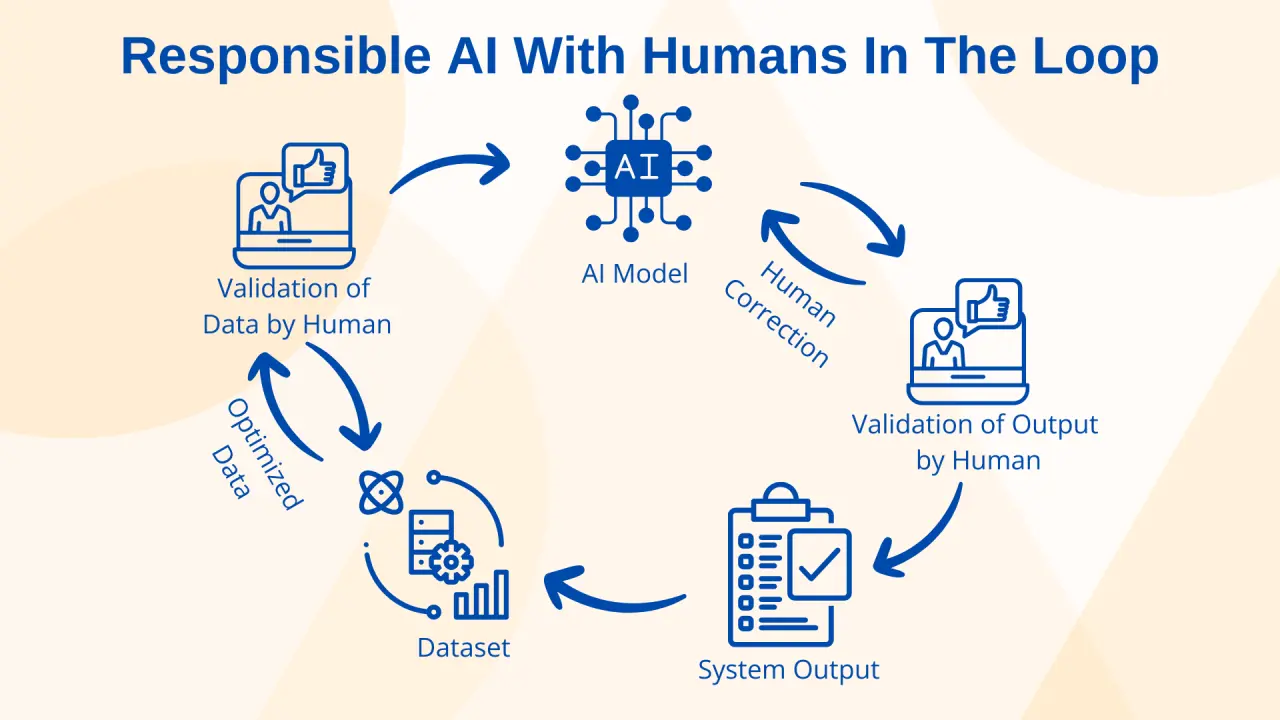
Image source: LinkedIn
AI can help analysts investigate cases faster, but responsibility for AML decisions should remain with compliance teams. Human oversight improves accountability, helps manage edge cases, and creates a clear record of who approved an outcome and why.
Without clear ownership, it becomes difficult to explain how a decision was reached, who approved it, or what evidence was used. This can create audit challenges, reduced trust in the system, and increased regulatory and operational risk.
5. Decide How to Implement AI
Before moving AI into your compliance workflows, decide whether you will build the solution in-house or with an AI partner. That decision shapes what you need to prepare, who does the work, and how you keep human oversight in place on higher-risk cases.
If you build in-house, look at whether you have the capacity to do the work, from technical teams that choose the right workflows and tools to leaders defining how AI-powered processes move to human review and get analysts using AI consistently and safely on live cases.
Alternatively, you can work with an AI partner to accelerate adoption and implementation.
Look for a partner that combines AI expertise with financial services experience, helps your teams build the capabilities they need, and can provide hands-on engineering support where a custom solution is required. That way, you can move into production faster while building internal ownership from the outset.
How Neurons Lab Can Help FSIs Implement AI for AML
Most mid-market AML firms can find it complex to handle implementation aspects like connecting their data, defining their processes, and ensuring human oversight on their own.
With Neurons Lab, they can move from AI experimentation to AI adoption rapidly, in a structured and compliant way.
As an enablement partner serving organizations across the US, Europe, and Asia, Neurons Lab combines executive training, adoption programs, and production-grade agentic AI implementation to support secure, practical deployment. Clients build operational AI capability aligned with core workflows, governance, and business priorities.
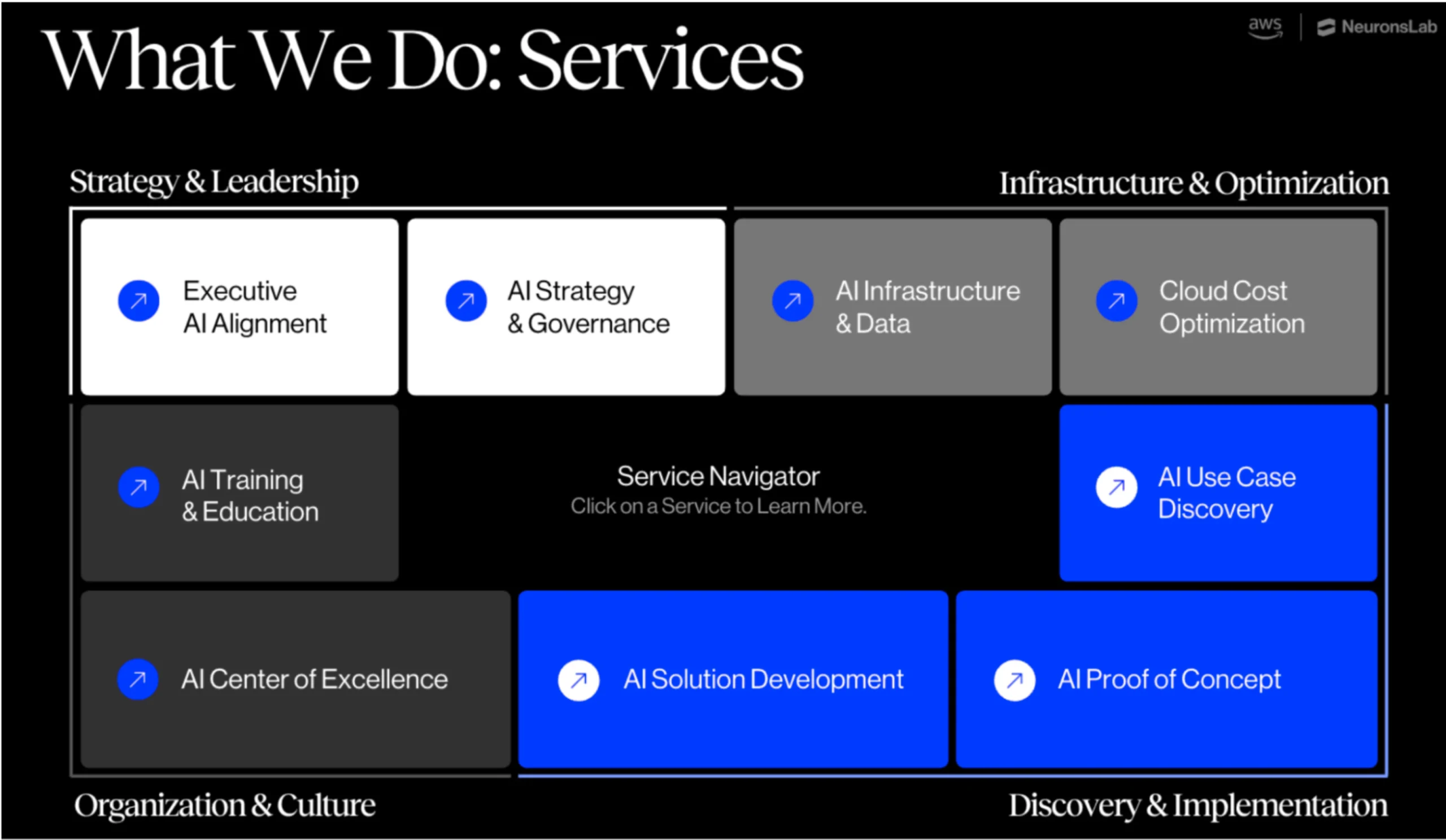
Trusted by 100+ clients, including HSBC, Visa, and AXA, we’ve accelerated AI integration in banking, wealth management, private equity, investment firms, fintechs, and other highly regulated industries.
Here’s how you’ll benefit from partnering with us to adopt and implement AI in your anti-money laundering workflows:
Identify AML Workflows Where AI Can Reduce Manual Effort
Like many mid-market FSIs, you may be stuck with manual processes across high volumes of investigations of suspicious cases. That slows your operations, increases operational costs, and puts additional pressure on compliance teams managing growing alert volumes. With Neurons Lab, you can understand which processes are suitable for automation and where human expertise remains essential before implementing AI.
The process starts by aligning compliance, operations, and technology stakeholders on business objectives, success criteria, and available data. This way, leadership and teams align on the investigation processes, review requirements, and decision points that AI will support.
Workflow assessments then show you where manual review pressure is highest across onboarding, screening, investigations, escalations, and case documentation. That way, you identify which AML processes create operational burdens and where automation can cut review time, false positives, and backlogs.
You then receive a step-by-step AML framework and roadmap for adopting AI across your AML workflows, mapped to regulatory compliance requirements, governance constraints, data readiness, and implementation priorities. This gives your whole firm a concrete path from AI strategy to pilot, rollout, and measurable operational improvement.
Create Consistent and Defensible AI-Supported Investigations through Enablement
It can be difficult to maintain consistent standards or make decisions that hold up under regulatory scrutiny when AI use is scattered across teams and everyone uses it differently. Neurons Lab helps you create more consistent and defensible AI-supported investigations.
With role-specific enablement workshops, your compliance, operations, investment, advisory, and technical teams learn how AI applies to their specific responsibilities. This helps each team understand where AI can support key workflows such as CDD, EDD, and alert triage, while keeping human review in place for higher-risk decisions.
With tailored investigation playbooks, you can document AML investigation best practices that teams can follow consistently across the organization. For example, playbooks define:
- Common investigation steps
- Evidence standards
- Escalation rules
- Review criteria
- Documentation requirements
Shared standards reduce duplicated work, make investigation outcomes easier to compare and review, and help teams apply AI more consistently.
As AI adoption expands, regular reviews also help refine how AI supports investigations while maintaining human oversight and accountability. This gives firms the governance needed to scale AI confidently across their workflows.
Build Reliable Data Foundations and Custom AI Solutions for Complex AML Workflows
Not every AML workflow requires a custom AI solution. Some can be supported using existing AI tools with the right guidance, governance, and access to relevant business information. Others rely on proprietary data, legacy systems, or specialized review processes that require a more tailored implementation.
Neurons Lab assesses your workflows, existing systems, and information landscape to determine whether an off-the-shelf tool is sufficient or whether a custom solution will deliver more reliable outcomes.
As part of the implementation process, our forward deployed engineers (FDEs) assess your existing data landscape to determine what information AI needs, where it resides, and whether existing tools can access it securely. In some cases, this means connecting existing systems. In others, it means organizing documents, defining authoritative sources, or preparing investigation records so AI produces reliable, traceable outputs.
When a custom solution is required, you’ll have hands-on support. FDEs work alongside your teams to build AI across your existing systems, controls, workflows, and ownership model. That way, AI fits how you actually operate. The knowledge your teams gain stays in-house, too, so they can own and run the solution long after the engagement ends.
For example, a capital markets team may need to screen counterparties across thousands of transactions. The records analysts rely on may sit in legacy systems that off-the-shelf AI tools cannot easily access or integrate with.
With Neurons Lab, you build a custom AI solution around that existing infrastructure. It pulls counterparty records, screening results, and transaction history into one place for each review, with each finding linked to its source. Your team clears reviews faster and with fewer gaps, and you keep full ownership of the system rather than depending on an outside tool.
How a European Financial Institution Reduced AML Review Costs by 80%
A European financial institution was handling more than 5,000 AML and KYC reviews every month, with manual review times reaching up to 30 minutes per case and increasing compliance costs. To help address this challenge, Neurons Lab built a custom AI solution to handle routine review activities, prepare evidence, and route higher-risk cases to human reviewers.
As a result, the institution saw 50% productivity improvement, 70% of routine reviews handled without manual intervention, and 80% lower implementation costs when expanding to additional compliance workflows.
These outcomes were achieved by matching the implementation approach to the organization’s workflows, systems, and operational requirements. The same principle applies to other financial services firms. Some AML workflows can be supported using existing AI tools, while others require a custom solution to deliver reliable, governed outcomes.
Regardless of the implementation approach, the objective is the same: reduce manual effort, improve investigation consistency, and maintain oversight as review volumes grow. For mid-market financial services firms, that means clearing cases faster, giving compliance teams more time to focus on higher-risk investigations, and scaling AML operations without increasing costs.
The Most Effective AML AI Initiatives Focus on Adoption, Not Just Tools
AI creates value when applied to specific AML workflows such as due diligence, ownership analysis, alert triage, and investigation preparation. It supports your team’s expertise, helping them work faster, review cases more consistently, and make better-informed decisions.
Successful implementation for mid-market financial services depends on data, process design, human oversight, and adoption. This is where Neurons Lab helps. We help you identify the right workflows, assess the right implementation approach, and build the capabilities your teams need to adopt AI effectively.
If you need help building a clear path from adoption to production with a partner that brings together AI expertise and financial services experience, get in touch with Neurons Lab.
FAQs
Can AI replace anti-money laundering compliance teams?
No. AI can’t replace AML compliance teams. Compliance professionals remain responsible for applying judgment in reviewing cases and making final decisions. Instead, AI supports routine tasks like information gathering, fraud detection support, and documentation preparation, helping them work faster and make better-informed decisions.
How can financial services firms identify the right AML workflows for AI adoption?
Start by identifying AML workflows, such as transaction monitoring alert triage, that involve high volumes of manual review, repetitive investigation steps, or significant documentation effort. Organizations can assess these workflows internally or work with an enablement partner to determine where AI can reduce manual effort while maintaining appropriate oversight.
When does an AML workflow require custom AI development instead of an off-the-shelf tool?
An anti-money laundering workflow requires custom AI development when it relies on proprietary data, legacy infrastructure, specialized review processes, or integrations that standard off the shelf tools can’t support.