
If you’re looking for the best AI tools for financial advisors its likely that:
- Your advisors spend significant time on client preparation, research, portfolio reviews, follow-ups, and administration, limiting the capacity available for client relationships.
- You’re already experimenting with artificial intelligence (AI), but usage is scattered across different tools, prompts, and review processes. This makes it harder to govern use consistently, see what’s working, and scale successful approaches.
- You’re concerned that adding more tools could create integration challenges, especially with limited IT support, and affect the accuracy and reliability of AI outputs.
The right AI tools can enable greater advisor capacity, stronger productivity, and more personalized client service. However, selecting them is only one part of adopting AI that works across your firm. Based on what we’ve seen working with financial services teams like RIAs, we cover both the tools available and the broader approach that helps financial advisors turn AI into measurable business results.
In this article:
- Key Takeaways
- What to Look For in an AI-Powered Tool for Financial Advisors
- Comparing the Top AI Tools for Key Financial Advisor Workflows
- Top AI Tools for Key Financial Advisor Workflows
- Why AI Tools May Not Be Enough for Financial Advisors
- How Neurons Lab Helps Financial Advisors Adopt and Scale AI
- 3 Examples of How Neurons Lab Has Helped Financial Advisors Adopt AI
- FAQs
Want to get more measurable business outcomes like productivity, improved client service and higher revenue from AI? Neurons Lab can help. Let’s talk
Key Takeaways
- Different AI tools support different parts of the client lifecycle. Mili and FinMate can help with meetings and administration, Nitrogen and Addepar with portfolio analysis, Claude Cowork and Microsoft 365 Copilot with research, and Practifi and Wealthbox with CRM and client management.
- When choosing a tool, look beyond features. Ease of adoption, support for multi-step workflows, secure integration with your systems and data, and built-in governance all affect how effectively AI can be used across your firm.
- AI adoption can be difficult to manage with lean internal resources. An external AI enablement partner can reduce the risk and guesswork around tool selection, integration, governance, training, and measurement so firms can improve productivity, increase advisor capacity, and scale adoption sooner.
What To Look For In An AI-Powered Tool For Financial Advisors
As a mid-market financial advisory firm, you’re under pressure to deliver a timely, relevant client experience with a lean team. Day-to-day work such as meetings, research, portfolio reviews, follow-ups, and CRM administration all compete for advisor time, leaving less capacity for client relationships and revenue-generating work.
When considering the best AI-powered tool for financial advisors, the right capabilities can reduce that workload while helping advisors support more clients. Look for the following:
- Ease of adoption: Tools that don’t add unnecessary complexity to workflows encourage more consistent use and fewer workarounds. Opt for minimal technical setup and practical guidance for applying the tool/ plus ongoing support for your teams, so AI adoption translates into actual time savings and productivity gains.
- Support for multi-step workflow automation: AI creates greater productivity gains when it can coordinate several stages of advisor work automatically. For example, a single workflow that prepares a meeting brief, generates follow-up actions, and updates CRM records once approved, frees advisors from coordinating each step manually.
- Integration with your systems and data: Connections to your CRM, financial planning software, portfolio systems, client communications, and internal research give AI more complete client context. This reduces preparation time and helps advisors deliver more relevant, personalized support across more clients.
- Built-in governance: Look for features such as source citations, audit logs, human review controls, and centralized monitoring of AI outputs and performance. These give your firm a clear record of how recommendations and other client-facing outputs were produced, making them easier to review, justify, and monitor over time.
- Control over client data: Look for clear data-handling policies, role-based permissions, retention controls, and restrictions on model training. These controls let you use sensitive client, KYC/KYB, and portfolio information across AI workflows in line with your firm’s compliance requirements.
These capabilities currently appear in different types of AI tools, from broad platforms that support several advisor workflows to specialist products designed for a particular task.
Comparing the Top AI Tools for Key Financial Advisor Workflows
| Workflow | Example tools | What the tools support |
|---|---|---|
| Client meetings and administration | Mili, FinMate | • Meeting preparation, conversation capture, notes, follow-ups, and CRM updates. • Security and governance features for handling sensitive client information. |
| Portfolio and client analysis | Nitrogen, Addepar | • Client risk assessment, portfolio analysis, and portfolio-aware insights that help advisors prepare recommendations and reviews. • Data protection and controls to support compliant use. |
| Research and firm-specific knowledge work | Claude Cowork, Microsoft 365 Copilot | • Research across market information, internal documents, communications, and connected business data. • Monitoring, permissions, and auditability providing additional guardrails as AI use expands. |
| CRM and client management | Practifi Sentir, Wealthbox | • Client history summaries, relationship intelligence, communications, CRM updates, and follow-up management. • Built-in permissions, human approval, audit trails, and data protection help firms automate more client-management work with greater control. |
The Top AI Tools for Key Financial Advisor Workflows
With so many options available, the challenge is understanding where each tool fits and which parts of your advisors’ work it can improve. To make the differences clearer, we’ve grouped the top AI tools by the financial advisor workflows they support and highlighted where each one can add the most value. Here are the leading tools across four common workflow categories:
1. Mili and Finmate For Client Meetings And Administration
AI can significantly reduce the admin, data entry and note-taking around client meetings. Key tools include:
- Mili: The platform’s meeting agent captures client conversations, generates meeting notes and follow-ups1, and updates connected CRM records in platforms such as XLR8 and Redtail2. Mili also provides PII protection, firm-level data isolation, and immutable audit logs retained for seven years3.
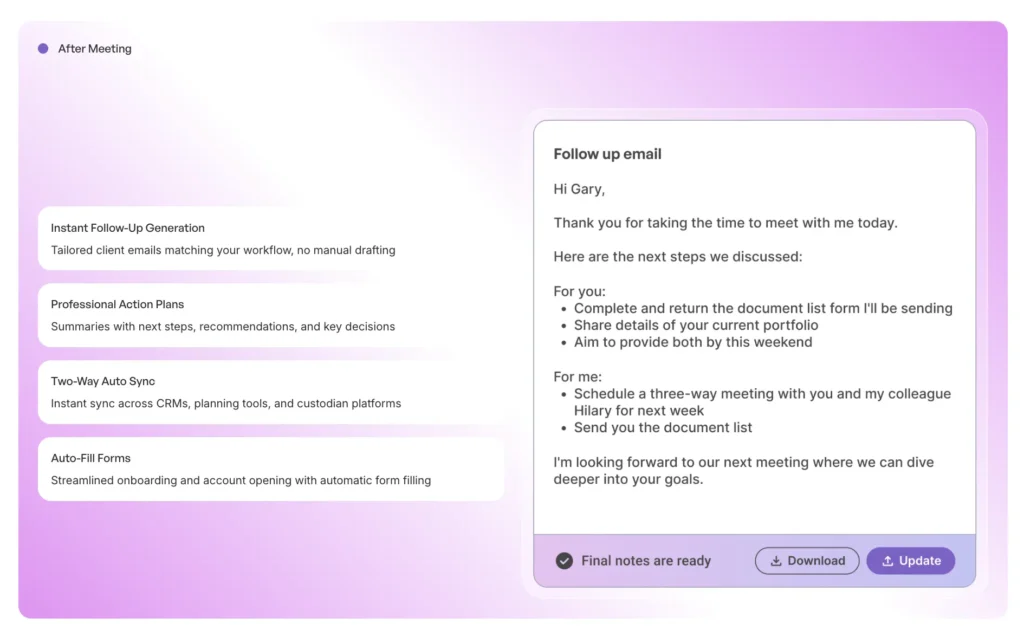
Mili Meeting agent after a client meeting – Image source: Mili
- Finmate: The platform’s Notetaker AI handles the meeting workflow from preparation through follow-up1. It generates pre-meeting talking points, captures conversations, produces summaries and action items, and connects with systems such as Outlook, and Google Calendar. Its agentic tools can also automate follow-ups and CRM updates. Finmate is also SOC 2 Type II compliant, stores data in the US, and states that user data is not used for AI training5.
With tools like Mili and Finmate, advisors spend less time on meeting administration, follow up with clients faster, and free up more capacity for relationship-building and revenue-generating work. This is all while maintaining stronger privacy, security, and oversight around sensitive client information.
2. Nitrogen and Addepar For Portfolio And Client Analysis
AI can help advisors assess client risk, analyze portfolio information, and flag what deserves attention before a client review.
- Nitrogen: This client engagement platform measures client risk tolerance helping advisors identify misalignment, assess individual holdings, compare portfolios, and explain risk and return more clearly to clients6. Nitrogen also operates in a structured data environment with advisor approval before AI actions are executed, backed by SOC 2 Type II and ISO 27001-certified infrastructure7.
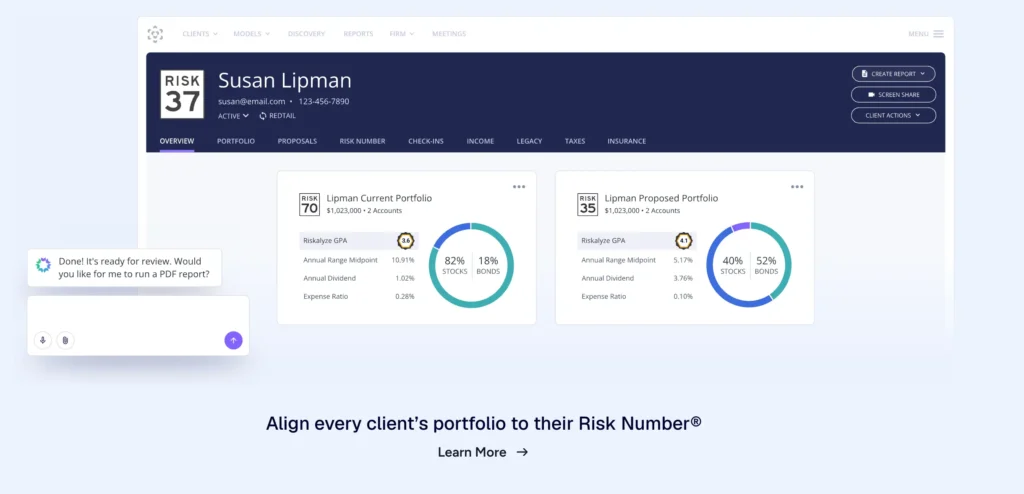
Nitrogen’s Client management dashboard – Image source: Nitrogen
- Addepar: This wealth and investment management platform consolidates financial accounts, investments, and market data into a unified portfolio view8. Its native AI experience, Addison, lets teams explore that portfolio data using natural language and surface portfolio-aware insights. Addepar’s core platform is covered by a SOC 3 report for security and privacy, with client data access-controlled and encrypted19.
These tools help advisors move faster from portfolio data to relevant recommendations, making reviews more efficient while supporting clearer, more personalized client conversations in line with FSI compliance requirements.
3. Claude and Microsoft 365 Copilot for Research and Firm-Specific Knowledge Work
AI can speed up research and financial reporting by bringing market information, internal documents, communications, and firm knowledge into the same working environment for advisors to search and analyze. Examples include:
- Claude Cowork: This agentic workspace can carry out multi-step research across connected firm files, tools, and financial data sources such as FactSet, Morningstar, S&P Global, and LSEG11. It can then analyze that information and turn it into finished work across documents, spreadsheets, and presentations, helping advisors move from scattered research to usable insights faster. Claude Cowork also supports OpenTelemetry monitoring, allowing security and operations teams to track usage, investigate incidents, and monitor performance through existing observability tools11.
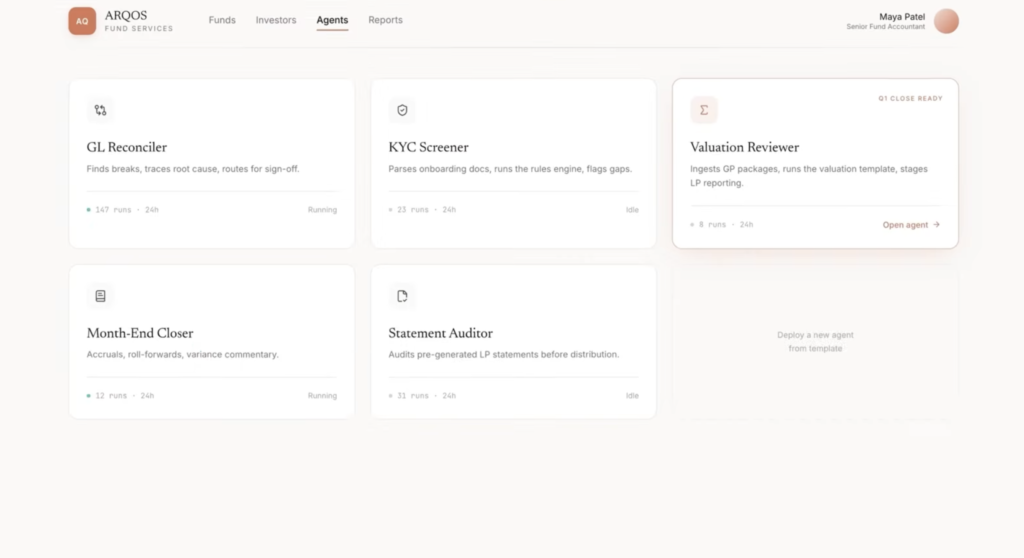
A library of reusable Claude Cowork agents for finance, reconciliation, and reporting – Image Source: Anthropic
- Microsoft Copilot: This AI productivity tool works across Microsoft 365 apps and organizational data12. It can use information from emails, files, chats, meetings, and connected business systems, making it particularly relevant for advisory firms already working heavily in Microsoft 365. It also inherits existing Microsoft 365 permissions and sensitivity labels, while Microsoft Purview can audit prompts, responses, and referenced content for compliance oversight13.
This means advisors spend less time finding and assembling information, respond to client questions faster, and prepare more relevant analysis and communication. Built-in permissions, monitoring, and auditability also put clearer guardrails around AI use as adoption expands.
4. Practifi and Wealthbox for CRM and Client Management
AI can turn CRM data into valuable relationship intelligence by summarizing client history, surfacing what requires attention, and automating routine updates and service tasks. Key tools include:
- Practifi Sentir: This AI-native CRM for wealth management embeds AI agents directly into the platform. Agents can interpret client context, prepare briefings, track relationship history, and surface what matters across the client book14. Built-in governance keeps PII inside the platform, applies existing Salesforce permissions, logs AI outputs for audit, and keeps advisors in control of final actions15.
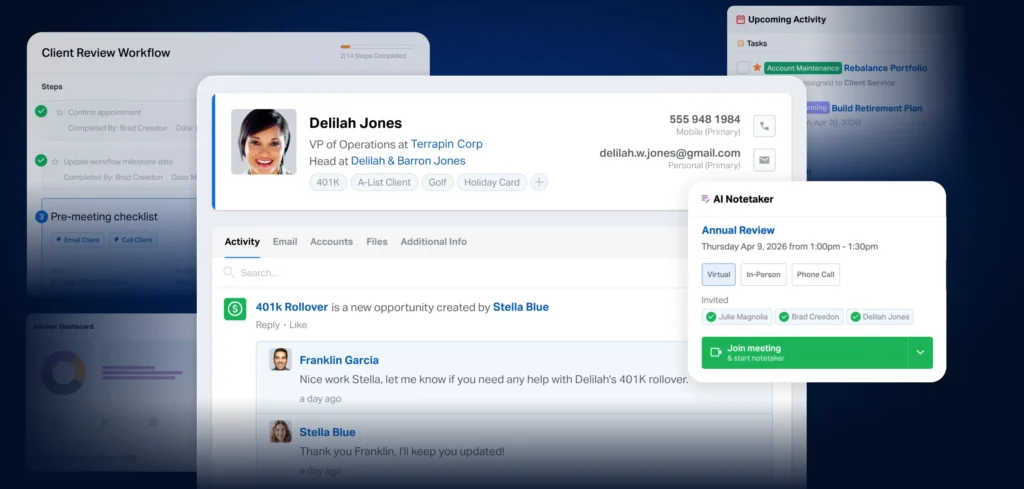
Wealthbox offers a complete view of every client. – Image Source: Wealthbox
- Wealthbox: This AI-powered CRM workspace includes an AI Assistant that works directly with client records16. Advisors can use it to summarize relationship activity, find information, draft communications, generate reports, and propose CRM updates for approval. It follows existing user permissions, retains AI conversations and actions for auditing and compliance, and protects sensitive data with encryption at rest under SOC 2 Type II-audited controls17.
This gives advisors a more current view of each relationship, reduces routine CRM work, and makes it easier to stay on top of follow-ups and opportunities across a larger client book. Built-in security and governance features also let firms automate more of that work without losing visibility over client data or AI-driven actions.
It’s clear that AI-powered tools can remove significant work across individual advisor workflows and give advisors more time for clients. But for a mid-market firm, combining several products can introduce trade-offs around cost, integration, governance, and how well each tool fits your own data and processes. That means choosing the right tools is only part of getting AI to work effectively across your firm.
Why AI Tools May Not Be Enough For Financial Advisors
Some AI platforms now cover large parts of the advisor workflow, from meeting preparation and follow-ups to CRM updates and onboarding. But even platforms marketed as end-to-end can only work with the integrations, data, and processes vendors have built them to support, rather than your firm’s unique requirements. Here’s where those limits can show up:
Inconsistent Adoption Makes AI Harder to Measure and Govern
Even the right AI tools can fall short if advisors use them differently or are unclear about where they fit into daily workflows. Without training, shared processes, and common governance across tools, usage can become scattered and difficult to track. This makes it harder to see what is working, standardize successful approaches, maintain accountability, and keep adoption compliant as it expands.
Disconnected Systems Can Slow Client Service
Client data often lives in separate portfolio management, financial planning, market data, or custody systems. This fragmentation means advisors still have to piece client information together from one tool to another, slowing their work.
Even if some platforms cover an entire workflow, disconnected systems within your firm can still prevent information from moving natively between analysts, advisors, legal, and compliance teams. This gathering and transferring of information manually can delay responses, follow-ups, and recommendations, making it harder to deliver timely client service.
Advisor Expertise Can Be Difficult to Scale With Generic AI
Your firm may have its own rules for reviewing portfolios, preparing recommendations, prioritizing outreach, or communicating with different types of clients. Without a way to capture those decisions, policies, and exceptions, AI is stuck producing generic outputs rather than consistently reproducing and scaling the way your firm actually works. As a result, teams spend more time reviewing and adapting AI outputs, making it harder to deliver the same standard of advice across a larger client base.
More AI Tools Do Not Guarantee More Advisor Capacity
Firms often invest in several point tools and run multiple AI experiments, hoping to automate more advisor work or create additional capacity. However, these efforts do not automatically add up to a viable, scalable AI setup. Without a clear strategy for prioritizing workflows and selecting or configuring the right products, you can keep adding tools while the manual work constraining advisor capacity remains largely unchanged. In turn, this makes it harder to translate AI investment into greater client coverage and revenue growth.
AI Tools Can Automate Simple Tasks While Complex Workflows Stay Manual
A generative AI tool powered by large language models (LLMs) may answer a research question or summarize a meeting when an advisor prompts it. But higher-value workflows often involve multiple steps, such as forecasting portfolio outcomes, running scenario modeling, comparing those changes against client goals, and alerting the right advisor. This can require AI to connect to legacy systems and run continuously in the background, which even workspaces like Claude Cowork or Microsoft Copilot can’t do. So, greater automation may mean considering custom solutions down the road.
Built-in Vendor Guardrails Can Still Leave Compliance Gaps
AI tools often come with their own security, permissions, and compliance controls. However, these may not automatically meet your firm’s internal policies or regulatory requirements.
You still have to define what data AI can access, which actions it can take, when human review is required, and how activity is logged and evaluated.
Without a governance layer that standardizes these rules across tools and workflows, your firm can lose visibility over AI use, expose sensitive information, or fall short of key FSI requirements such as SEC Regulation S-P.
Finding the right tools is only part of the solution. You also have to work out how these products fit into your existing workflows and systems, how your teams will use them consistently, what guardrails will need to be set up, and how AI will scale across your firm. Over time, you may also need to decide where more custom capabilities could add value. Managing all of these moving parts can be complex, particularly for a lean advisory firm without dedicated AI expertise.
How Neurons Lab Helps Financial Advisors Adopt and Scale AI
Coordinating the right tools, workflows, systems, consistent firm-wide use, and governance frameworks is what turns AI investment into measurable gains in productivity, client service, and revenue growth. This is where Neurons Lab operates.
We help mid-market financial services firms move from AI experimentation to reliable adoption at scale. As an AI enablement partner serving organizations across the US, Europe, and Asia, we combine executive training, AI adoption programs, and custom AI agent builds to support secure, practical deployment.
Our clients build operational AI capability aligned with core workflows, governance, and business priorities. Trusted by 100+ clients, including HSBC, Visa, and AXA, we’ve accelerated AI integration in banking, wealth management, private equity, investment firms, fintechs, and other highly regulated industries
Here’s how we help you build AI you can trust to support goals like time saved and increased advisor capacity:
Choose the Right AI Tools with AI Partners Specialized in FSI
Your advisors may already use AI for some tasks while still handling others, such as gathering client context and drafting follow-ups manually. This leaves less capacity for managing and nurturing client relationships.
Neurons Lab helps you identify where manual work is still taking up advisor time and which tools fit each workflow so you can automate more of the client lifecycle.
Our AI adoption program maps where advisors spend time across client preparation, meetings, research, portfolio work, follow-ups, and CRM administration. We then assess what you currently use, determine which tools make the most sense for each workflow, and help you decide whether point solutions are enough for how your firm works and what you want to achieve, based on the KPIs we help you define. That way, you know exactly where to invest.
You then get a tailored AI roadmap that ranks opportunities by advisor time saved, client impact, cost, and effort, while identifying the data and system connections each workflow requires. It then sets out what to implement and in what order. This gives your lean advisory team a clear path from scattered AI experiments to repeatable workflows that free up advisors to support more clients while improving team productivity.
Turn Scattered AI Use Into Consistent, Scalable Workflows
AI use can quickly become fragmented and unstructured, with individual advisors using different tools, prompts, and review processes for the same types of work. That makes it harder to control how sensitive client data is handled, increases compliance risk, limits visibility into which approaches are actually working, and makes successful use cases harder to scale across your firm.
Neurons Lab works alongside your team to establish a consistent way of using the AI tools you already have, so successful individual use cases can become shared, governed ways of working.
Through practical, role-specific enablement, financial advisors learn to use approved AI tools effectively for the workflows they actually perform. Guidance is tailored to their roles, helping teams move beyond isolated experimentation and use AI more confidently and consistently in day-to-day work.
We also help capture and document proven approaches and knowledge from your highest-performing advisors and turn them into shared AI skills or reusable workflows that help teams apply that knowledge consistently.
This replaces individual workarounds with consistent ways of working that can scale across the firm. It also preserves expertise when senior advisors leave and helps new hires become effective faster.
To ensure these standardized workflows are delivering measurable value, our KPI dashboard tracks AI adoption against business measures such as time saved, advisor capacity, and client-service outcomes. This shows what is working and which approaches are worth expanding across the firm.
Integrate and Scale AI With Embedded Support
You may be worried that any new or additional AI tools will be difficult to integrate with your existing systems. And that limited IT support could compromise the accuracy and reliability of AI outputs. With Neurons Lab, you get hands-on technical support throughout implementation so these integration challenges don’t fall back on your internal team.
Through embedded delivery, our forward-deployed engineers work alongside your team to connect AI tools with existing systems such as your CRM, calendars, emails, market data, and meeting notes. We also clean that data and create a standardized layer across those sources. This gives AI access to more complete and consistent information, resulting in more reliable and more reliable and accurate AI outputs for client prep, portfolio alerts, and personalized outreach.
Alongside those integrations, we also help you establish governance and evaluation frameworks. This includes defining what data AI can access, what actions it can take, who can approve sensitive steps, and where human review is required. Audit trails show which data, policies, and market information contributed to assisted outputs, while security safeguards support requirements such as GDPR and those set by regulators including the OCC, FCA, and MAS.
When existing tools are no longer enough, or you want to scale AI use, we help you build custom agents around more advanced workflows. That way, you automate repetitive loops and advisors can focus more on judgment and client relationships.
Should you need it, our forward-deployed engineers can stay on after implementation, providing hands-on support to operate, maintain, govern, and extend integrated systems over time. This helps you keep improving what has been built, add new capabilities as needs evolve, and compound the value of your AI investment
3 Examples Of How Neurons Lab Has Helped Financial Advisors Adopt AI
From structured adoption and workflow enablement to connected agentic systems and eventual custom builds, these examples show how Neurons Lab can support a firm as its needs and capabilities mature.
1. How A US Wealth Management Firm Achieved Structured AI Adoption
Advisors at a US wealth management firm spent 2 to 3 hours preparing for each client meeting and more than 10 hours weekly on market updates and business development. This limited advisor capacity and left less time for client-facing and revenue-generating work.
Partnering with Neurons Lab, the firm is now co-creating its AI strategy and rolling out six Cowork-native modules covering foundations, email, writing, meeting prep, next-best conversations, and back-office work. This includes a shared toolkit, governance framework, and SOC 2-aligned adoption roadmap, giving the team a more structured and consistent way to adopt AI across the firm.
2. How Embedded AI Delivery Helped a Wealth Management Firm Reduce Prep Time
Relationship managers (RMs) at a European wealth management firm spent hours gathering communications, KYC updates, portfolio changes, and other context before making advisory decisions. This increased prep time and made compliant client interactions harder to scale.
Neurons Lab’s forward-deployed engineers worked alongside the RMs to capture their procedural knowledge and turn it into an AI solution that automatically queries legacy systems to compile a full, auditable context brief for every client interaction.
With embedded delivery and support through implementation, the firm moved to an augmented workflow that significantly reduced prep time while maintaining zero compliance gaps in client communications
3. How a Custom AI Build Helped an Asian Bank Double Client Reach
A leading Asian bank wanted to increase RM capacity and client coverage without adding headcount. Its relationship managers were spending significant time on manual tasks, compliance checks, and gathering data across disconnected systems.
Neurons Lab integrated three legacy systems into a unified knowledge layer and deployed a custom agentic AI solution. Through one conversational interface, RMs could prioritize opportunities, access market intelligence, prepare for meetings, and generate personalized product recommendations.
As a result, the bank doubled monthly client reach, unlocked capacity for 20+ additional clients per RM without new hires, and increased NPS by 15%.
The custom AI solution developed for the bank unified RM data, cut prep time, and increased client capacity.
The Best AI for Financial Advisors Starts With Structured Adoption
Measurable business outcomes like greater advisor capacity, higher productivity, better client experiences, and revenue growth start with AI tailored around your firm. That means success depends on more than choosing the right tools. You also have to define and measure KPIs, standardize AI use, establish appropriate governance, and get the support required for an effective and compliant rollout.
For a lean advisory firm, putting that structure in place without adding more operational burden can be difficult. An AI enablement partner can provide the strategy, technical support, and oversight required to turn scattered AI use into a scalable approach that delivers measurable value
Ready to move beyond individual tools and build AI around the way your advisory firm actually works? Book a call with Neurons Lab.
FAQs
What is the best AI tool for financial advisors?
There is no single best AI tool for financial advisors. Successful adoption depends on clear KPIs, standardized usage, appropriate governance, and implementation support for a compliant rollout. Together, these help turn AI investment into measurable gains in productivity, advisor capacity, and client service.
Can one AI platform support all financial advisor workflows?
No. One AI platform typically can’t support every financial advisor workflow. Financial advisor technology remains fragmented across specialized platforms, enterprise AI, and separate data sources, while some processes still require human review. Broader automation therefore often depends on integrations and technical expertise to connect these components securely and make them work together.
How can financial advisory firms measure whether AI is improving advisor productivity and client service?
Financial advisory firms can measure whether AI is improving advisor productivity and client service by first establishing a baseline for current performance, then defining KPIs for the workflows where AI will be introduced. After implementation, firms can compare results against that baseline using measures such as time saved, advisor capacity, and client service outcomes.
Sources
- https://getmili.ai/
- https://getmili.ai/integrations?3_category_equal=CRM
- https://getmili.ai/security
- https://finmate.ai/
- https://finmate.ai/security
- https://nitrogenwealth.com/
- https://trust.nitrogenwealth.com/?_gl=1
- https://addepar.com/
- https://addepar.com/assets/addepar-analytics-reporting-and-navigator-platforms-soc-3-2024-2025.pdf
- https://claude.com/product/cowork
- https://support.claude.com/en/articles/14477985-monitor-claude-cowork-activity-with-opentelemetry
- https://learn.microsoft.com/en-us/copilot/finance/welcome
- https://learn.microsoft.com/en-us/microsoft-365/copilot/microsoft-365-copilot-architecture-data-protection-auditing
- https://www.practifi.com/sentir/
- https://www.practifi.com/sentir/
- https://www.wealthbox.com/
- https://www.wealthbox.com/security/